
Part of The Access Shift — an ongoing series examining how access is being quietly reshaped across American life. New stories every Wednesday at 12:00pm CDT.
The assumption is that we’ve become isolated. That we’re retreating into ourselves, spending more time alone, more time at home, more time inside our own worlds. The data supports part of that — Americans are spending more time alone than they did two decades ago, according to the U.S. Bureau of Labor Statistics. But alone no longer means what it used to.
We see more of each other than ever. We know what people are doing, where they’re going, what they’re thinking — often in real time, often without asking. Group chats stay open across the day. Social feeds surface the texture of people’s lives in between everything else. Streaming has built its own version of shared experience — entire audiences watching the same thing, reacting together, holding a conversation that unfolds across screens instead of rooms. Isolation, in the traditional sense, has become harder to achieve even when you’re trying.
And yet something is missing from this picture, and most people can feel it even when they can’t name it.
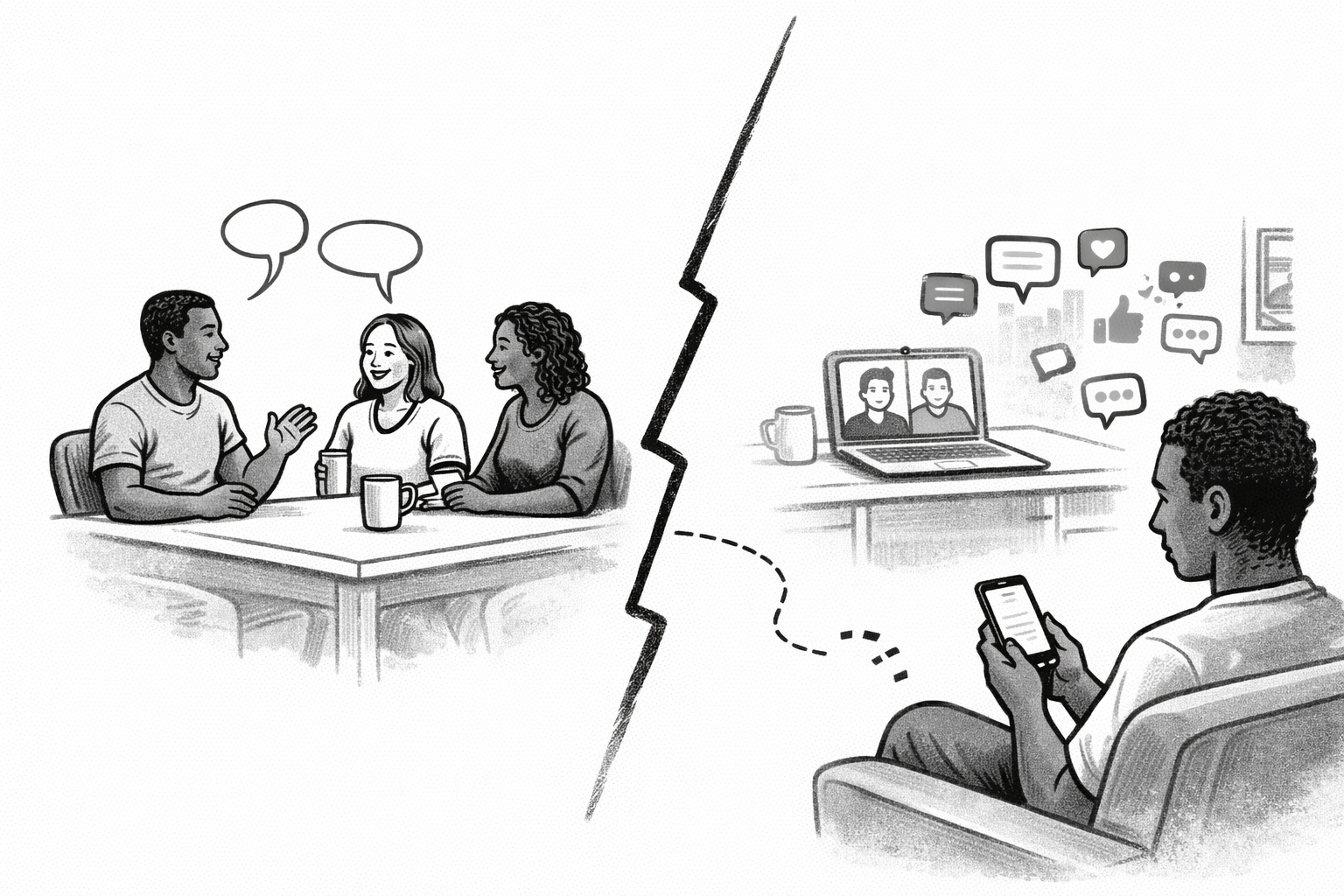
There is a difference between being connected to someone’s life and being in the same room with them. Casual conversation. Unplanned encounters. The small, unremarkable moments that happen when people are physically together — the kind that don’t get posted because they don’t need to be. Those don’t translate through a screen. What we’ve gained in visibility, we may be quietly losing in proximity.
I notice it in small decisions. The calculation between going out or staying in, between being around people or simply keeping up with them. It is easier now to feel socially engaged without ever leaving your space — and that ease, repeated often enough, starts to reshape what socializing means in the first place.
This is not a story about people becoming less social. It may be a story about social life being redefined without anyone deciding to redefine it. Connection has become more continuous, more controlled, more available on our own terms. In the process, the spaces that once made social life feel natural — the café, the gym, the gathering place, the in-between moments — have become increasingly optional. As explored in The Decline In Third Spaces, much of what those spaces once provided has quietly moved indoors.
The question is not whether we’re still connecting. It’s whether connection without presence is enough — and what we lose when we stop noticing the difference.