
The national racial wealth gap is a number most people have encountered in some form. The median Black family holds roughly 15 cents of wealth for every dollar held by the median white family. The median Latino family holds about 22 cents. Those figures are accurate, important, and almost entirely insufficient as a basis for policy or organizing — because wealth gaps are not national phenomena. They are local ones, shaped by specific histories of redlining, urban renewal, highway construction, discriminatory lending, and municipal disinvestment that played out differently in Baltimore than in Los Angeles, differently in Miami than in Chicago, and differently in Boston than in Washington D.C. A national statistic describes a pattern. A city-level analysis names a place, a history, and a set of policy choices that can be interrogated, challenged, and changed.
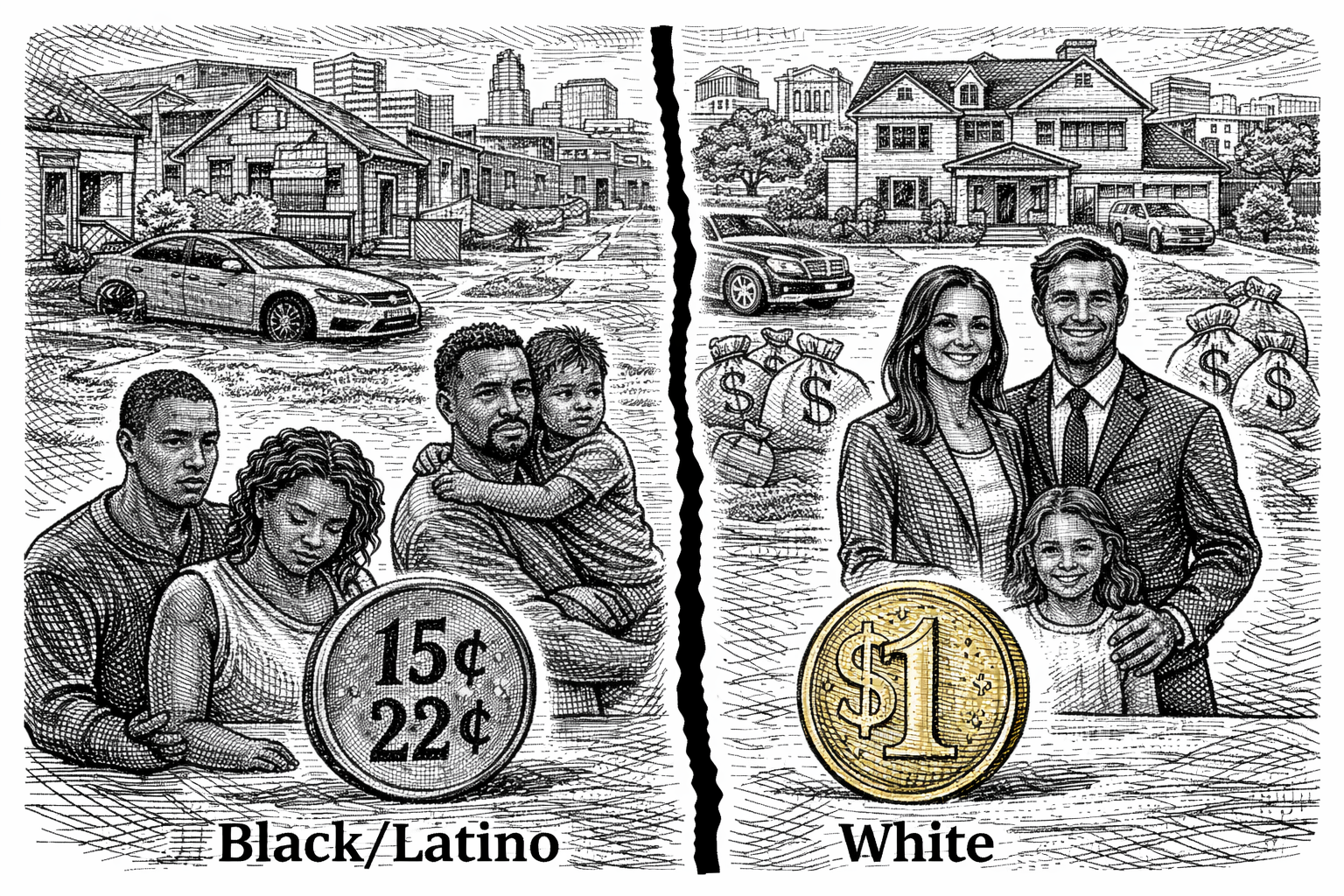
That is the foundational argument behind the Color of Wealth report series led by Dr. Darrick Hamilton, Founding Director of The New School’s Institute for Race, Power and Political Economy. The series — with reports covering Baltimore, Boston, Chicago, Los Angeles, Miami, Tulsa, and Washington D.C. — uses fine-grained local survey data to examine not just income disparities but wealth disparities, a distinction that Hamilton’s framework treats as essential. Income is what you earn. Wealth is what you own, what you can borrow against, what you can pass to your children, and what stands between your family and financial catastrophe when income is interrupted. The racial income gap is significant. The racial wealth gap is generational. And it is the wealth gap, not the income gap, that determines whether a community’s economic position improves across time or simply oscillates within a fixed range of precarity.
The reports’ city-level findings reveal the degree to which national statistics flatten what are actually radically different local conditions. In Boston, a city whose higher education and healthcare industries generate enormous wealth, the median net worth of Black households has been documented at near zero — a figure that exists alongside one of the highest concentrations of university wealth and nonprofit endowments in the country. In Los Angeles, the intersection of housing costs, immigration history, and discriminatory lending has produced wealth gaps that vary significantly across Latino subgroups in ways that aggregate statistics obscure entirely. In Miami, the relationship between race, national origin, and wealth is shaped by Caribbean and Latin American migration patterns that create a more complex picture than the Black-white binary captures. In Chicago, the spatial concentration of wealth and poverty along racial lines is among the most extreme of any major American city, a product of some of the most explicitly discriminatory municipal policies in twentieth century urban history. In Washington D.C., proximity to federal employment and government contracting has produced a Black middle class with income mobility that has not translated into proportional wealth accumulation. In Baltimore, decades of redlining, urban renewal demolition, and the highway construction that severed majority-Black neighborhoods from the rest of the city have produced a wealth landscape that the homicide reduction narrative rarely accounts for.
What makes the Color of Wealth framework particularly useful for SSC’s editorial project is its insistence on treating wealth inequality as a policy outcome rather than a cultural or behavioral one. The gaps documented in each city are not the product of individual financial decisions made by Black and Latino families. They are the accumulated consequence of decisions made by governments, financial institutions, real estate industries, and employers over decades — decisions that systematically excluded Black and Brown families from the wealth-building mechanisms available to white families, and that continue to shape outcomes through the compounding logic of inherited disadvantage. Identifying those decisions, naming the institutions that made them, and connecting them to present-day conditions is the work the Color of Wealth reports do — and it is the work SSC’s city-level coverage will extend.
This piece is the first in an ongoing SSC series examining racial wealth data city by city across SSC’s primary markets. Baltimore, Boston, Chicago, Los Angeles, Miami, and Washington D.C. will each receive dedicated coverage — grounding the national argument in local history, local data, and local policy stakes. The wealth gap is not a national abstraction. It is a local address. And it is time to read it that way.