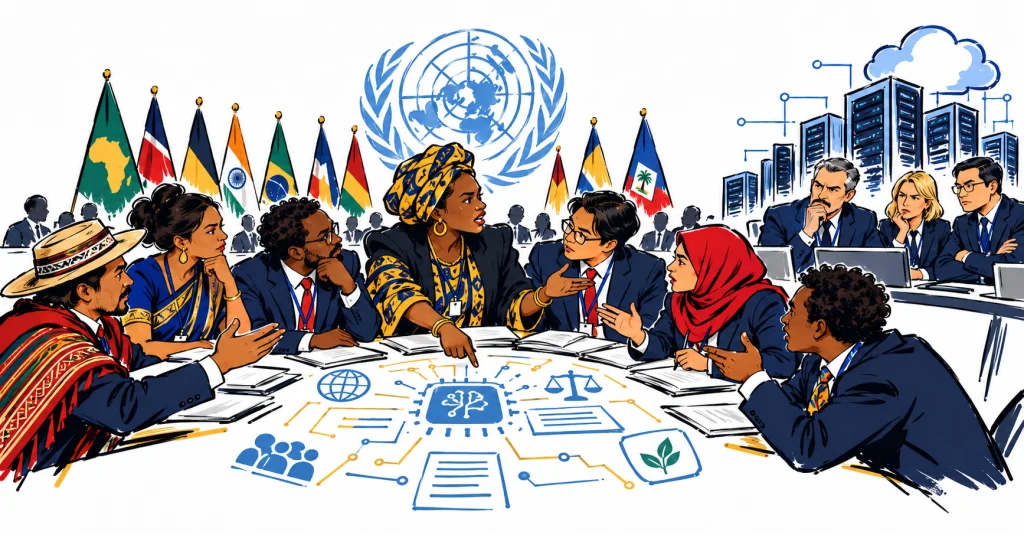
At the United Nations, governments from Africa, Asia and Latin America argued that countries expected to use AI should also help govern it. The fight over artificial intelligence is becoming a fight over who gets institutional power before the technology is fully built.
Developing countries used this year’s United Nations gathering to demand a larger role in writing the rules for artificial intelligence. Reuters reporter Doyinsola Oladipo reported that officials from Africa, Asia, Latin America and the Caribbean warned that AI could reinforce existing economic inequality if the technology, standards and regulatory institutions remain concentrated in wealthy countries.
The scale of the shift was visible inside the UN itself. Bangladesh Foreign Minister Khalilur Rahman said only five delegations raised AI in the General Assembly hall four years ago; this year, 128 delegations addressed it. Democratic Republic of Congo Foreign Minister Thérèse Kayikwamba Wagner argued that developing countries should not be reduced to users of technologies designed elsewhere or recipients of rules they had little role in creating.
That argument reaches beyond representation. Standards determine who can build systems, what data can be used, how safety is measured, what infrastructure qualifies and which companies can enter regulated markets. Countries that enter the process after those standards are established may have formal sovereignty over AI policy while operating inside technical rules designed around someone else’s companies, infrastructure and assumptions.
Technology arrives with institutions attached
Developing economies have substantial reasons to want AI quickly. The World Bank has argued that the technology could allow developing countries to accelerate improvements if they close gaps in electricity, connectivity and skills. The International Monetary Fund estimated in July that AI could increase Sub-Saharan Africa’s economic output by about 4% over the next decade under favorable conditions.
Those potential gains create leverage for the companies and countries already controlling advanced models, cloud infrastructure and computing capacity. A government that needs outside technology to modernize health systems, education, agriculture or public administration is negotiating from a different position than the government whose companies own the model and data centers. Adoption can increase productivity while also creating technological dependence.
That is why governance has become an economic-development issue. Rules over AI safety, data, procurement and accountability will determine whether countries can build domestic capacity or remain customers of systems trained, hosted and governed elsewhere. The earlier those rules solidify, the more expensive it becomes for late entrants to change them.
UN Secretary-General António Guterres connected the AI debate to the power imbalance already visible in global climate negotiations, arguing that both raise questions over who holds power, who is denied it and how it is used. Donald Trump, by contrast, dismissed warnings about AI risk during his UN remarks. Those competing positions show that there is not yet international agreement even on what the governance problem is, much less which institution should control it.
The developing-country demand therefore comes before the global system has hardened. That timing is important. Once standards become embedded in procurement contracts, safety frameworks, trade agreements and infrastructure investments, changing them becomes far more difficult than participating while they are being written.
The next divide in AI may not be measured only by which countries possess the best models. It may be measured by which countries helped decide what everyone else is permitted to build, buy and deploy. Developing nations are trying to secure that authority before becoming dependent on a technological system whose rules arrived with the technology.