
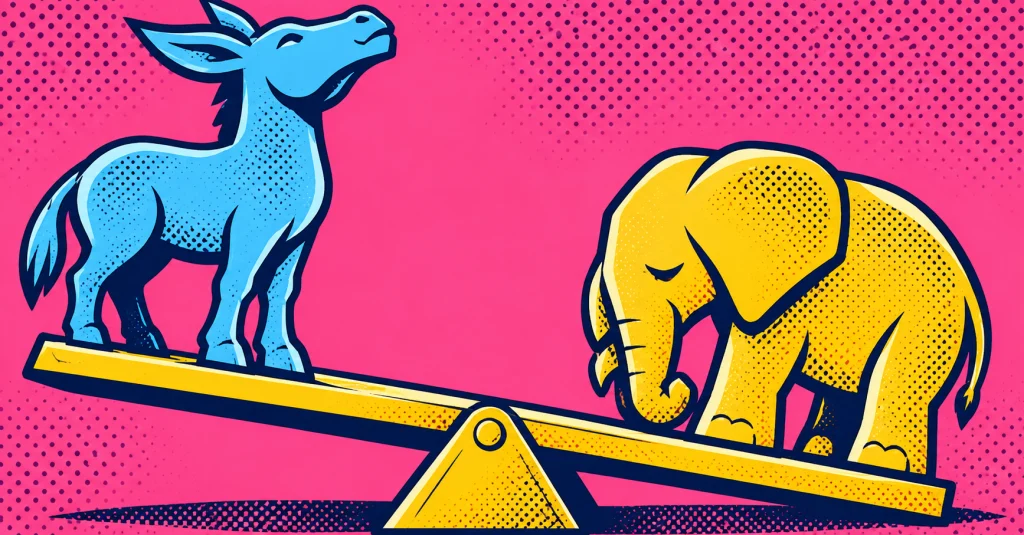
Pew’s postelection survey shows party optimism tracks the last result more than anything else. The split inside the Republican Party by age says more about 2028 than the topline does.
Policy · Analysis · 4 min read · Nov 20, 2026 ·
Democrats’ optimism about their party’s future has climbed back to 85% after the party’s midterm wins, according to a Pew Research Center survey of U.S. adults conducted Nov. 9-15 and reported by J. Baxter Oliphant. Only 14% of Democrats and Democratic-leaning independents now call themselves pessimistic, down from 49% two years ago after Donald Trump‘s reelection. Republicans moved the other way. Just 57% of Republicans and GOP-leaning independents say they are optimistic about their party’s future, down from 86% in 2024 and lower than after any midterm or presidential election in the last decade.
Two years, two mirror images
The swing follows a pattern Pew has tracked for a decade: partisans feel good right after they win and sour right after they lose. In November 2024, Pew found Democrats split almost evenly, 51% optimistic and 49% pessimistic, while Republican optimism had jumped from 65% after the 2022 midterms. A year ago, 67% of Democrats told Pew they were frustrated with their own party, and many said it hadn’t pushed back hard enough against Trump and the GOP. The party didn’t settle its arguments over message and leadership in 12 months. It won the House and Senate on Nov. 3, and the mood followed the result. Party optimism works like a lagging indicator, a reading of the last election far more than a forecast of the next one.
The Republican number that lasts
Republicans are still more upbeat today than Democrats were after Trump beat Kamala Harris, which keeps the drop in perspective. The more durable finding sits inside the party. Republicans 65 and older are 70% optimistic about the GOP’s future, compared with 56% of those 50 to 64 and 51% of those under 50. Conservative Republicans (60%) are somewhat more optimistic than the party’s moderates and liberals (53%).
A party’s future candidates, organizers and donors come from its younger ranks, and a 19-point generational gap means the Republicans with the longest runway are the ones least sure about where the party is headed. Midterm losses usually wear off once the next nominee arrives and gives the losing side something to rally around. An age gap in confidence is the kind of split that shapes who decides to run, who writes checks and who shows up in an off year, and it doesn’t fade just because the calendar turns.
Democrats’ near-unanimity has a shelf life
Pew found large majorities of Democrats across age, education and political ideology say they are optimistic about the party’s future. That breadth comes from winning. Agreeing that the party is on the right track costs nothing the week after it takes Congress, and it papers over the same disputes that drove frustration to 67% a year earlier. A governing majority now has to produce results, and the 2028 presidential primary will force the party to pick among competing directions. At that point 85% optimism turns into a contest over whose version of the future the party actually means.
What comes next
Expect Democratic optimism to drift down from 85% as the 2028 field forms and voters start grading the new congressional majority on what it delivers. Expect Republican optimism to recover once a post-Trump nominee emerges, since Trump can’t run again and the party will finally have a new face to project its hopes onto. The figure to track is Republicans under 50. If their optimism doesn’t rebound with the rest of the party by the next postelection survey, the GOP has a generational problem on its hands, not a midterm hangover.