
The United States has not blockaded Cuba like this since the Cuban Missile Crisis. That is not hyperbole. Beginning in February 2026, the Trump administration began blocking oil tankers heading to Cuba, targeting companies including Mexico’s state-owned Pemex and threatening tariffs on any country that continued supplying the island. After the U.S. intervention in Venezuela removed Nicolás Maduro from power, Venezuelan oil shipments to Cuba — which had long served as a lifeline — were cut off, leaving Cuba without adequate fuel supply for the first time in decades. The island produces roughly 40% of the fuel it needs domestically. The rest had been coming primarily from Venezuela and Mexico. Both pipelines are now under effective U.S. control.
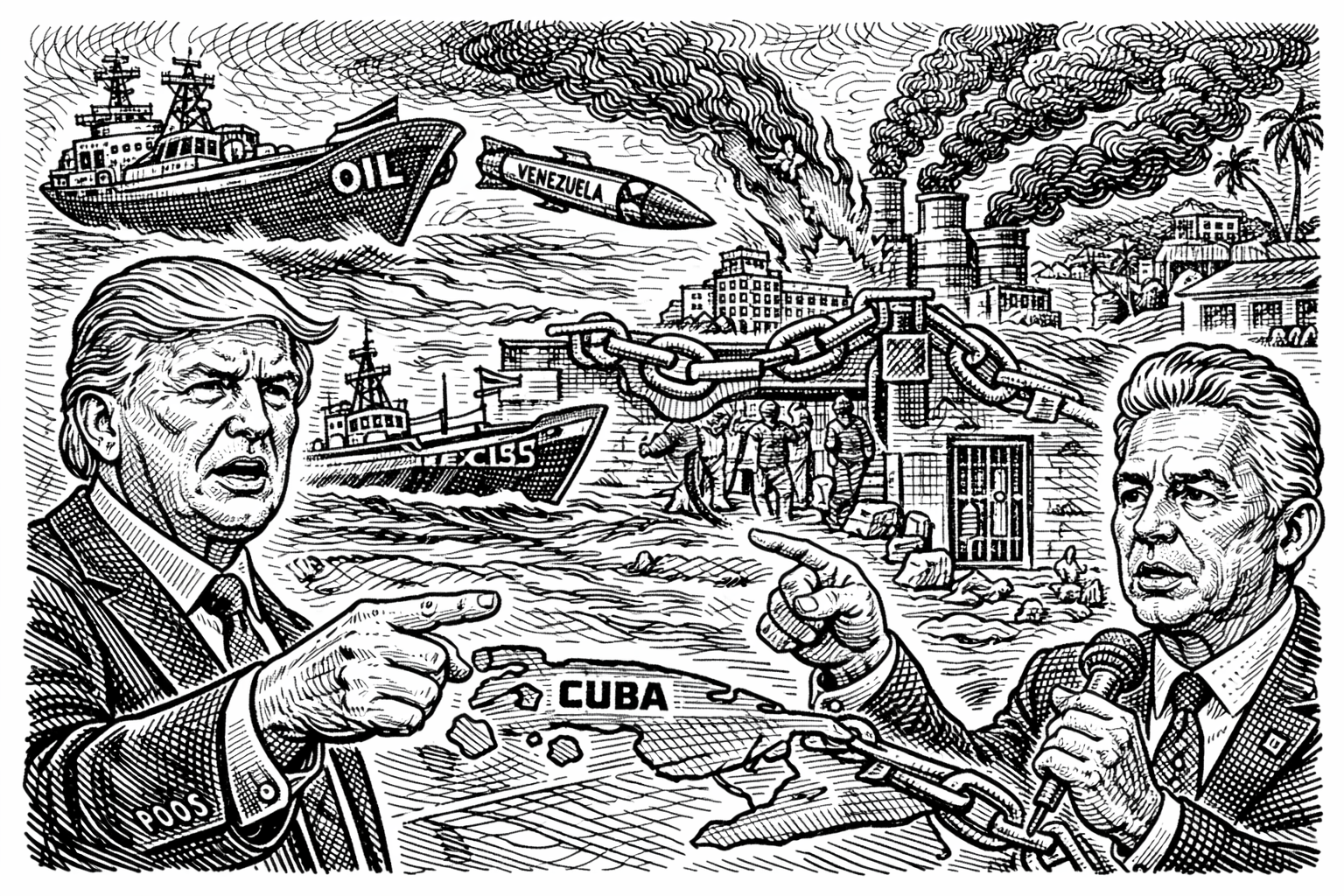
The humanitarian dimensions of that compression are not abstract. Cuba’s energy crisis predates the blockade — the island has experienced rolling blackouts and fuel shortages since 2024 — but the intensification of U.S. pressure has accelerated a collapse that was already underway. On April 3, Cuba released more than 2,000 prisoners in the largest such release in years, a move widely interpreted as a concession tied to ongoing diplomatic contacts with the Trump administration. The release was framed by Cuban President Miguel Díaz-Canel as part of diplomatic efforts to address the blockade, and by the U.S. side as evidence that pressure is producing results. Both framings are partially accurate and strategically incomplete. Cuba is releasing prisoners because it needs relief. The U.S. is accepting the releases as progress while maintaining the blockade. Neither side has committed to anything structural. The on-the-ground dimension of that compression — rolling blackouts interrupting medical care, food storage failures, transportation halted — is documented in SSC’s published reporting on Cuba’s infrastructure crisis, which frames the blockade not as a single policy but as a series of constraints that compound until everyday life becomes unstable.
The diplomatic back-channel is more complicated than either government is publicly acknowledging. Experts warn that without meaningful buy-in from the Cuban exile community in Miami, no durable agreement between the U.S. and Cuba is politically viable, while analysts note that the Cuban-American community’s near-total alignment with the Republican Party has actually reduced its leverage as Florida has ceased to be a swing state. That creates an unusual dynamic: the community whose historical influence shaped decades of U.S.-Cuba policy is now politically captured in a way that may limit rather than amplify its voice in the current negotiations. Miami’s hardliners want regime change. The administration has stated that regime change is the goal. But what constitutes regime change — and whether any deal short of full political transformation will satisfy the exile community — remains unresolved, and the gap between stated goals and achievable outcomes is where these negotiations are most likely to break down. Cuba is a majority Black and Afro-Latino nation, which means the burden of the blockade falls disproportionately on Black Caribbean communities — families absorbing the cost of a geopolitical standoff they did not design and cannot exit.
What is unfolding in Cuba is a case study in economic coercion as foreign policy, and it raises questions that extend well beyond the island. The oil blockade is designed to produce internal instability severe enough to force either political concessions or political collapse. The prisoner release suggests the strategy is generating pressure. It does not suggest it is generating the kind of conditions under which a stable, negotiated transition becomes possible. Economic compression of this severity tends to harm civilian populations most acutely — the same populations whose welfare the administration claims to be advancing — while entrenching the governing class that controls rationing, distribution, and internal security. Cuba’s government has survived six decades of embargo. The question is not whether this pressure campaign will break the state. It is what it will break in the process, and who will be left holding the consequences when the blockade eventually ends or evolves into something else.
For the Miami diaspora and for Caribbean communities watching closely, the current moment carries weight that the diplomatic framing tends to obscure. Families remain separated. Remittances are constrained. The humanitarian condition of the island is deteriorating in ways that affect real people regardless of their political alignment. The story of Cuba in 2026 is not simply a geopolitical chess match. It is a human crisis being managed as a leverage instrument, and the people absorbing the cost of that management are not the ones making the decisions on either side of the Florida Straits.