
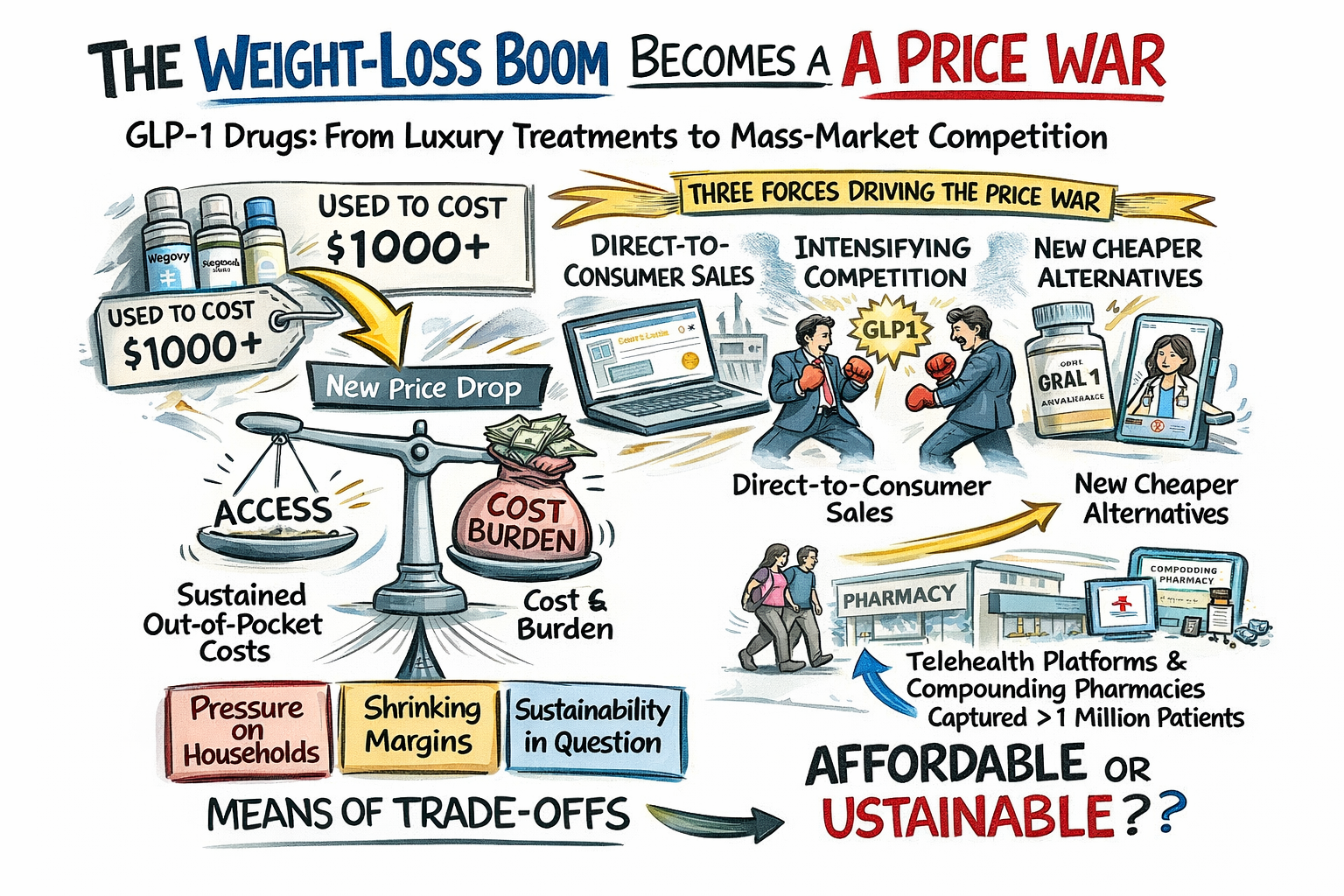
Weight-loss drugs like Wegovy and Zepbound were once positioned as breakthrough treatments priced to match—often exceeding $1,000 per month and largely out of reach without strong insurance coverage. That model is now breaking down.
A price war among major pharmaceutical companies is rapidly reshaping the category. Monthly costs have fallen sharply, in some cases to between $149 and $299 for self-pay patients. Three forces are driving this: direct-to-consumer distribution models, intensifying competition between manufacturers, and efforts to bypass pharmacy benefit managers that have historically obscured pricing. What was once a high-margin, scarcity-driven market is beginning to resemble a volume-driven one.
Several developments have accelerated this shift. A late-2025 pricing agreement between federal regulators and drugmakers established new ceilings for direct-to-consumer pricing while expanding limited Medicare access for the first time. Meanwhile, the introduction of oral GLP-1 medications—cheaper to manufacture and easier to distribute than injectable alternatives—is lowering the cost floor and broadening the potential user base.
Competition from outside the traditional pharmaceutical system has also played a role. During recent drug shortages, telehealth platforms and compounding pharmacies captured more than a million patients by offering lower-cost alternatives. In response, branded drugmakers are now pricing aggressively to narrow the gap with those alternatives and reclaim market share.
On the surface, these trends suggest improved access. But the underlying structure tells a more complicated story. Insurance coverage remains inconsistent, with many providers still declining to cover GLP-1 drugs for weight loss. The system is effectively shifting costs directly onto consumers: prices are lower than before, but still high enough to require sustained out-of-pocket spending—often in an economic environment where households are already making difficult trade-offs, a dynamic explored in [What Doesn’t Make It Into the Cart].
That tension introduces a structural constraint. The current model depends heavily on middle-class consumers funding their own treatment over time, and early signals suggest that may not be sustainable at scale—particularly as broader economic pressure persists. The pattern mirrors what happens when demand expands faster than the systems designed to support it, as explored in When a City Becomes a Destination Before It’s Ready.
Investors are beginning to take note, with some revising long-term market projections downward amid concerns about margin compression and weakening demand durability. Competition, meanwhile, is no longer defined by price alone. Clinical effectiveness remains a key differentiator, and next-generation drugs are being evaluated on outcomes as much as cost—placing affordability, efficacy, and manufacturing scale in direct tension with one another.
What’s emerging is a familiar pattern: a high-demand product moves from innovation to accessibility, but the system supporting it fails to fully adapt. Prices fall and availability expands, yet the burden shifts rather than disappears—leaving a category that is technically more accessible but still uneven in practice. Available to many; sustainable for fewer.
The GLP-1 market is moving out of its early gold-rush phase into a more mature, competitive landscape. The $1,000-per-month model is already collapsing, but what replaces it remains unsettled. The question is no longer whether demand exists—it’s whether the system can support that demand without forcing consumers to absorb the gap. That issue is showing up across sectors, from healthcare to infrastructure, including the use of ICE agents to backfill TSA staffing shortages at U.S. airports .