
Social Storytellers Collective | May 22, 2026 | 3PM CDT
The long weekend starts tonight. The highway signs are already counting down. 45 million Americans are on the move, and the number will be called a record by morning. The government just committed $2 billion to quantum computing — IBM gets half, adds another $1 billion of its own, and breaks ground on America’s first quantum chip foundry. Aaron Rodgers told Pittsburgh “this is it” — 22 seasons, one last ride, an exit on his own terms. In a boardroom somewhere, an HR department is being reframed as a liability. In a Texas classroom that didn’t exist two years ago, someone is learning to repair a mechanical watch. The systems that were supposed to hold are being quietly retired. The people inside them are figuring that out in real time.
None of these stories are unrelated. They are the same story told different ways.
We are excited to kick off the second part of The Degree Economy series on Monday. The first four parts explored how the credentialing economy is restructuring in real time — who the fire sale benefits, who it leaves behind, and which institutions are being squeezed out of the market at exactly the moment their students need them most. Next week we go deeper on the institutions the system is trying to squeeze — and why they’re growing anyway.
The MBA is on sale. The jobs it was supposed to unlock are disappearing. And the workers who most need the upgrade are the least positioned to use the discount. We will continue to follow the credentialing economy as it restructures in real time.
Part I — The Credential Is Deflating — When a degree goes on sale, the market has already decided what it’s worth. Part II — AI Ate the ROI — The jobs the MBA was supposed to unlock are the first ones being eliminated. Part III — Who Gets Left Out of the Sale — A 40% cut on something you couldn’t afford is still unaffordable. Part IV — The HBCU Squeeze — The fire sale benefits the schools that can absorb the loss. Everyone else gets squeezed harder.
Coming Monday — The Degree Economy: The HBCU Ascent
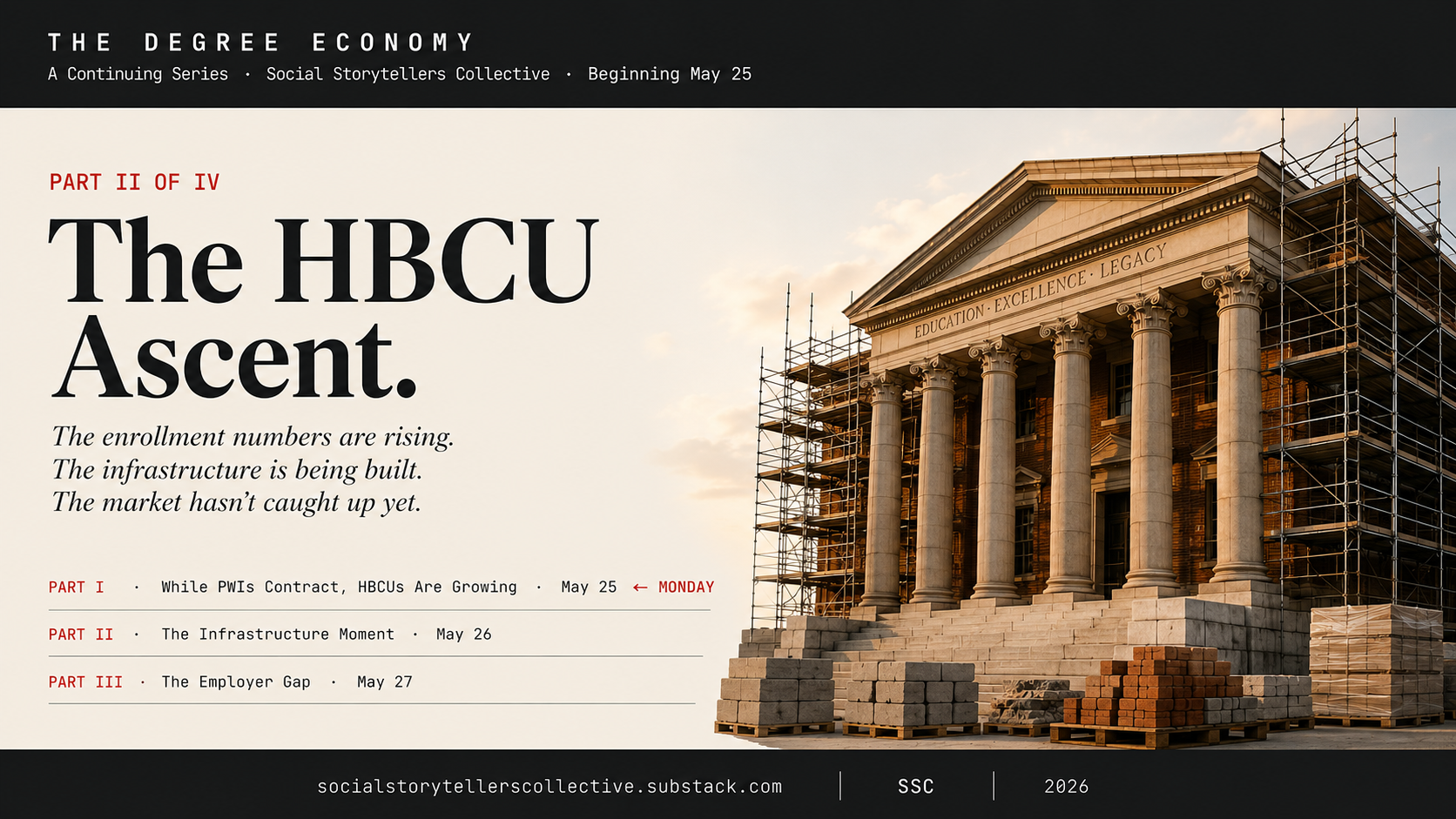
While this week’s series documented the fire sale and who gets left out of it, The HBCU Ascent looks at the institutions absorbing the most pressure — and growing anyway. Enrollment is up. Infrastructure is being built. But the employer relationships, recruiting pipelines, and funding structures haven’t caught up to the moment. Three days. Three arguments about what it actually takes to turn momentum into permanence.
Part I — While PWIs Contract, HBCUs Are Growing — The enrollment numbers tell a story the mainstream narrative keeps missing.
Part II — The Infrastructure Moment — The HBCU Research Institution launch isn’t just symbolism. It’s the structural investment that makes the growth sustainable.
Part III — The Employer Gap — HBCU enrollment is rising. HBCU talent is in the pipeline. But the employer relationships, recruiting infrastructure, and starting salary outcomes haven’t caught up to the moment. The schools are producing more. The market isn’t absorbing it proportionally.
Three days. Three arguments. One through line: the institutions the system is trying to squeeze are growing anyway — and the window to build on that momentum is open right now.
We’ll see you Monday.
What connects today’s edition is a question that runs underneath every story in the stack: who decides what the terms are — of your job, your neighborhood, your career path, your access to food, your device, your ability to leave for the weekend — and what happens to the people who weren’t in the room when the terms got set? The CEO who eliminated HR didn’t consult his workforce before calling accountability a liability. The streaming platforms that turned Harlem into IP didn’t ask the neighborhood what it was worth. The federal government that cut SNAP didn’t hold a press conference when 4.3 million people fell off the rolls. Amazon didn’t ask the 2 million people still using older Kindles whether they were done with them. The terms keep getting rewritten. The people most affected keep finding out after the fact.
That pattern is what today is actually about. Not any single story — the pattern underneath all of them.
Ryan Breslow stood at the Fortune Workplace Innovation Summit in Atlanta this week and told a room full of executives that eliminating his entire HR department was an act of courage. The audience received the line without visible alarm. That reaction is worth sitting with longer than the story itself. Bolt, the fintech company Breslow founded in his Stanford dorm room and rode to an $11 billion valuation before watching it collapse to roughly $300 million by 2024, is being framed as a turnaround story. He returned as CEO in 2025, declared the company in “wartime,” eliminated HR, replaced the leadership team wholesale, removed four-day workweeks and unlimited PTO, and is now down to roughly 100 employees. What he eliminated, piece by piece, was every structure designed to give employees formal standing inside the company. The word he used for workers who expected their employment terms to be honored was “entitlement.” That word is doing significant work in 2026. It is the word used when accountability becomes inconvenient. It is the word used when the terms of someone else’s job get rewritten after they’ve already built their life inside them.
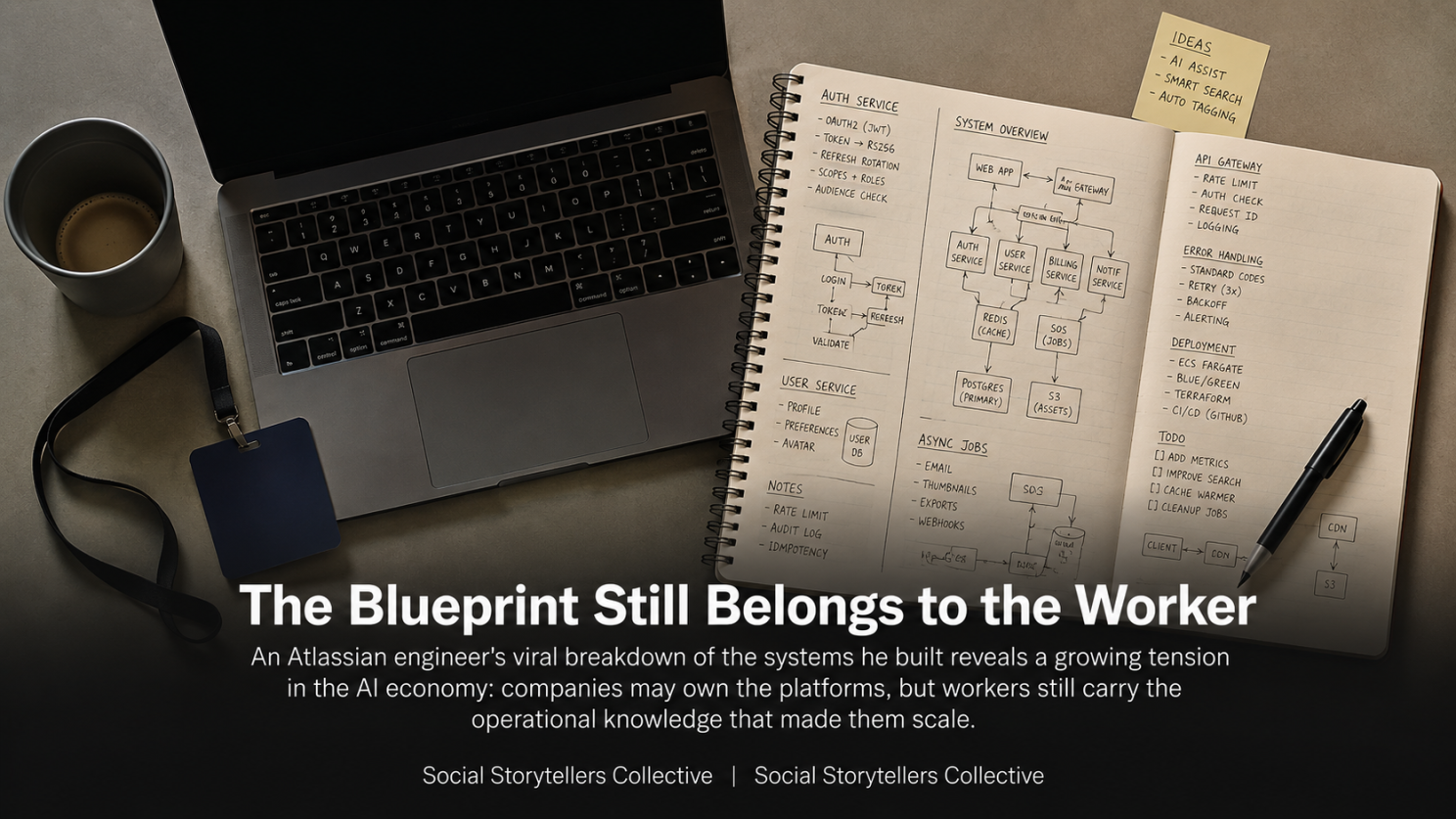
Atlassian reported roughly $1.79 billion in quarterly revenue and reaffirmed its long-term investment in AI infrastructure the same quarter it laid off a senior systems engineer named Vasilios Syrakis — who had spent nearly eight years building critical backend systems inside the company. In the current tech climate, that story would have barely registered. What made it different was what Syrakis did next. Instead of a grievance thread, he uploaded a 38-minutevideo walking through the architecture patterns, infrastructure decisions, and scaling strategies behind the systems he helped build. No proprietary code. No confidential business logic. Just operational understanding — the invisible layer beneath consumer technology, suddenly legible to millions. The video went viral. The engineer who got laid off became the one doing the teaching. Atlassian may own the product, the codebase, and the platform. But Syrakis carried the blueprint in his head. And in the modern economy, that blueprint can become its own form of capital — if the person holding it decides to make it public.
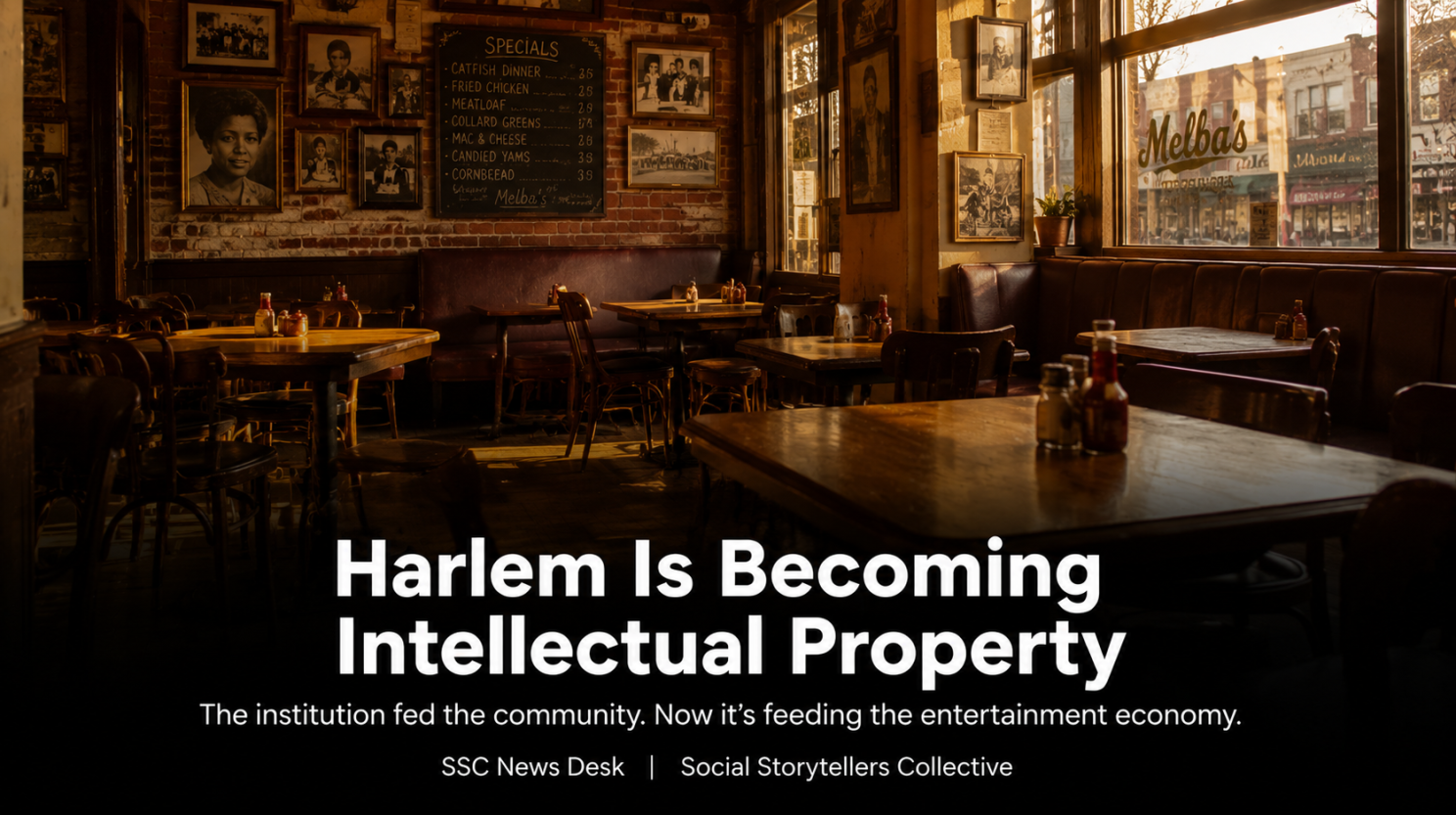
Apple TV is developing a comedy series inspired by restaurateur Melba Wilson and her Harlem restaurant Melba’s, with Oprah Winfrey attached as executive producer. On the surface it reads like a feel-good adaptation story: beloved restaurant, community legacy, charismatic founder, television expansion. Culturally it says something larger about where media companies are now sourcing value. For decades, restaurants like Melba’s functioned as physical institutions first — gathering spaces built on repetition, familiarity, and neighborhood trust. What streaming platforms increasingly recognize is that these spaces also contain narrative equity — and the restaurant is no longer just selling chicken and waffles. It is selling memory, identity, migration history, Black entrepreneurship, and community mythology in a form that can travel globally through a screen. Harlem has spent years navigating aggressive gentrification, rising commercial rents, and cultural commodification. A television series centered on a Harlem institution inevitably participates in that transformation. Recognition can produce investment. It can also produce extraction. Communities that built these institutions deserve more than a credit in the opening titles.
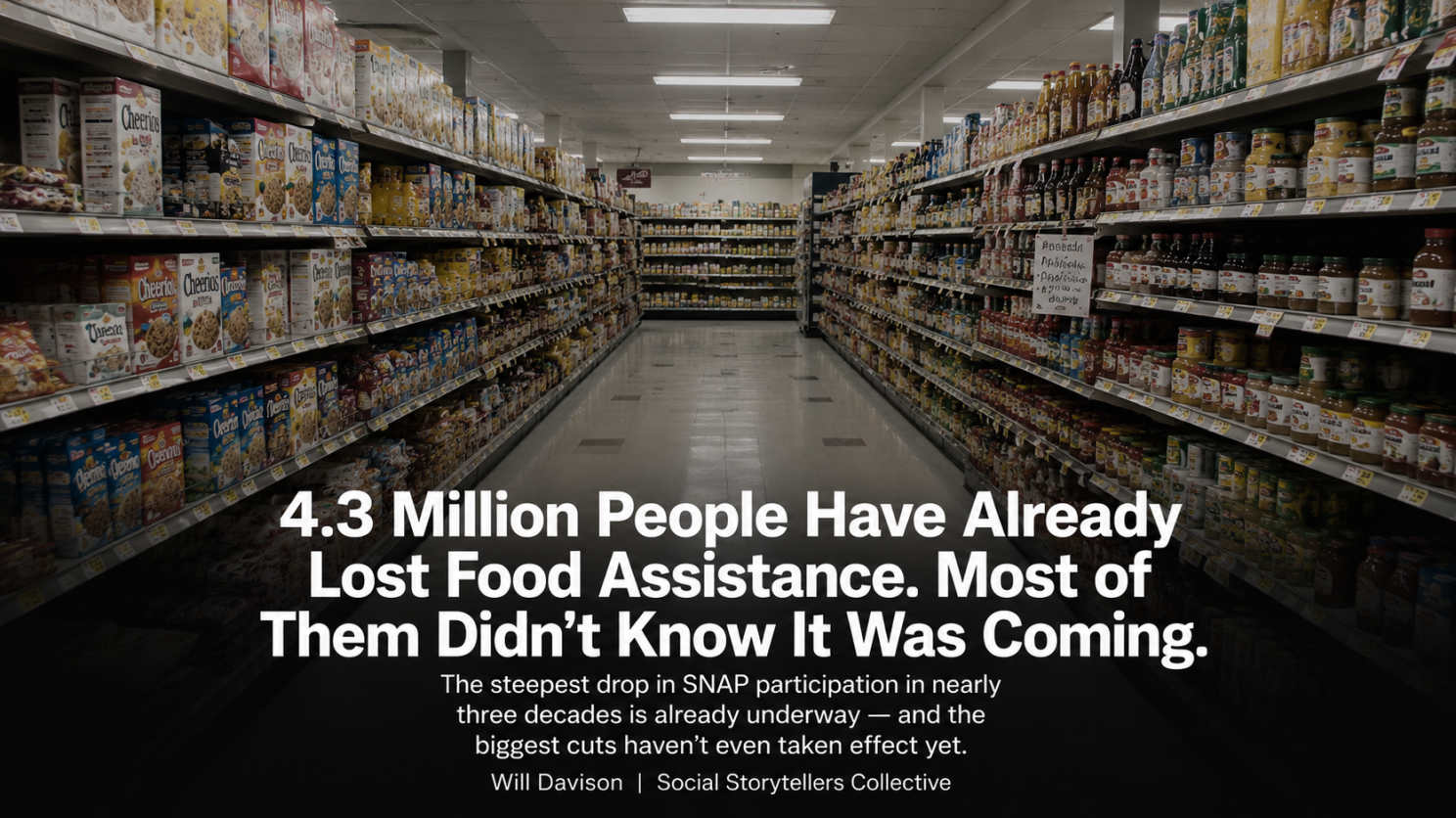
The number arrived without a press conference. No ceremony, no announcement, no specific moment when a policy crossed a line and the country paused to register what had changed. It showed up in the data: 4.3 million people have been removed from SNAP since the One Big Beautiful Bill Act became law last July 4th. The drop in participation is the steepest in nearly three decades — the last comparable decline was 1996. What makes the current numbers more alarming than the headline figure is the mechanism producing them. The participation decline is outpacing the law’s explicit timeline — meaning eligible people are being removed not because of formal policy provisions but because the program has been made harder to access. Shorter documentation windows, call center backlogs, fewer federal administrative dollars reaching state agencies — the friction is doing the work. The formal SNAP cuts haven’t fully landed yet. Work reporting requirements, mandatory semi-annual eligibility redeterminations, new retailer stocking standards that may push smaller grocers out of the SNAP network entirely — those provisions are still on the timeline. The food insecurity being built right now will show up in the data months from now. By then, the news cycle will have moved on.

adidas didn’t launch its new Satisfy collaboration at a press event in New York or Paris. They flew to the Sonoran Desert — specifically Oro Valley, Arizona — set up a pump track loop in the middle of it, and called the experience “The Circle Pit.” That detail is the whole story before anyone looks at the shoe.
Satisfy is a Paris-based technical running label that has spent years building something rarer than a product line: a genuine subculture. Runners who log 50-mile weeks and care equally about the aesthetics of the kit they do it in. When Sabastian Sawe stormed to a record-breaking sub-two-hour victory at the 2026 London Marathon wearing custom Adidas Adizero shoes, adidas running sales surged. Now adidas wants what Satisfy has — credibility that cannot be purchased with a marketing budget. The desert wasn’t a location. It was a message.
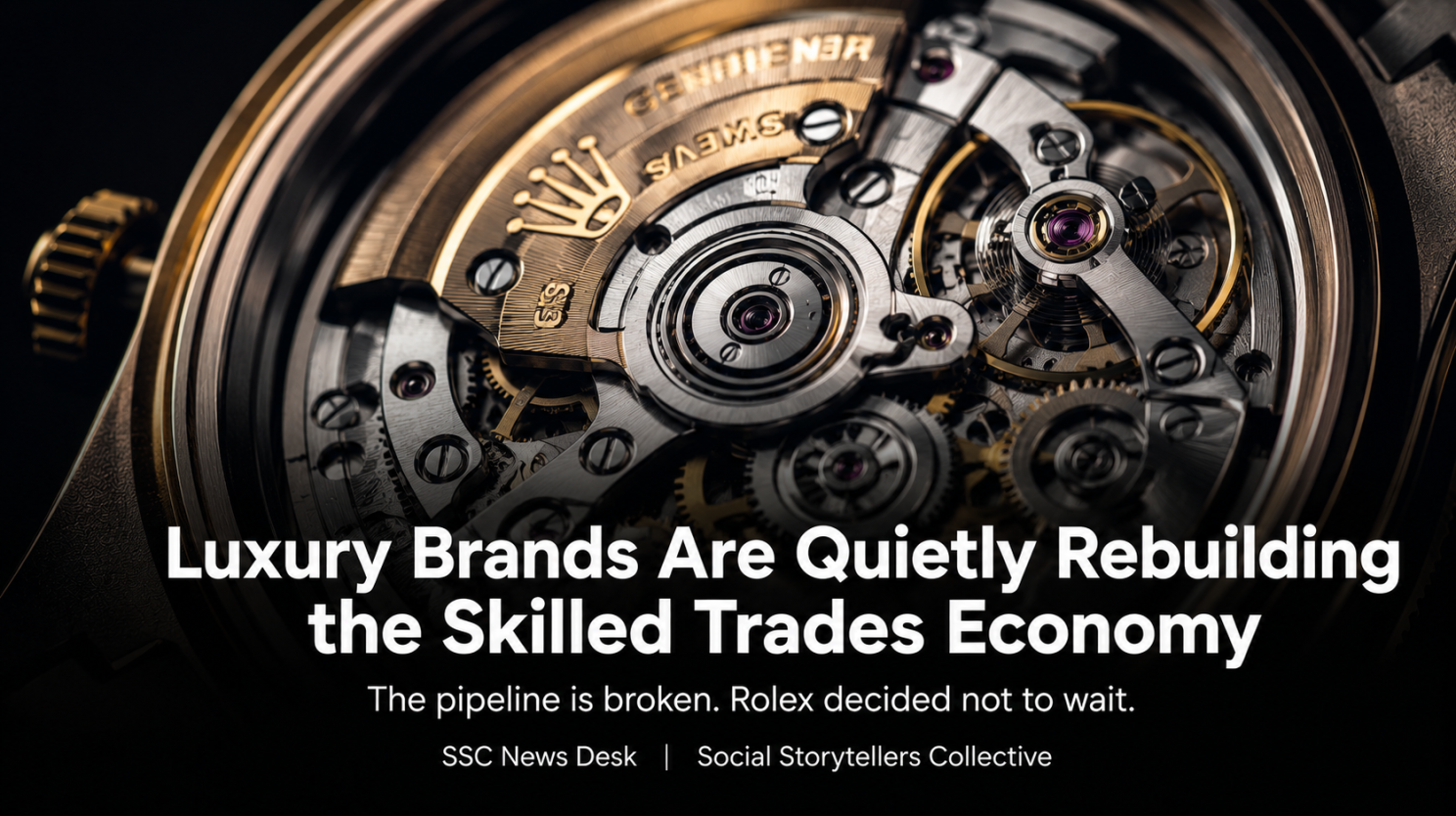
Rolex has opened a tuition-free watchmaking school in Texas. That sentence contains more structural information about the American labor market than most economic reports published this month. Fewer than 2,000 certified watchmakers reportedly remain in active practice in the United States — and as demand for luxury watches surged globally over the last decade, the labor infrastructure required to sustain that market failed to scale alongside it. Career paths in the field reportedly reach around $95,000 annually, a figure that challenges longstanding assumptions about what constitutes high-value work. What the Rolex school ultimately says is less about watches than it does about where structural power in labor is shifting — the companies benefiting most from those skills have decided they can no longer wait for the educational system to produce workers on its own. That decision is quietly redrawing who gets access to economic stability, and on whose terms.
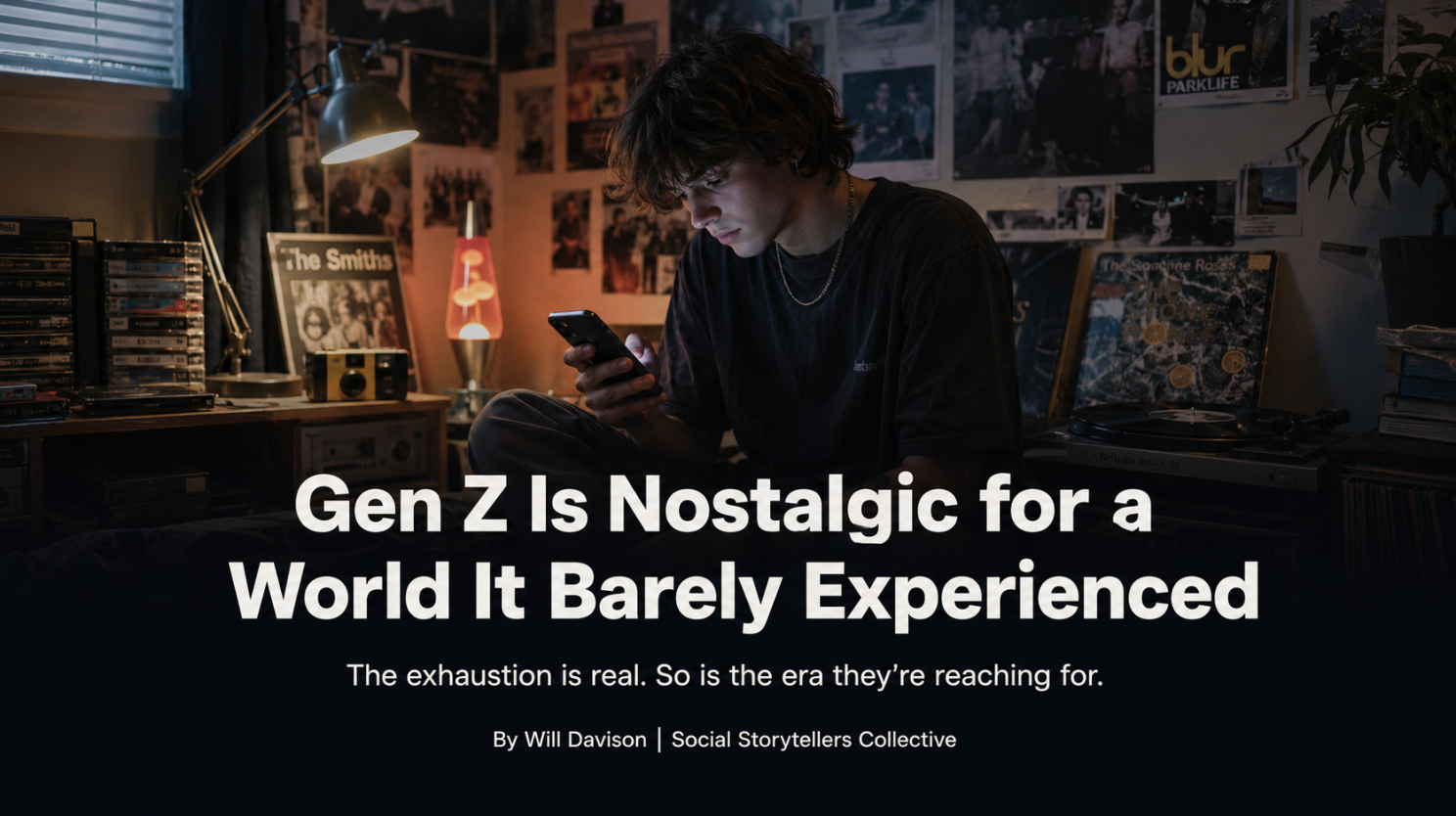
A new NBC News Decision Desk poll finds that 47% of adults between 18 and 29 would choose to live in the past rather than the future. Only 15% said they’d prefer to jump ahead. Nearly two-thirds believe their quality of life will ultimately be worse than previous generations — an extraordinary collapse in generational optimism in a country historically built around the promise of upward mobility. This is not ordinary nostalgia. Much of Gen Z‘s fascination with earlier eras is reconstructed through aesthetics, archived media, inherited memory, and internet mythology. The appeal is less about returning to a specific historical moment and more about escaping the emotional architecture of the current one— and the deeper irony is that this nostalgia is being produced and distributed through the same platforms generating the exhaustion. Gen Z discovers “simpler times” through algorithmic feeds optimized for engagement. The past becomes another consumable aesthetic delivered through hypermodern systems. What the poll reveals is structural: a generation losing faith that technological acceleration automatically produces a better human experience. That is not a phase. It is a positioning that will shape culture, markets, and politics for the next decade.
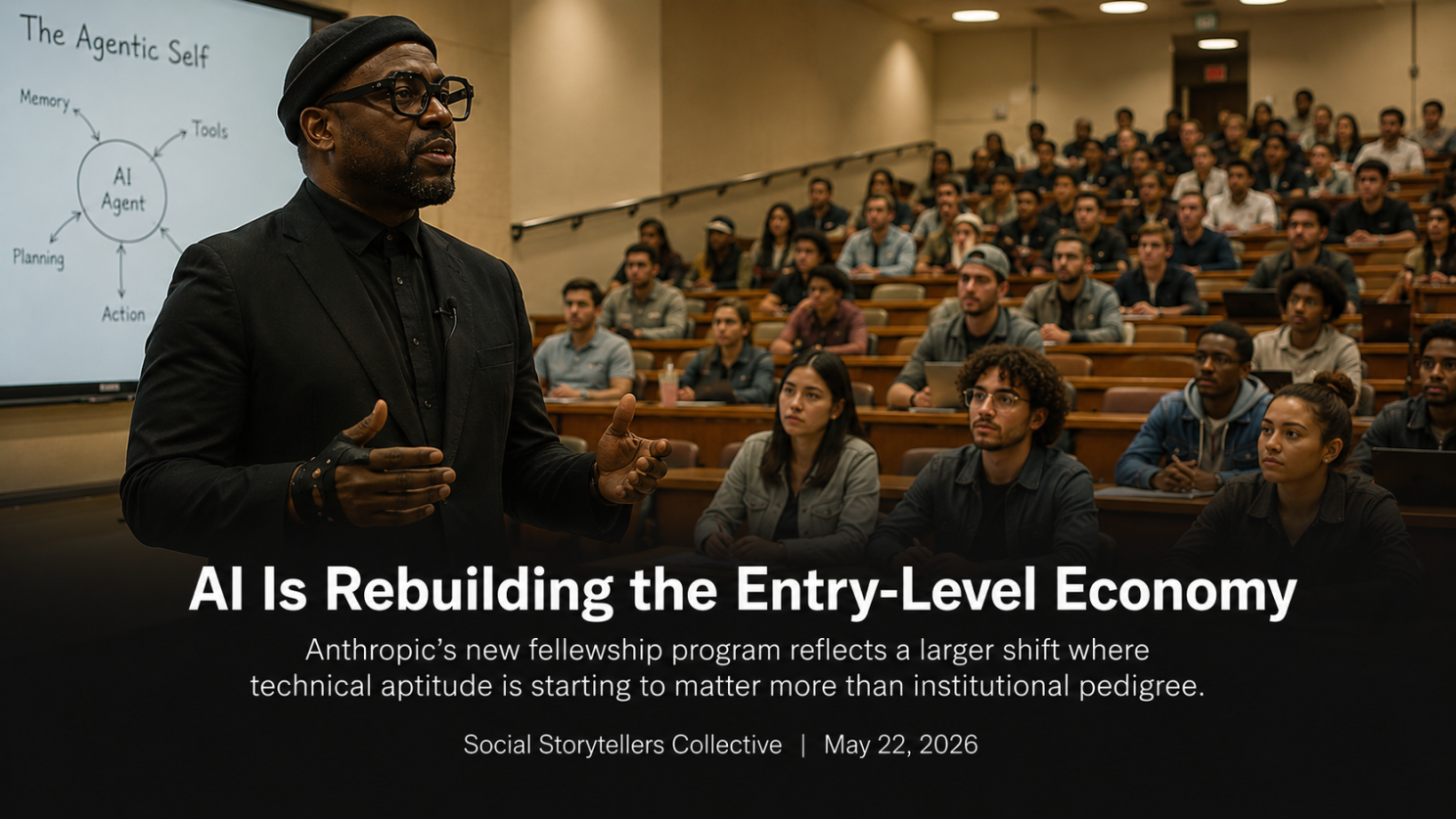
The Anthropic Fellows Program offers approximately $3,850 per week for participants to conduct AI safety research, with no prior AI research experience required. And then there is will.i.am — founder and CEO of FYI.AI — who just completed his first semester teaching “The Agentic Self“ at Arizona State University’s GAME School. 75 students, ages 18 to 70, across two locations, 16 class meetings. Student projects ranged from tools helping small business vendors in Brazil to assistants helping military veterans understand their benefits to agents teaching African languages Google Translate doesn’t support. He framed the course as a solution to AI replacing human jobs. A musician who asked “Where is the love?” for two decades is now teaching the next generation how to build the technology that will reshape their working lives — and his classroom looks nothing like the rooms where AI has traditionally been built. The Anthropicprogram and the ASU course are two angles on the same question: who gets to be in the room when AI gets built, and who has been deciding that until now. The gate has widened. It has not disappeared.
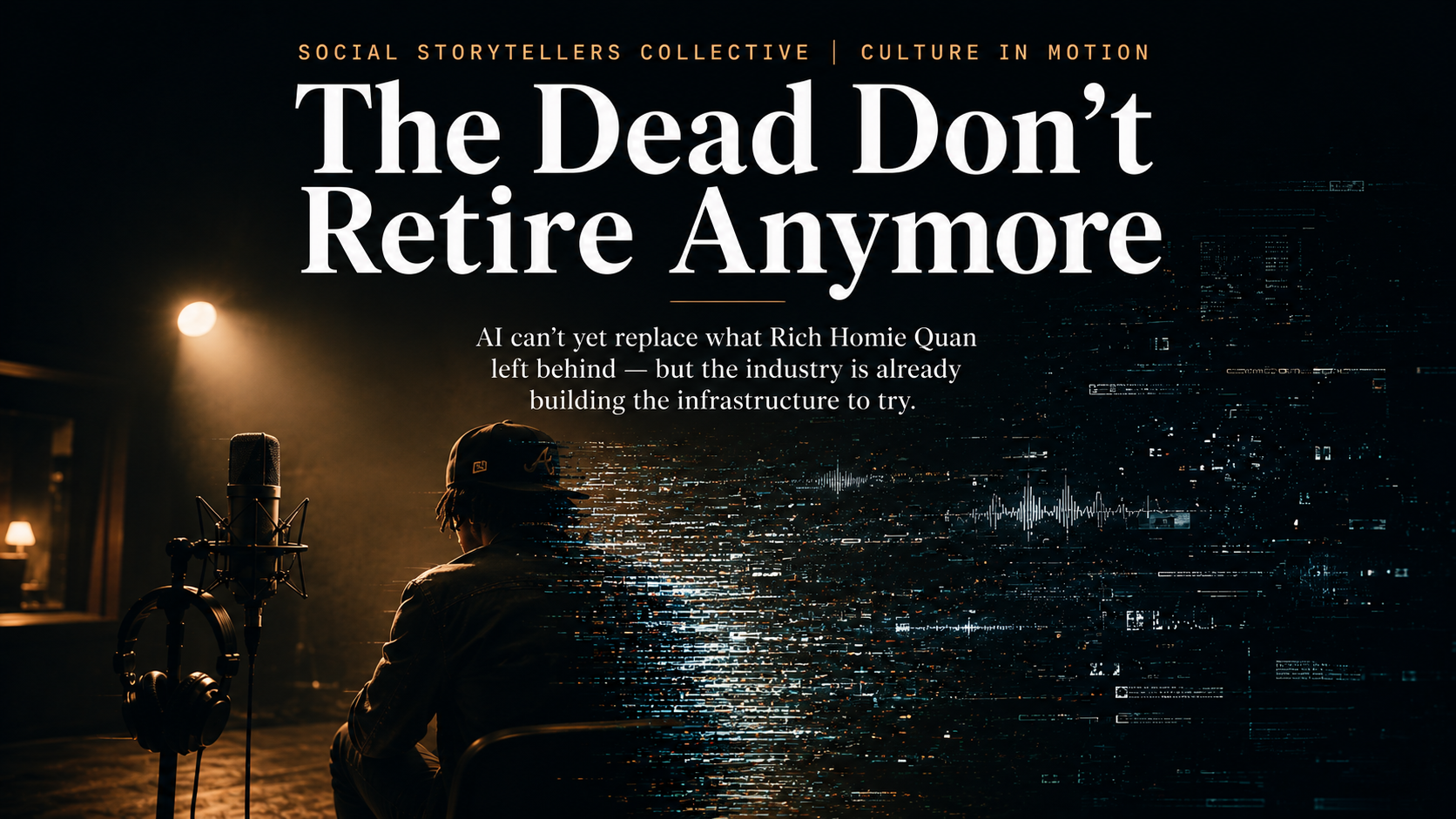
When My Mixtapez posted that Rich Homie Quan’s team was releasing a music video after his death, the internet didn’t respond with consensus. It responded with negotiation. Some fans called it exploitative. Others said: if it’s feeding his kids, what’s the problem. And then the revealing part — almost immediately, the conversation shifted to AI, even though the video didn’t use any. The footage was real. The family approved it. And still, audiences reached for the AI question anyway.
That tells you everything. The question is no longer whether AI was used. It’s whether it could have been — and whether that distinction still matters. Leena Alridge makes the case in The Dead Don’t Retire Anymore that artists are no longer just remembered. They are maintained. And the industry has every financial incentive to let that continue.
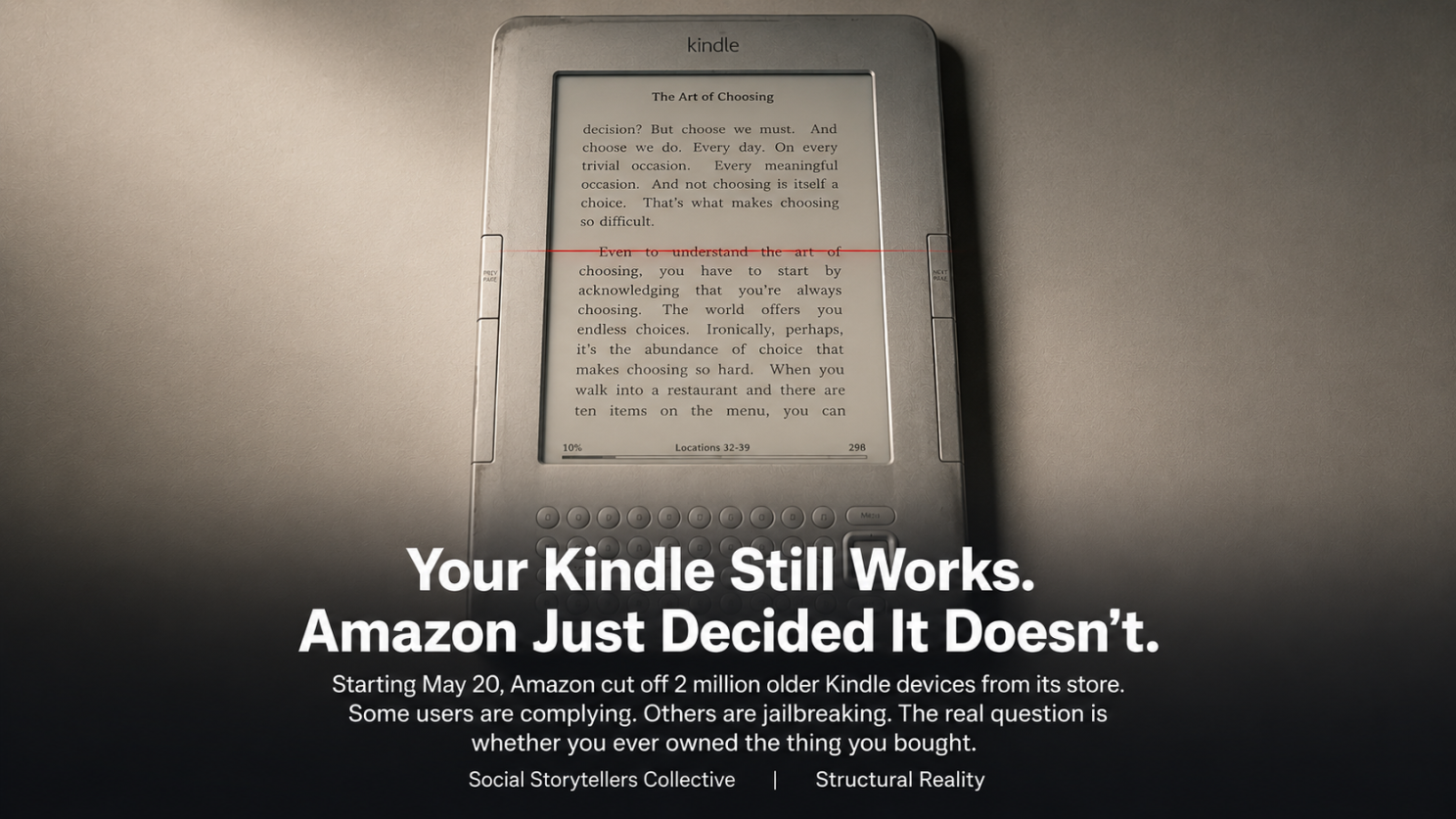
On May 20, Amazon ended store access for every Kindle model released in 2012 or earlier — 12 devices in total, from the original 2007 keyboard model through the first-generation Paperwhite and early Kindle Fire tablets. The Restart Project estimates the discontinuation could generate more than 624 tonnes of electronic waste. Amazon controls 72% of the e-reader market, and as a gesture toward affected users the company is offering a 20% discount on new hardware and a $20 ebook credit. What the offer doesn’t address is the more fundamental question: did they buy a device, or did they buy access to a device contingent on Amazon’s continued goodwill? A physical book purchased in 2007 still works in 2026. It doesn’t require the publisher’s permission to remain readable. The people now loading Calibre onto their laptops and transferring ebooks over USB cables are not doing anything radical — they are doing what anyone does when the terms get changed without their consent. They are finding a way to keep what they already had on the terms they originally understood. The paperback diehards had a point all along.
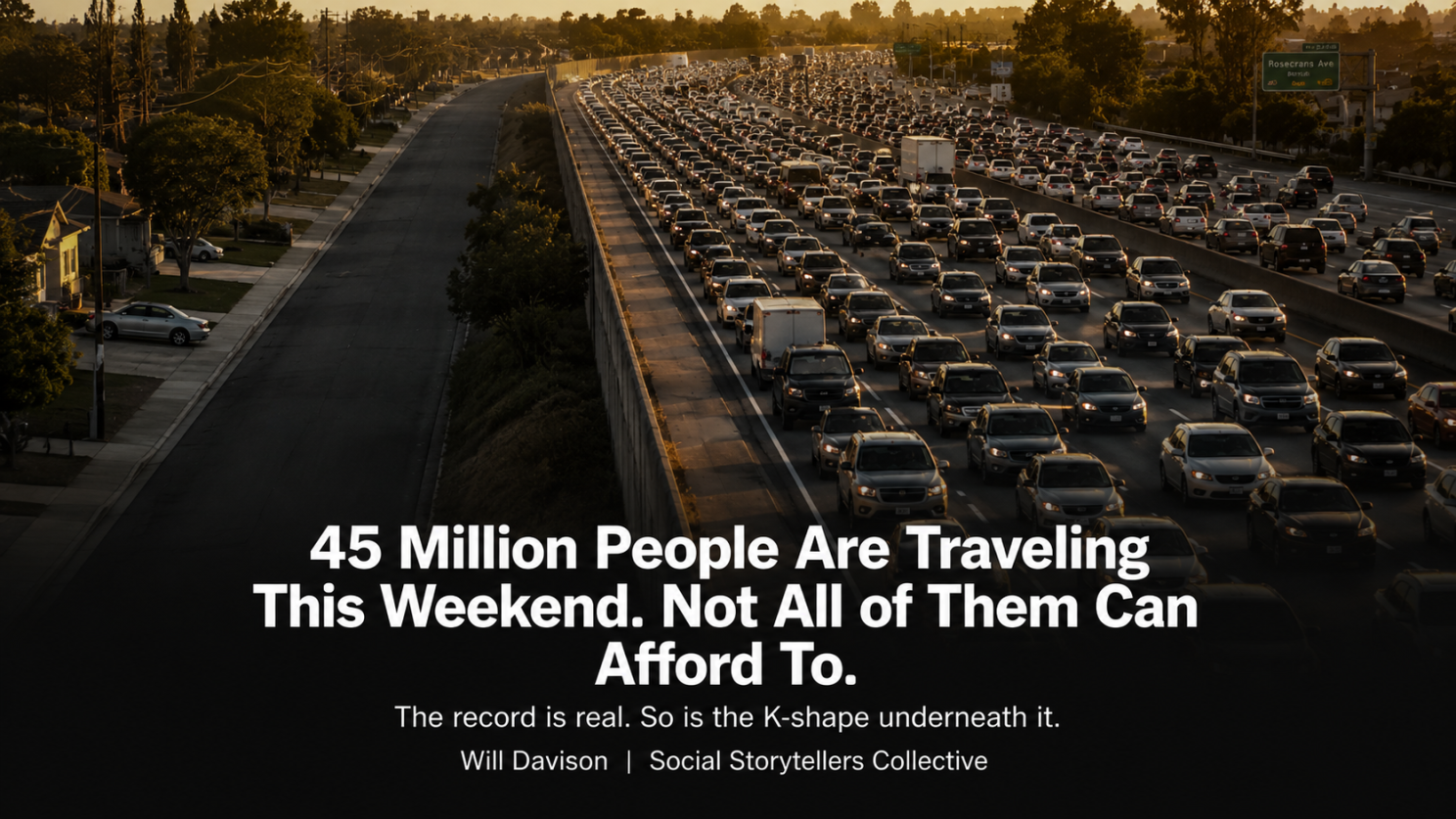
AAA projects 45 million Americans will travel at least 50 miles from home between Thursday and Monday — a new Memorial Day record. The majority, 39.1 million, are going by car. Another 3.66 million are flying, with roundtrip domestic tickets averaging $800. The headline is clean. Americans are traveling in record numbers. Summer is back. The economy is moving. Here is the number that doesn’t make the headline: according to Bank of America’s 2026 Summer Travel Outlook, nearly 40% of households earning $66,000 or less have no summer travel plans at all. Zero trips. Not scaled back — none. The personal savings rate has dropped to 3.6%, the lowest since 2022. Gas sits at $4.53 per gallon, up roughly 40% from this time last year. Overall travel costs rose 7.8% year over year in April, more than double the 3.8% rate of general inflation. The record is being set by the top half of the income distribution. The bottom half is watching the highway signs from where they are.
Featured Story: A Survey of 1,600 Black Male Voters Found 92% Say Voting Matters — and More Than 1 in 4 Say They Won’t Vote in November.
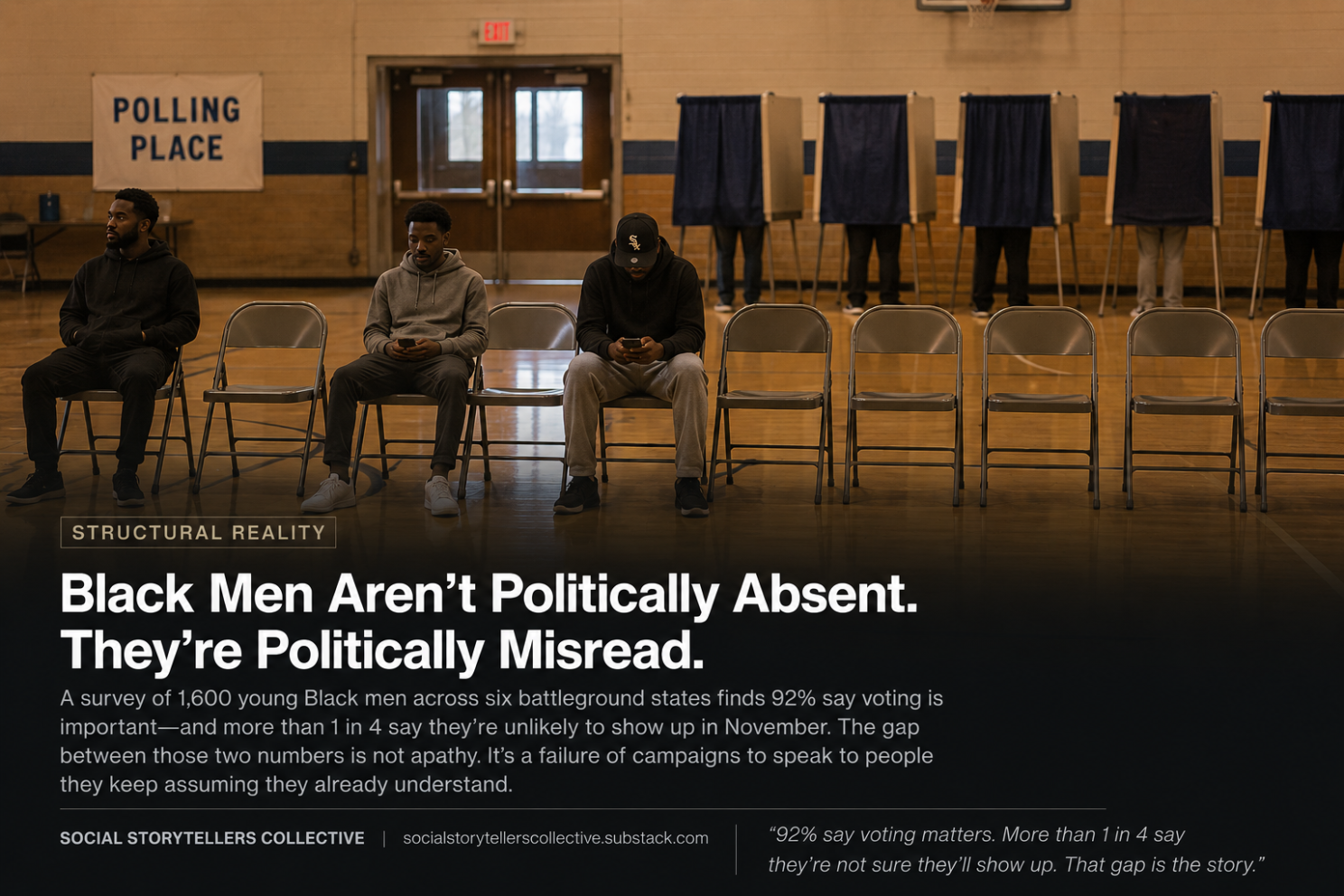
A survey of 1,600 Black male voters across six battleground states found 92% say voting matters — and more than 1 in 4 say they won’t vote in November. The gap between those two numbers is not apathy. Michael Bland of Black Men Vote, who commissioned the survey, is direct: campaigns keep sending the wrong message, through the wrong channels, about the wrong things — and Black men can tell. YouTube is where 90% of young Black men get political news. Most campaigns are still running TV ads and mailers. The party that asks Black voters to carry its hardest bets every cycle has not built the year-round engagement infrastructure that would actually close that gap. 92% believe in the process. The process has not yet earned the other 27% back. November is seven months away.
Daily Visual Signal
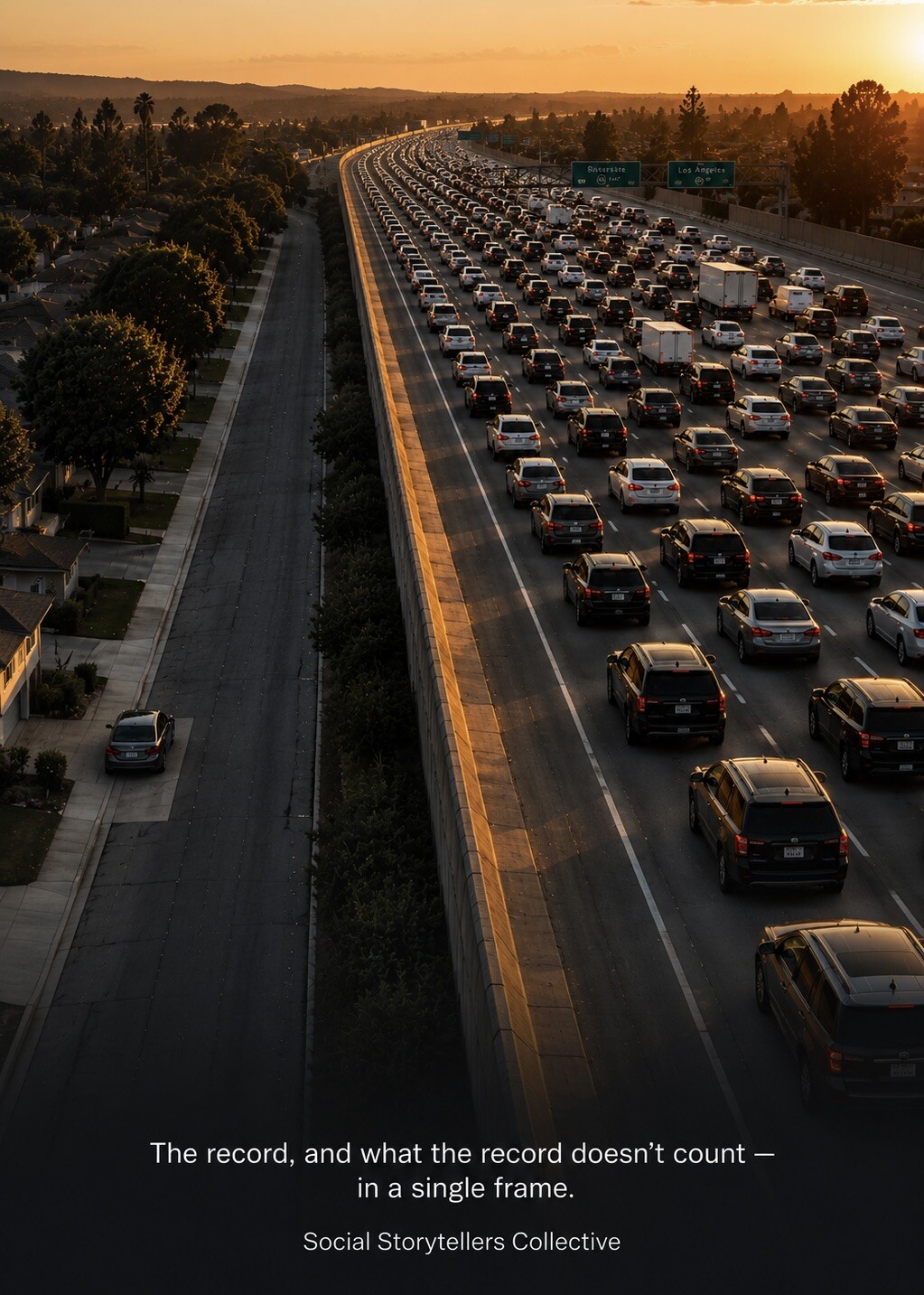
A packed six-lane interstate shot from an overpass at golden hour — bumper to bumper in the outbound direction, every lane full. At the edge of the frame, just visible over the concrete barrier: a quiet residential street. One car in a driveway. No movement. The highway and the side street in the same image, separated by a shoulder. The record, and what the record doesn’t count, in a single frame.
The CEO rewrites the terms of employment and calls accountability entitlement. The streaming platform converts a neighborhood institution into IP on its own timeline. The federal government removes 4.3 million people from food assistance without a press conference. A musician walks into a university classroom and teaches 75 people how to build the technology reshaping their working lives — in a room that looks nothing like the ones where those decisions have traditionally been made. Amazon decides your functional device is no longer supported. The travel industry announces a record weekend built on the spending of households the bottom 40% of earners aren’t part of.
All of it is true. And underneath all of it is the same structural question: who was in the room when the terms were set? The answer, across every story in today’s edition, is roughly the same. The people with the most structural power made the call. The people most affected found out later.
That is not a conspiracy. It is an architecture. And it is worth holding onto going into a long weekend that the news cycle is about to take off. The highway is full tonight. A lot is still in motion. Some of it will still be moving when Tuesday arrives.
The SSC End of Day Closing Note publishes weekdays at 3PM CDT. Start your morning with the Daily News Brief — drops at 10AM CDT. Friday Forward drops every Friday at 9AM EST. Subscribe · Join the SSC LinkedIn Group