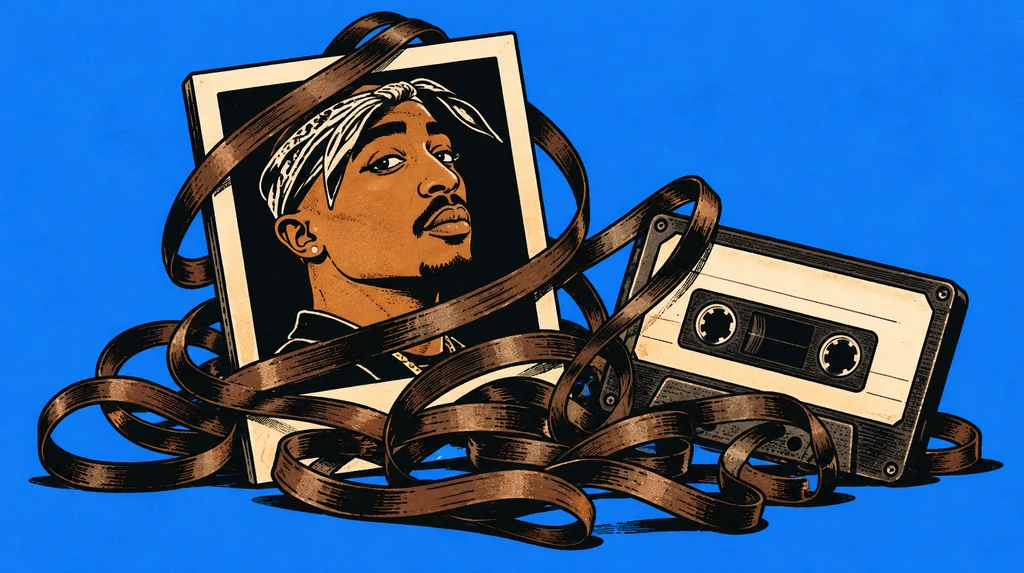
Duane “Keffe D” Davis was sentenced to 40 years to life for orchestrating the 1996 killing. The legal case is finally reaching an endpoint. The cultural story has been unfolding for three decades.
Tupac Shakur has now been dead longer than he was alive. He was 25 when he was shot near the Las Vegas Strip on September 7, 1996, and died six days later. Nearly 30 years after his killing became one of the most enduring mysteries in American music, Duane “Keffe D” Davis was sentenced Tuesday to 40 years to life in prison for orchestrating the drive-by shooting. The Associated Press reported that Davis, 63, will not become eligible for parole until he is at least 100, even after receiving credit for time already served. Reuters reported that the sentence consists of two consecutive terms of 20 years to life — one for murder and another for use of a deadly weapon.
Davis was convicted in August of first-degree murder after prosecutors argued that he organized the shooting in retaliation for a fight involving his nephew, Orlando Anderson, inside the MGM Grand hours earlier. Davis had acknowledged being in the white Cadillac that pulled alongside the vehicle carrying Shakur and Death Row Records co-founder Marion “Suge” Knight, and said he passed a gun to the back seat before the shots were fired. Prosecutors relied heavily on Davis’ own statements to investigators, documentarians and in his memoir, while his defense argued that there was no physical evidence directly tying him to the killing. He remains the only person ever charged in Shakur’s death.
But this is not simply the end of a murder case. For hip-hop, Tupac’s death became something much larger than a criminal investigation. It became a permanent reference point in the culture: part tragedy, part mythology, part cautionary tale about fame, violence, loyalty and the consequences of an era when music-industry rivalries increasingly overlapped with street conflicts. The East Coast-West Coast feud became one of the dominant narratives of 1990s rap, and Shakur’s killing helped freeze that period in public memory. For decades, the unanswered question of who was responsible became almost as culturally persistent as the music he left behind.
That uncertainty mattered because Tupac never stopped being present. His catalog continued circulating. His image moved across murals, clothing, documentaries and classrooms. His writing and interviews continued to be quoted by people who were not alive when he died. He was inducted into the Rock & Roll Hall of Fame in 2017, and successive generations discovered him not simply as a rapper but as a political and cultural figure whose work dealt with poverty, policing, race, masculinity and survival. Reuters noted that his influence grew after his death even as the circumstances surrounding the killing remained unresolved.
His sister, Sekyiwa “Set” Shakur, brought that larger legacy into the courtroom. According to AP and Reuters, she described her brother as someone their mother, Afeni Shakur, had raised to think of himself as a human-rights activist and said she believed he could have eventually moved beyond music into activism or politics. Judge Carli Kierny made a similar point from the bench when she told Davis that the world had never forgotten Shakur. Those statements explain why the sentencing carries a different cultural weight than most long-delayed criminal cases. The person who died in 1996 never remained confined to the circumstances of his death.
There is also something uncomfortable about the way the case was ultimately resolved. Investigators spent years unable to bring charges, yet Davis repeatedly discussed his alleged role publicly. His interviews and memoir helped provide prosecutors with evidence they later used against him. That means one of hip-hop’s longest-running mysteries did not end because of a dramatic forensic breakthrough. It ended largely because a participant kept talking. The same machinery that helped turn the murder into folklore — interviews, documentaries, books and decades of fascination — eventually became part of the prosecution.
The sentence does not undo the cultural damage of September 1996, and it cannot answer every question surrounding the shooting. Prosecutors have said there is currently insufficient evidence to charge anyone else, while the identity of the person who actually fired the fatal shots has never been conclusively established in court. What the sentencing does provide is something hip-hop has rarely had in this case: a legal conclusion. For nearly three decades, Tupac’s murder lived somewhere between history and mythology. Now there is finally a conviction and a sentence. The culture will still be deciding what Tupac meant long after the courtroom closes.