
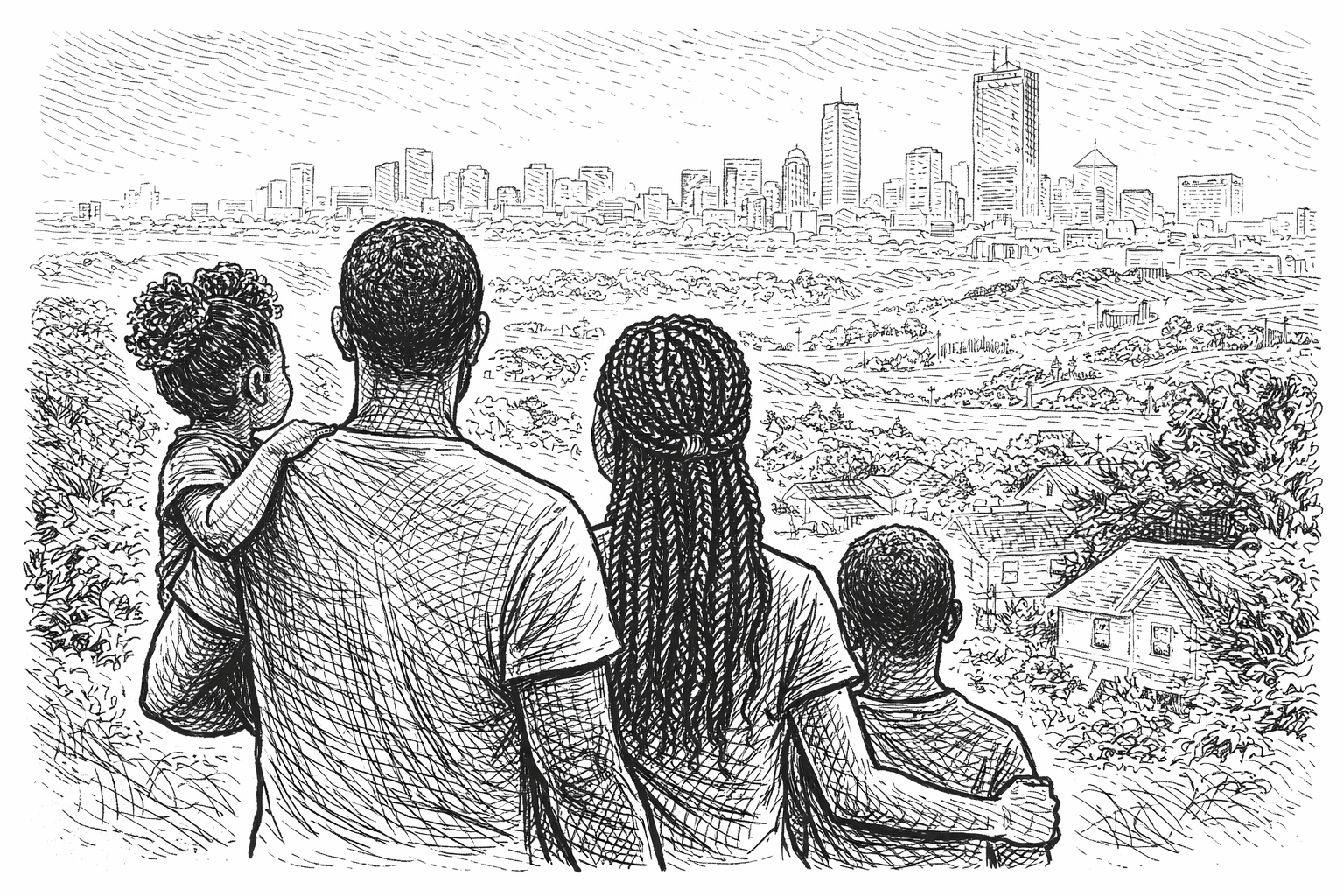
There is a particular kind of displacement that does not make the news the way it should. It does not arrive as a sudden announcement or a policy memo. It arrives as a rent increase. A neighborhood that starts to feel different. A commute that keeps getting longer. A slow accumulation of signals that the place you built your life in has decided, without saying so directly, that it has other plans.
That is what is happening to Black Boston.
The data, mapped and published by the Boston Globe earlier this year, shows what many Black residents already know from lived experience: the Black population of Boston proper has continued to shrink since the pandemic, while communities south of the city have absorbed that growth. Brockton is now majority-Black at 51%, the first community in Greater Boston to reach that threshold. Randolph sits at 46%. Avon follows close behind. Further south, Stoughton — where nearly one in five residents is now Black — sits at the outer edge of that formation, still growing, still absorbing. The direction of movement is clear. But the corridor is not uniformly hospitable. In Sharon, just miles away, Black residents who are present face a poverty rate of 42.6% — compared to 2% for white residents in the same town. Geographic proximity does not guarantee the same conditions. The southern corridor is where Black Boston is going. Whether it becomes where Black Boston can thrive is a different question entirely.
Black families are moving south not primarily by choice, but because soaring housing costs in Boston and its northern suburbs have made staying impossible. The word that tends to appear in coverage of this shift is “growth.” Black community formation is growing in Brockton. The Black middle-class corridor south of the city is expanding. And there is something real in that framing — new Black churches anchoring neighborhoods, first-time homebuyers building equity, community institutions taking root in places that have space for them. That is not nothing. That matters.
But growth and displacement are not opposites. They can be the same thing, described from different angles. What looks like expansion from one vantage point looks like being priced out from another. The question worth asking is not just where Black Boston is going — it is why, and who benefits from the vacancy being left behind.
The income disparities embedded in the data add another layer. Foreign-born Black households in Greater Boston carry a median income nearly $20,000 higher than native-born Black households — $66,000 compared to $55,000. Afro-Latino households trail further behind at $45,500. These are not small differences. They reflect distinct trajectories, distinct relationships to the labor market, and distinct degrees of exposure to the structural barriers that have compressed wealth-building opportunities for native-born Black Americans across generations. A single headline about a growing Black population south of Boston flattens all of that into a narrative of progress that the numbers do not fully support.
What the data describes, underneath the demographic optimism, is a familiar Access Shift. The places where Black families could afford to own, to build community, to stay — those places are contracting. The places absorbing them are further from the economic centers of the region, further from the networks and institutions that drive upward mobility, and further from the political power concentrated in Boston proper. Distance is not neutral. It is a structural condition that shapes access to jobs, schools, healthcare, and the kind of visibility that translates into civic power.
Boston has long had a complicated relationship with its Black residents — a city that carries the legacy of the abolition movement and the reality of some of the most entrenched residential segregation in the Northeast. What is happening now is not a rupture from that history. It is a continuation of it, dressed in the language of real estate markets and demographic trends rather than the explicit policy mechanisms of earlier eras. The mechanism has changed. The outcome has not.
The Black families building lives in Brockton and Randolph deserve to have those lives taken seriously — not as a consolation prize for being pushed out of Boston, but as communities with their own claims on resources, infrastructure, and political attention. And the displacement driving that migration deserves to be named for what it is, rather than absorbed into a growth narrative that makes structural harm look like organic movement.
Why This Matters Where Black communities are allowed to exist — and under what economic conditions — is a structural question, not a demographic one. When housing costs push Black residents out of urban centers and into communities further from economic opportunity, the distance created is not just geographic. It is a distance from networks, institutions, political power, and the kind of proximity to resources that compounds over time. Boston’s story is not unique. It is playing out in Houston, in New York, in every major American city where the cost of staying has been allowed to rise faster than the wages of the people who built those neighborhoods. The question is not where Black families are going. It is what we intend to do about the conditions that keep moving them.