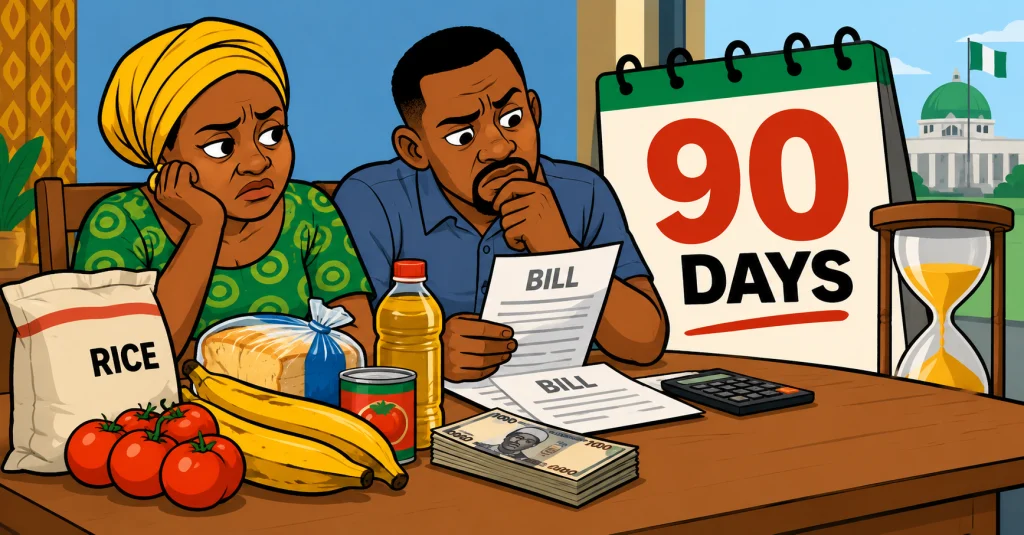
For a Nigerian household calculating the week’s expenses, a new government economic plan matters only if it eventually changes what remains after buying food, paying for transportation and meeting basic obligations. The country has spent years defending difficult economic reforms as necessary for long-term stability. Now, with consumers continuing to face pressure from prices and operating costs, the government has endorsed a 90-day action plan intended to make the benefits of those reforms more visible.
Nigeria’s National Economic Council endorsed the proposal during its 161st meeting on October 22, chaired virtually by Vice President Kashim Shettima. The plan was presented by Finance Minister Taiwo Oyedele and focuses on five priorities: food affordability, tax harmonization, completing high-impact public projects, resolving investment bottlenecks and targeted household support. TheCable reported that the government wants the measures to reduce living costs while accelerating projects capable of delivering direct economic benefits.
The announcement reflects the tension surrounding Nigeria’s reform agenda. Officials have argued that restructuring fuel subsidies, exchange-rate arrangements and public finances is necessary to improve long-term economic performance. Households and businesses, however, have had to navigate significant price changes during the transition. Improved fiscal indicators do not automatically mean a worker can afford the same groceries or transportation as before. The new plan appears designed to address that gap between national economic management and everyday purchasing power.
Food affordability is an especially important starting point because price increases affect virtually every household, but their consequences vary by income. Lower-income families generally have less flexibility to absorb rising food costs without reducing consumption or spending less on other essentials. Government coordination can potentially improve distribution, reduce administrative delays and support production, but the plan’s announcement does not yet establish how quickly those mechanisms will affect retail prices.
The proposal also addresses tax harmonization, an issue with direct implications for businesses operating across different levels of government. Multiple taxes, levies and compliance requirements can increase operating costs, particularly for smaller enterprises with limited administrative capacity. Simplifying those obligations could make commercial activity less expensive, but implementation would require coordination among federal and state authorities and clarity about which charges would actually change.
Completing high-impact projects introduces another challenge. Public infrastructure can support economic growth through improved transportation, more reliable services and lower business costs, but projects that remain unfinished do not deliver their full intended benefits. A 90-day program may be able to accelerate selected construction or administrative milestones, although major infrastructure projects cannot necessarily be completed within that period.
The government has also approved a national dashboard to track projects and report on the use of funds saved through petrol-subsidy removal. Channels Television reported that officials intend to strengthen transparency around project delivery and economic implementation. The value of that system will depend on whether it provides sufficiently detailed, regularly updated information for citizens to assess spending and progress rather than simply listing official activities.
State governments will be critical to the outcome. Economic policies designed in Abuja often depend on local implementation, distribution networks, infrastructure and administrative capacity. The Guardian Nigeria reported that Ogun State officials are considering bulk purchases of essential food items and expanded mass transit as part of efforts to reduce household expenses. Those initiatives illustrate how national priorities could translate into state-level action, although their actual effects remain to be measured.
The central test is whether the government can identify tangible improvements within the promised period. That could mean changes in the cost of selected staple foods, reduced business compliance expenses, completed public projects or documented delivery of household support. Without published benchmarks and timelines, the 90-day commitment risks becoming difficult for the public to evaluate.
Nigeria’s economic reforms will not be judged solely through central-bank indicators or government revenue reports. Their credibility also depends on whether households begin to experience greater financial stability. The new plan creates a short window for officials to demonstrate progress—and a clear reason for citizens to expect measurable results rather than another statement of economic intentions.