
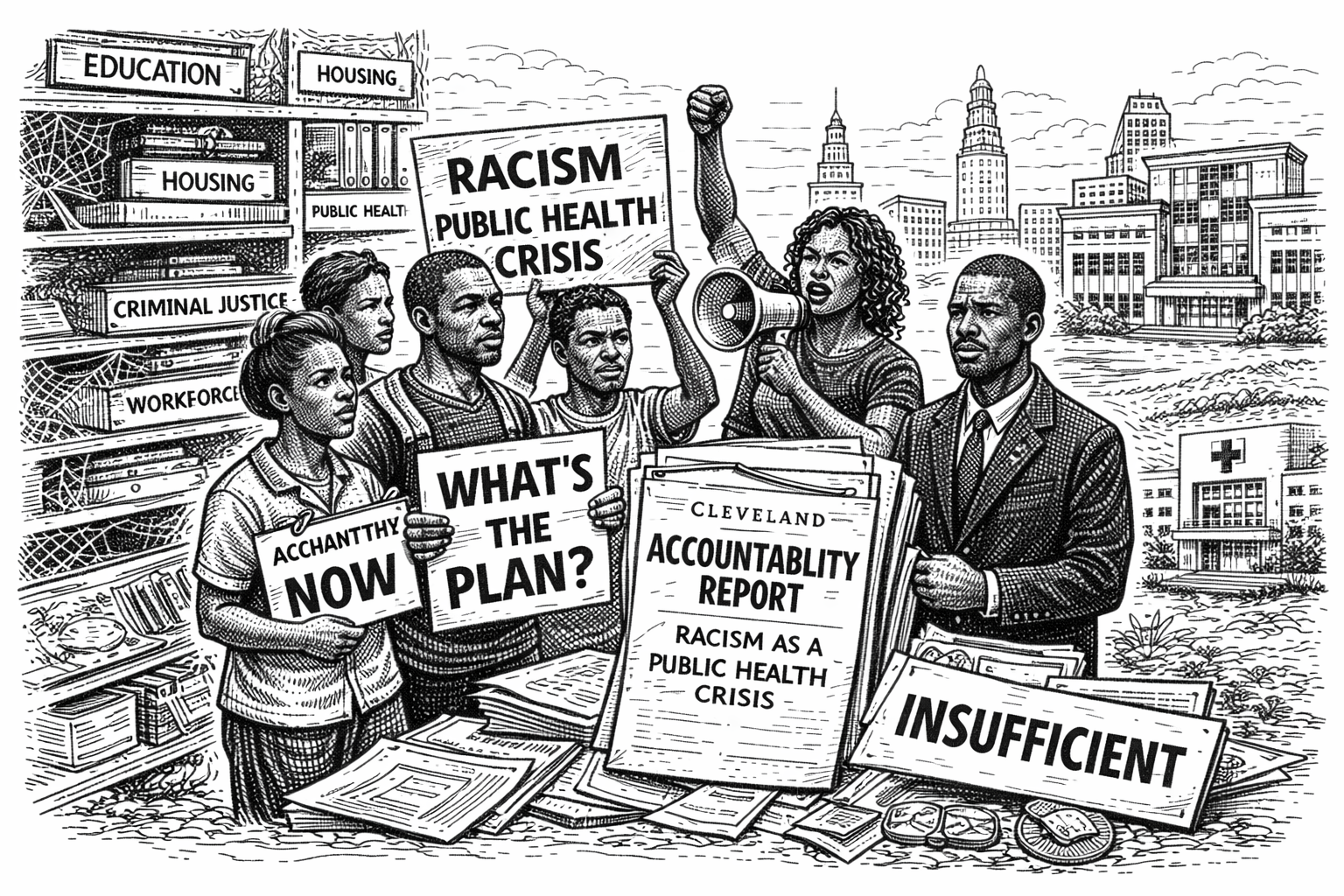
Five years ago, Cleveland became one of a growing number of American cities to formally declare racism a public health crisis — acknowledging what health equity advocates have long documented: that race, independent of income and individual behavior, shapes health outcomes, life expectancy, housing stability, educational attainment, and economic mobility in ways that require naming the system producing them. This week, the Racism as a Public Health Crisis Coalition released its first formal accountability report. The 52-page document examines systemic barriers across education, housing, workforce development, public health, and criminal justice — and was met with a mix of praise and criticism from the community, according to Ideastream Public Media.
The praise is for documentation that didn’t previously exist in this form. The criticism is for the gap between naming and acting — the distance between acknowledgment and change. That gap is the story. Declarations establish language and signal recognition, but they do not close maternal mortality gaps, reduce infant mortality, or change conditions in neighborhoods shaped by long-term disinvestment. The report shows the city has defined the problem. It does not yet show that the problem is being solved.
Cleveland is not alone. Over the past five years, dozens of cities and counties have passed similar declarations, built equity frameworks, and formed coalitions to track progress. The pattern is consistent: the declaration passes, the coalition forms, the report gets written, and the underlying conditions remain largely unchanged. This is not cynicism. It reflects the difference between political will expressed through language and political will expressed through budget, policy, and enforceable accountability.
The report matters because it makes the record clear. It documents what the barriers are and when they were known. That clarity shifts future inaction from oversight to choice. As SSC covered in Why Stories Are Missing, the relationship between Black communities and the institutions claiming to serve them is shaped by the distance between what is said and what is done. The Cleveland report is the city speaking clearly. The community’s response is asking whether that is enough.
Why This Matters
Declaring racism a public health crisis was a political act. So is releasing a report that documents barriers without timelines, budgets, or enforcement mechanisms to address them. The demand for more is not a rejection of the report — it is a response to what the report represents. Documentation without action is its own form of institutional response, one that names the problem while leaving its conditions intact. The next report will matter more than this one. What changes, what is measured, and who is held responsible for the gap — that is where accountability lives.