
After 30 years as a flight attendant, Ramone de Jesus had to give up the job when he was diagnosed with HIV, because some countries on his routes wouldn’t let him in. He moved from Puerto Rico to Chicago and couldn’t find work or people to lean on. “It’s hard getting old and lonely with the disease,” he told Borderless Magazine’s Tara Mobasher, in a story republished by Block Club Chicago on Nov. 18. “I need to be around people that are in the same situation as me.” He found them at CALOR, an organization founded in 1990 to serve Latinos at risk of or living with HIV. Its staff helped him get food, therapy and housing. “I have confidence talking to them,” he said, “because most of them are gay like me.” He went from homelessness to a new apartment and a job as a waiter. He still stops by a few times a week.
His story shows how Chicago’s HIV response actually works. In 2024 the city recorded 818 new HIV cases, nearly half of them among Latinos, according to the Chicago Department of Public Health, and new cases rose 29% from 2022 to 2024. Treatment that stops the virus and prevention that blocks new cases both exist. “We have all the tools to end the HIV epidemic,” said Bridget Magner of Erie Family Health Centers. “They are just not being deployed equitably.”
Why This Matters
- $46 million: direct federal funding for HIV testing and PrEP navigation at 96 community organizations that the Trump administration stopped renewing in July. The money now flows through health departments, which are encouraged but not required to pass at least 25% to community groups
- $600 million: CDC HIV and STD prevention grants the administration cut in four states including Illinois; a judge temporarily blocked the cut while litigation continues
- About 40%: the share of non-elderly adults living with HIV whose coverage comes from Medicaid, which H.R. 1 is projected to cut by an estimated $911 billion over 10 years
The money is moving away from the people doing the work
The July change didn’t only cut funding. It changed who controls it. Money that used to go straight to neighborhood organizations now goes to state and local health departments, which decide how much reaches the groups whose staff speak Spanish, share their clients’ backgrounds and know where to find them. When control of the funding moves up, the services that depend on trust are usually the first to thin out. Medicaid cuts add pressure from the other side. Magner warned that people who lose coverage may put off care to pay for food, housing and child care, and in HIV, a missed prescription is when the virus can spread again.
Testing where people already go
CALOR and the Puerto Rican Cultural Center have adapted by going out. At Fiesta del Sol, the country’s largest free Latino festival, CALOR staffed a table with bilingual sex-ed pamphlets, condoms and free HIV tests, and its mobile clinic tests people across the Southwest Side. The cultural center’s Vida/SIDA program brings testing and medication to Boystown bars and Latino music nights. “This is how we’re able to go to the population most needed,” said Ricardo Jimenez, the center’s director of public health initiatives, “because most of them like to go out.” The people doing the outreach count too. “Individuals who are in the South Side or West Side seeing another queer Latina individual helping them out creates a safe space,” said Iselle Jimenez, CALOR’s housing navigator.
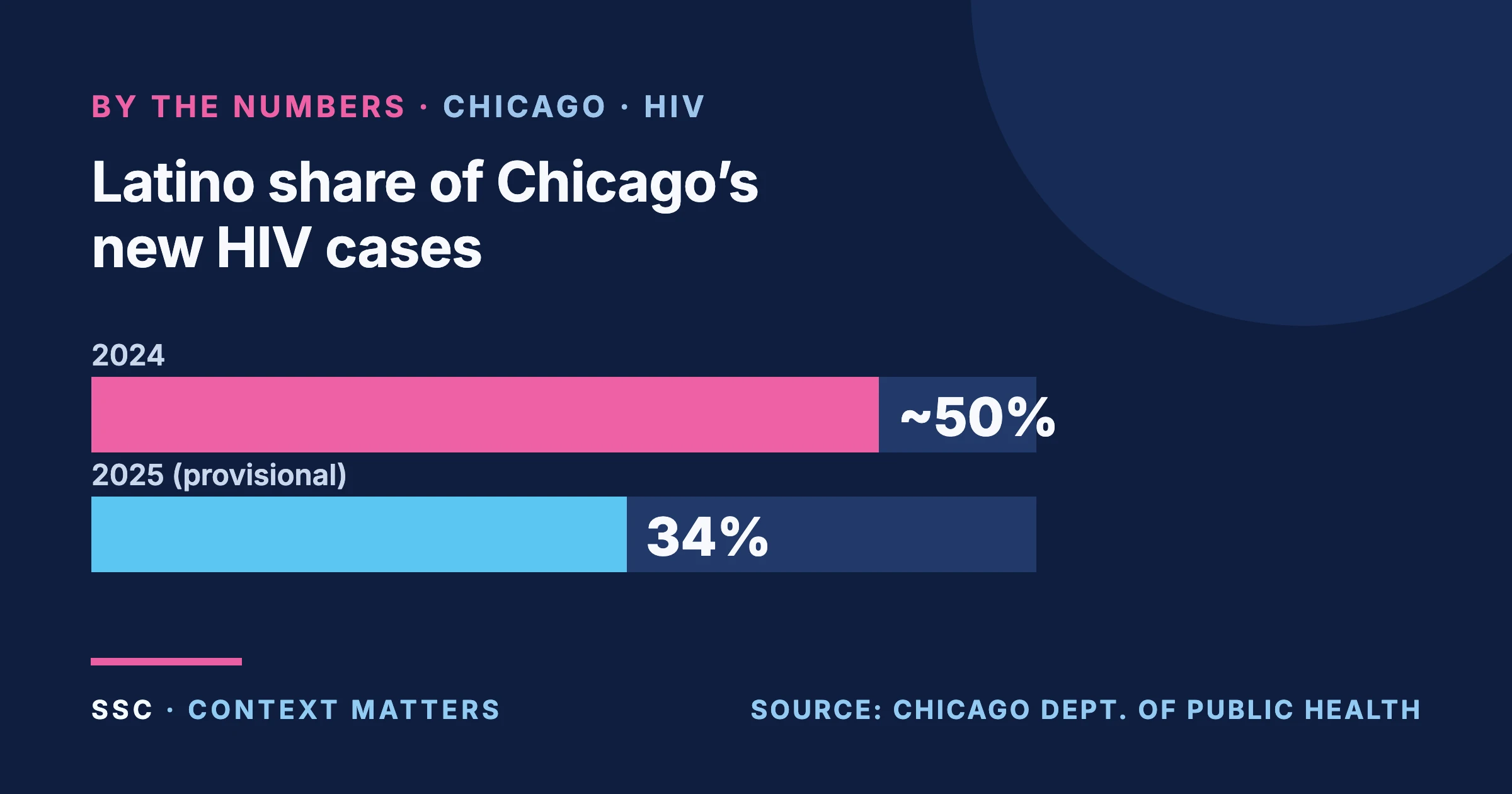
That outreach matters more now that immigration enforcement keeps people away from clinics. Provisional 2025 data show new cases fell, with the Latino share dropping to about 34% from 50%. Advocates caution that the drop may partly reflect people avoiding testing out of fear of ICE. “We cannot ignore the potential impact of immigration enforcement on willingness to engage in HIV testing and medical care,” said John Peller of AIDS Foundation Chicago. The health department put it more bluntly: “we also cannot mistake progress with success.”
The city releases final 2025 data next month. If the Latino share holds near 34% while testing at community events keeps rising, Chicago’s outreach model is working. If the decline turns out to come from people who stopped getting tested, the next count will climb, and the groups best placed to find those people will be operating on money that now passes through a health department first.