
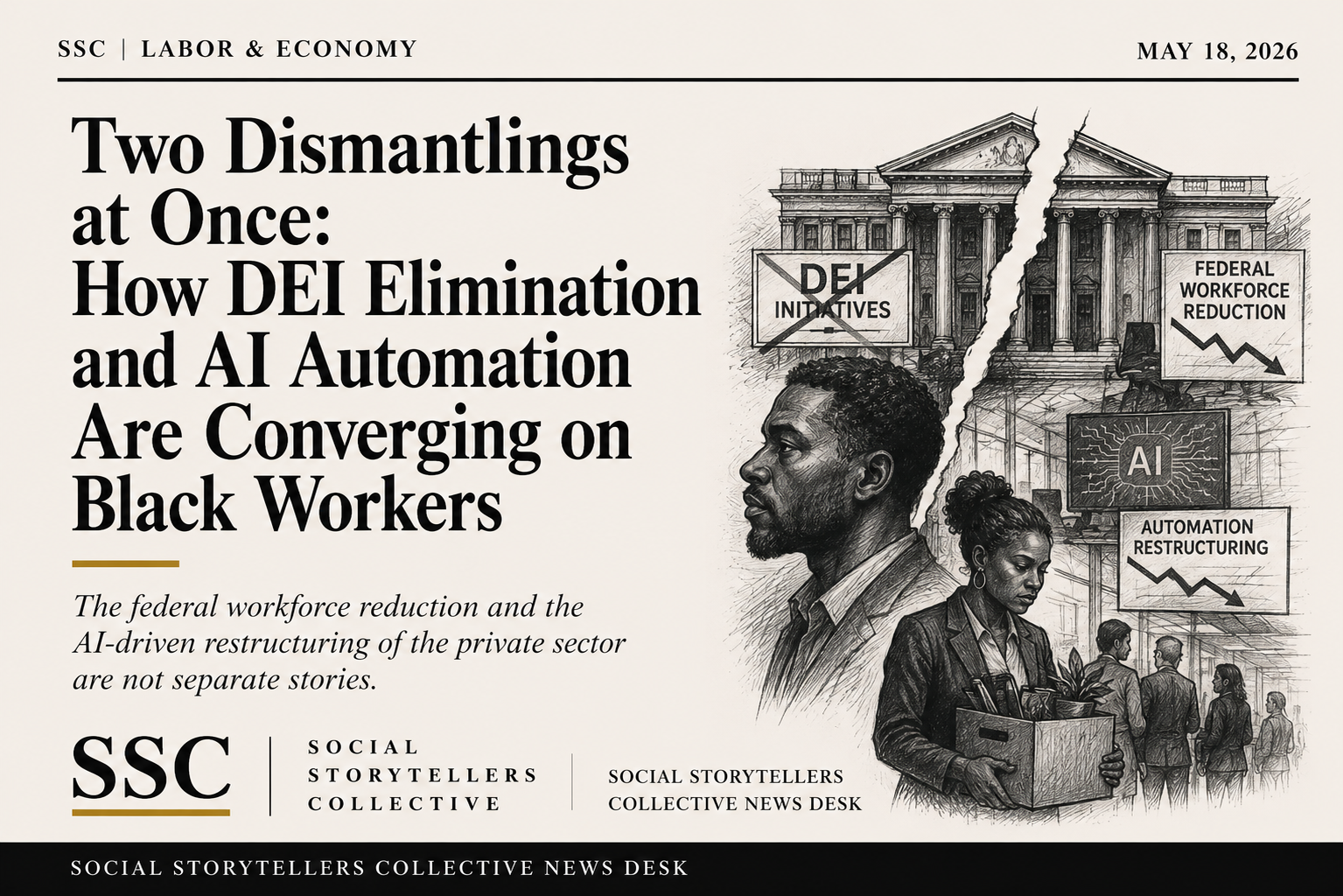
For Black workers — and Black women in particular — they are the same story arriving from two directions simultaneously.
Two of the most significant labor-market disruptions of the current period are happening at the same time, moving in the same direction, and concentrating their impact on the same population. That is not a coincidence. It is a structural condition that is not being named as such in most of the coverage tracking either disruption separately.
The first disruption is the federal workforce reduction. Since January 2025, the Trump administration has separated approximately 300,000 federal civil service employees — roughly 9 percent of the entire federal workforce. The stated rationale has shifted between efficiency, cost reduction, and the elimination of what the administration characterized as ideologically compromised programs. The practical result is visible in the demographic data. Black women represented 12 percent of the federal workforce in 2024 — double their share of the national labor force. They represented 33 percent of federal layoffs in 2025 and 2026. The Black women’s unemployment rate now stands at 7.1 percent, significantly above the national average of 4.4 percent.
The mechanism behind that disparity is not random. The agencies with the highest planned workforce reductions were also the agencies with the highest concentrations of women, minority, and Black employees. The executive orders eliminating DEI programs did not specify those employees by name — they did not need to. Eliminating the programs that created structured pathways into federal employment, and simultaneously reducing the agencies those programs disproportionately fed, produced a targeted outcome through an untargeted mechanism. The result is identical whether the intent was discriminatory or procedurally neutral. Black workers, and Black women specifically, are absorbing the concentrated impact.
The second disruption is the AI-driven restructuring of the private sector. Of the 6.1 million workers whose jobs are most likely to be disrupted by AI automation and least likely to adapt — those in roles that involve routine information processing, administrative coordination, and structured communication — 86 percent are women. The roles most at risk are not factory floors. They are air-conditioned offices: secretaries, receptionists, payroll clerks, customer service representatives, middle management, marketing, communications, HR, and online journalism. These are the roles that previous generations of Black women used to access professional stability after decades of exclusion from manufacturing and skilled trades that men historically dominated.
That history matters because it explains why the intersection is not coincidental. Black women’s entry into the professional workforce was later, harder, and more dependent on public-sector employment and structured private-sector pathways than other groups. The federal government was, for decades, one of the most reliable routes to middle-class stability for Black workers precisely because civil service protections offered a degree of insulation from the racial bias documented extensively in private-sector hiring. The roles AI is now most aggressively targeting — in information, administration, and structured professional work — overlap heavily with the roles Black women most recently gained access to through exactly the mechanisms now being dismantled.
The framing that treats these as two separate stories — federal downsizing as a political/budgetary event, AI automation as a technological/economic event — misses the structural intersection at which they are both operating. A Black woman who loses a federal communications position due to a reduction in force enters a private-sector job market where communications roles are among the categories most aggressively targeted by AI-driven headcount reduction. There is no adjacent sector absorbing the displacement. There is no version of the fallback that is not also under pressure.
What makes this moment particularly consequential is the simultaneity. The federal workforce reduction and the private-sector AI restructuring are not sequential — one creating a shock while the other remains stable enough to absorb displaced workers. They are concurrent, moving at comparable speeds, concentrating impact in overlapping populations without any coordinated policy response designed to address the intersection.
The political response to both disruptions has largely treated them in isolation. The DEI executive orders are defended as anti-discrimination measures. The AI-driven layoffs are described as inevitable market transitions. Neither framing engages with the demographic concentration of impact or the structural reasons that concentration is predictable. A disruption that follows existing lines of access and vulnerability does not require discriminatory intent to produce discriminatory outcomes. It requires only the absence of a policy designed to interrupt the pattern.
That policy does not currently exist at the federal level. And the institution best positioned to develop one — the federal government itself — is simultaneously eliminating the workforce and the programs most equipped to recognize what is happening and design a response.