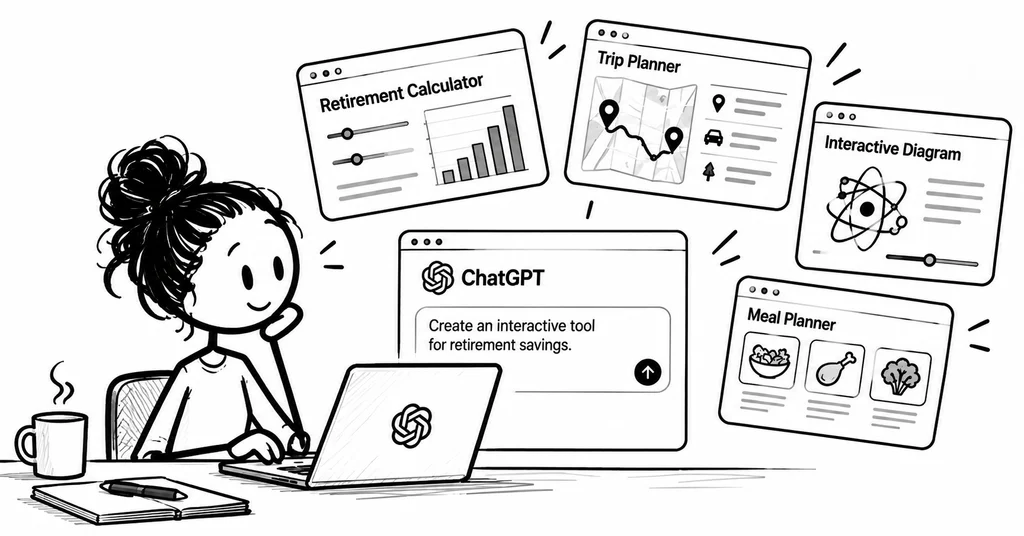
OpenAI’s new Intelligent UI can turn a prompt into charts, calculators, maps, diagrams and interactive tools, pushing ChatGPT beyond the text box that defined the first generation of consumer AI.
For most of ChatGPT’s existence, using artificial intelligence has followed a familiar pattern: type a question into a box and receive a block of text in return. OpenAI is beginning to dismantle that format. On October 7, the company introduced Intelligent UI, a new GPT-6 capability that can generate interactive interfaces directly inside a ChatGPT conversation, including charts, forms, tappable buttons, diagrams and task-specific tools. OpenAI says the system is being built for a product now used by more than 1.2 billion people each week, giving what might sound like a design update much broader implications for how people interact with software. OpenAI’s announcement describes the objective simply: ChatGPT should decide whether a user needs text, a visual explanation or an interface they can manipulate.
The Answer Can Now Become the Tool
The change means users may no longer need to leave a conversation to perform the next step of a task. Ask about retirement savings, for example, and ChatGPT can produce an interactive calculator whose assumptions can be changed inside the chat. A question about a road trip could generate a map. A complicated concept could become a diagram that changes as the user adjusts variables. OpenAI demonstrated examples including meal planning, bicycle mechanics, hiking routes and airplane lift, while its own announcement shows use cases ranging from a dinner bill splitter to interactive explanations of statistics. The model is effectively being given permission to decide what the answer should look like instead of forcing every answer through the same conversational template.
Underneath that experience is an architectural change as well. OpenAI says it built a library of native interface components and a compiler capable of processing them while the model generates a response, allowing the interface to appear progressively rather than waiting for an entire application or page to load. GPT-6 has also been trained to make decisions about layout, visual presentation and interaction, not simply language. That moves generative AI closer to something many software companies have been working toward for years: interfaces that reorganize themselves around what a user is trying to accomplish.
Software Starts Moving Toward the User
That could alter the economics of relatively simple software. Today, users often rely on separate products for calculators, comparison tools, trip planners, learning modules, simple dashboards and other narrow tasks. Intelligent UI does not eliminate those applications, particularly when specialized data, collaboration, security or persistent records are required. But it introduces a competing model: instead of finding an app designed for a particular problem, users can describe the problem and have a lightweight interface assembled when they need it.
The education implications may be especially significant. OpenAI had already introduced interactive learning modules for more than 70 math and science topics earlier this year, allowing users to change equations and variables and immediately see the effect on graphs. Intelligent UI expands the underlying concept beyond predetermined lessons. A student trying to understand aerodynamics, probability or economics can potentially move between explanation, visualization and experimentation without changing tools. The company says making complex subjects easier to learn is one of the central goals of the new interface.
Users will retain some control over how visual the experience becomes. OpenAI says ChatGPT can still return straightforward text when that is the clearest format, and users who prefer fewer visual elements will be able to reduce them. Plus, Pro, Business and Enterprise users begin receiving Intelligent UI globally on October 7, while Free and Go users are scheduled to receive it October 8.
The longer-term shift is less about prettier answers than about where the interface comes from. Traditional software asks designers and developers to anticipate what users might need and build screens around those assumptions. Generative interfaces reverse part of that process: the user describes the objective first, and the system constructs an experience around it. If that approach holds up at scale, the next phase of consumer AI may not be defined by chatbots that become better at answering questions. It may be defined by software that increasingly appears only after someone asks for it.