
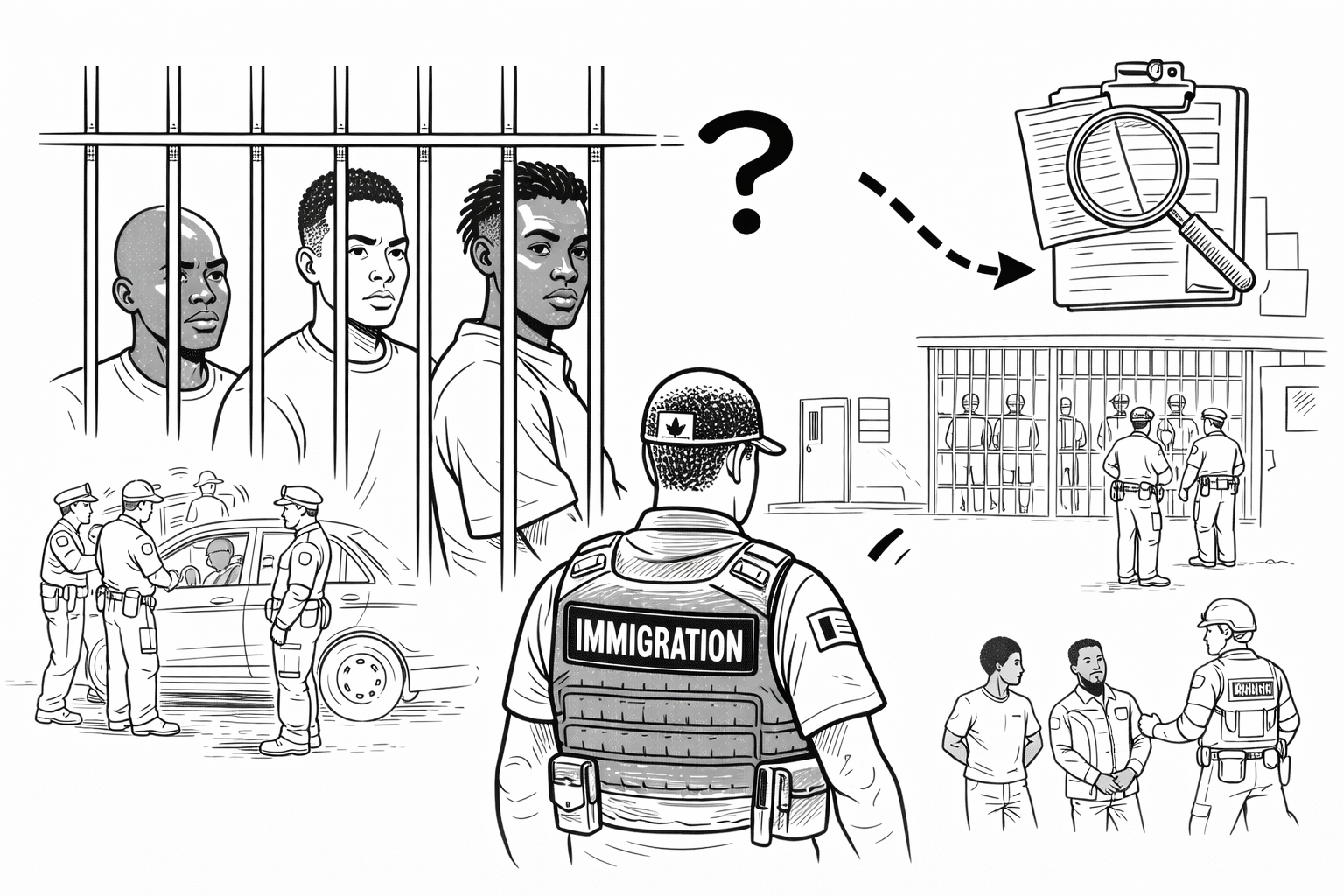

Canada detained almost 60,000 people between 2015 and 2025, including children. It does not know how many of them were Black. Not because the information is unavailable, but because Canada’s immigration detention system does not collect race-disaggregated data on who it detains. A February 2026 report from the University of British Columbia — the first study to comprehensively analyze race and racism in Canada’s immigration detention system — documents what that absence conceals.
The report found that the system contains no meaningful safeguards to prevent racism, race-based stereotypes, and other forms of racial bias from shaping detention decisions, and lacks effective avenues to identify and challenge racism and racial bias. Heavy policing of Black and other racialized communities, disproportionate traffic stops, disproportionate criminalization, and overuse of wellness checks all funnel racialized people into immigration detention at disproportionate rates. The researchers describe a system built on racist legal architecture — one from which the explicit racial language has been removed while the racial outcomes remain.
The absence of data is itself the finding. A system that does not track its racial outcomes cannot be held accountable for them — and Canada’s immigration detention system has been structured, whether deliberately or not, to make its own racial bias invisible. When a Somali man is detained after a wellness check. When a Congolese woman is held for months while her case is processed. When children from Caribbean families are detained alongside adults in facilities not designed for them. None of these outcomes are recorded as racial outcomes. They are recorded as immigration outcomes. The distinction is the mechanism of deniability.
This is a pattern SSC has documented in different forms across American institutions. The AI resume screen that doesn’t record who it rejected. The quiet cutting that doesn’t announce who it targeted. The mortgage rejection that doesn’t collect the race of the applicant it denied. As SSC covered in The Airport Isn’t Just a Transit Hub Anymore — It’s a Checkpoint, immigration enforcement in the current moment is expanding its reach while contracting its accountability. Canada’s detention system is the longer-running version of that dynamic — a structure that has been producing racially concentrated outcomes for decades without ever having to name them as such.
The report’s authors — drawn from UBC’s law school, the Black Legal Action Centre, and the University of Toronto — are calling for the gradual abolition of immigration detention as currently practiced, alongside immediate steps including a national independent review focused on race and racism, an independent oversight body with investigative authority, mandatory collection of race-disaggregated data, a maximum time limit on detention, and a prohibition on detaining children. None of these recommendations require waiting for the system to acknowledge what it is doing. They require building the infrastructure to see it.
Canada has an Anti-Racism Strategy for 2024-2028 that identifies immigration as one of four priority areas for advancing racial equity. That strategy exists in the same country as a detention system that, according to the first report ever to examine it through a racial lens, was built on racist laws and has never been structurally reformed. Both things are true. The distance between them is where accountability goes to disappear.
Why This Matters
The absence of race-disaggregated data in Canada’s immigration detention system is not a gap waiting to be filled. It is a design feature that prevents the system from being held responsible for what it produces. The UBC report makes the pattern visible for the first time. What follows — whether Canada treats documentation as the beginning of accountability or as a substitute for it — is the question that will define whether this report matters or joins the long archive of findings that changed nothing.