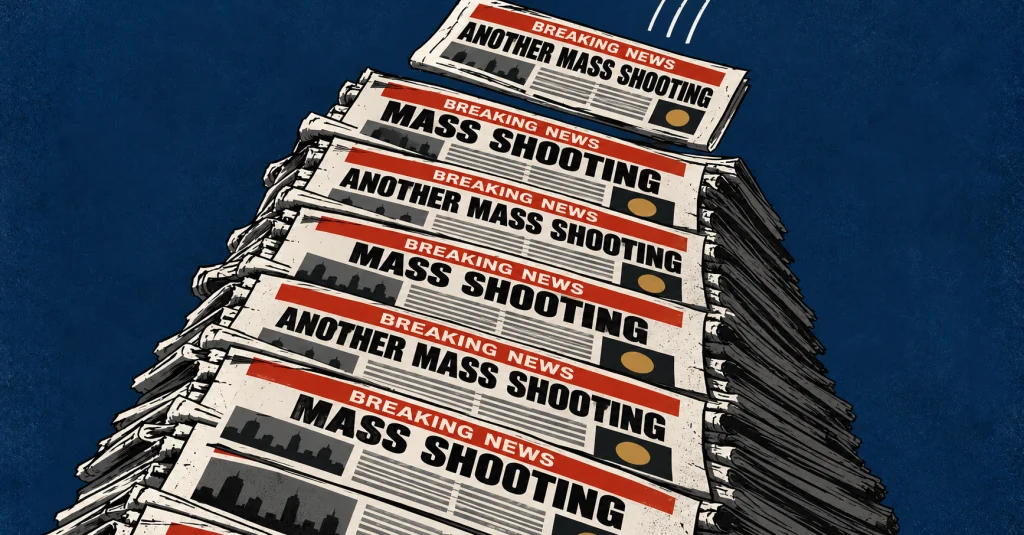
Four mass shootings in four states over one weekend left two people dead and 23 wounded. Americans mourn, communities recover and daily life goes on. The frequency of these attacks raises an unsettling question: how much violence can a society learn to live around?
A college homecoming in Florida. An event center in Tennessee. A parking lot in Indiana. An industrial park in North Carolina. Different places, different circumstances, the same devastating outcome. Over the weekend of October 24–25, at least four mass shootings across the United States left two people dead and 23 others wounded by gunfire. By Monday morning, four communities were dealing with the aftermath of violence that has become disturbingly familiar in American life.
The weekend began early Saturday in Memphis, where five people were shot outside an event center; police arrested a 24-year-old man. The largest shooting came that night near Florida A&M University’s Bragg Memorial Stadium in Tallahassee, where 11 people were shot after a homecoming football game. Six of the injured were minors, the youngest 11 years old. Police arrested a 15-year-old suspect on Sunday. Early Sunday, five people were wounded in a parking lot in Muncie, Indiana, near Ball State University. Hours later, a shooting at an industrial park in Charlotte killed two people, ages 16 and 19, and wounded two others, also 16 and 19. Each shooting set off its own investigation, while the rest of the country moved through an otherwise ordinary autumn weekend.
For the families involved, nothing about it was ordinary. There are hospital rooms, frantic phone calls, unanswered questions and lives that may never return to what they were. Nationally, though, the shootings slot into a familiar sequence: breaking news alerts, police briefings, statements from elected officials, community vigils. One incident dominates the headlines while another stays a local story. The country has become practiced at processing several tragedies at once, even as the people directly affected are only beginning to understand what happened.
Hundreds of Shootings, One Country
The numbers help explain why the news cycle feels so relentless. According to an October 19 analysis by The Trace, the United States recorded 354 mass shootings in the first nine months of 2026, up from 327 in the same period last year. The figures come from the Gun Violence Archive, which counts a mass shooting as any incident in which at least four people are shot, not including the shooter. That is broader than definitions limited to attacks in which four or more people are killed, and it includes shootings that grow out of disputes, domestic violence and other circumstances, not only indiscriminate attacks in public places. Even with those distinctions, the frequency is extraordinary: more than one mass shooting a day.
The data also reveals a contradiction. Overall shooting deaths and injuries have fallen sharply in 2026, continuing a broader decline in gun violence, according to The Trace. Mass shootings, however, rose through the first three quarters of the year. Both findings matter. The decline in overall violence is real progress, but it does not erase the incidents that wound or kill several people at once. Nor does a national count capture what it is like to live in a community where shootings happen again and again with little coverage beyond local news.
We Have Learned How to Prepare for the Unthinkable
Consider how much of ordinary American life now includes preparing for gun violence. Students practice lockdown drills. Teachers learn how to secure their classrooms. Employees complete active-shooter training. Concert venues, houses of worship and public institutions write emergency plans for situations most people hope they will never face. Many of these measures are sensible, and not all of them exist only because of mass shootings. Together, though, they show how seriously institutions must take the possibility that someone could open fire where people have gathered to learn, work, worship or celebrate.
That preparation creates an uncomfortable contradiction. Americans keep going to concerts, sending their children to school and gathering in public because ordinary life cannot simply stop. Yet the possibility of sudden violence now shapes how institutions operate and how some people size up their surroundings. A locked classroom door or a clearly marked exit can be reassuring, but it is also a reminder of the threat it was built for. A society does not have to accept violence for its routines to start accommodating it.
When Shock Becomes Familiar
It would be wrong to conclude that Americans no longer care. Communities still hold vigils, support survivors, demand accountability and debate prevention. The familiar language of grief does not mean the grief itself runs any less deep. Still, repetition changes how these events are perceived. When shootings happen in several states in a single weekend, the national conversation cannot give each one sustained attention. Some victims become household names. Others get only a passing mention outside their hometowns. The difference in coverage does not reflect a difference in the value of their lives.
Every major shooting also renews the arguments over firearm access, public safety, mental health, policing and the role of government. Supporters of stricter gun laws focus on keeping firearms away from people in dangerous circumstances. Gun-rights advocates emphasize constitutional protections, enforcement of existing laws and other ways to prevent violence. Those disagreements involve real questions about rights, effectiveness and safety, but the recurring debate can itself become part of the ritual. The country argues over what should change, attention moves on, and the next shooting brings the same arguments back.
The Danger of Learning to Live With It
Perhaps the most consequential change is not that Americans have stopped reacting to shootings, but that communities have learned to keep functioning in spite of them. Schools reopen, businesses resume and neighborhoods rebuild. Those responses often reflect resilience, not indifference. But resilience can also carry an expectation: that people will absorb another tragedy, recover as best they can and return to normal while the conditions behind the violence remain unchanged.
For the families in Memphis, Tallahassee, Muncie and Charlotte, this weekend will never be just another statistic. What happened to them will last long after the headlines fade. Across the country, other families are living with similar losses from shootings most Americans never heard about. The United States has developed ways to respond to mass shootings, investigate them, prepare for them and remember their victims. What remains uncertain is whether the country can make them happen far less often.
The measure of normalization may not be whether another mass shooting still shocks us. It may be how readily we have come to expect the next one.