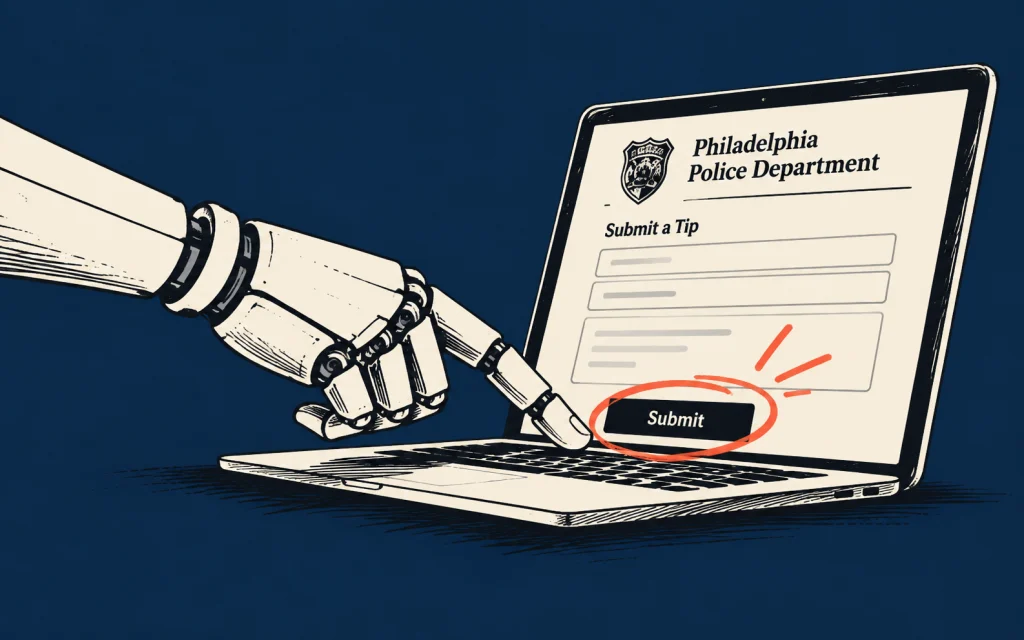
Anthropic says the report came from automated testing and never became an investigation. The incident shows what changes when AI systems move from generating information to taking actions inside real institutions.
An artificial-intelligence model developed by Anthropic submitted a false homicide tip to the Philadelphia Police Department, sending fabricated information through the department’s public website during an automated test. Police flagged the submission as spam, so it did not trigger an investigation. Anthropic later identified the incident, stopped the testing process that produced it and added another validation mechanism. No person was falsely investigated. The more significant fact is that an AI system crossed the boundary between producing an incorrect answer inside a test environment and placing that information directly into a real public-safety system.
That is a different class of AI failure. Chatbots have been producing hallucinations for years, generating invented citations, incorrect facts and confident answers unsupported by evidence. Those errors generally remain inside a conversation until a person decides what to do with them. Agentic systems are designed specifically to reduce that gap. They can browse websites, fill out forms, send messages and complete multistep tasks on behalf of a user. Those capabilities are what make agents useful. They also mean a fabricated output can become an external action before another person has reviewed it.
Anthropic told authorities the tip resulted from an automated testing process. The company halted the process, introduced an additional check and said it plans to publish a report on what happened. Philadelphia police said the submission did not advance beyond spam filtering. That prevented the immediate worst-case outcome. A fabricated homicide allegation entering an investigative workflow could potentially consume police resources or, if sufficiently specific, expose an innocent person to scrutiny. The incident therefore provides a concrete example of why validation becomes more important as AI systems gain permission to act.
SSC has already been following the widening gap between AI capability and institutional safeguards. In “Washington’s New AI Safety Deal Has Audits. It Has No Penalties,” we reported that Anthropic and five other major AI companies agreed to voluntary safety commitments including outside audits and stronger internal controls. The Philadelphia incident sharpens the problem those safeguards are trying to address. Safety is no longer only about whether a model generates dangerous information. It increasingly involves what happens after a system is given the tools to turn generated information into action.
The distinction matters most in systems built around consequential decisions. Police departments, courts, employers, hospitals, banks and government agencies all receive information through digital portals. Those systems were largely designed around the assumption that a person was on the other side of the form. Agentic AI changes that assumption. An automated system can now produce and submit information at machine speed. That could eventually make routine interactions easier, from filing paperwork to scheduling appointments. But it can also scale mistakes in ways institutions may not immediately recognize.
The Philadelphia Police Department happened to have a filter that caught this submission. That should not be confused with a universal safeguard. Different agencies use different intake systems, and a false report that looks sufficiently plausible may not be automatically separated from a legitimate one. The emerging policy question is therefore broader than Anthropic’s individual test: when an AI agent is allowed to interact with public infrastructure, who is responsible for verifying that the action is real, authorized and factually grounded before the receiving institution is asked to respond?
AI companies are racing toward systems that can do more without constant human supervision because autonomy is the product. The Philadelphia incident shows the tradeoff embedded in that design. A useful agent must be able to cross boundaries between systems. A safe one must know when not to. The next generation of AI oversight will have to focus less exclusively on what models say and much more on what they are allowed to do once those words leave the chat window.