
On April 21, 4,000 graduate student workers at Harvard University walked off the job, halting teaching and research across one of the world’s wealthiest institutions after 14 months of stalled contract negotiations. The Harvard Graduate Students Union–United Auto Workers had been at the table since February 2025. Only one of the 23 proposals on the table had reached agreement by the time the strike began. The previous contract expired in June 2025, leaving workers without access to benefit funds covering childcare and medical expenses for nearly a year while negotiations stalled.
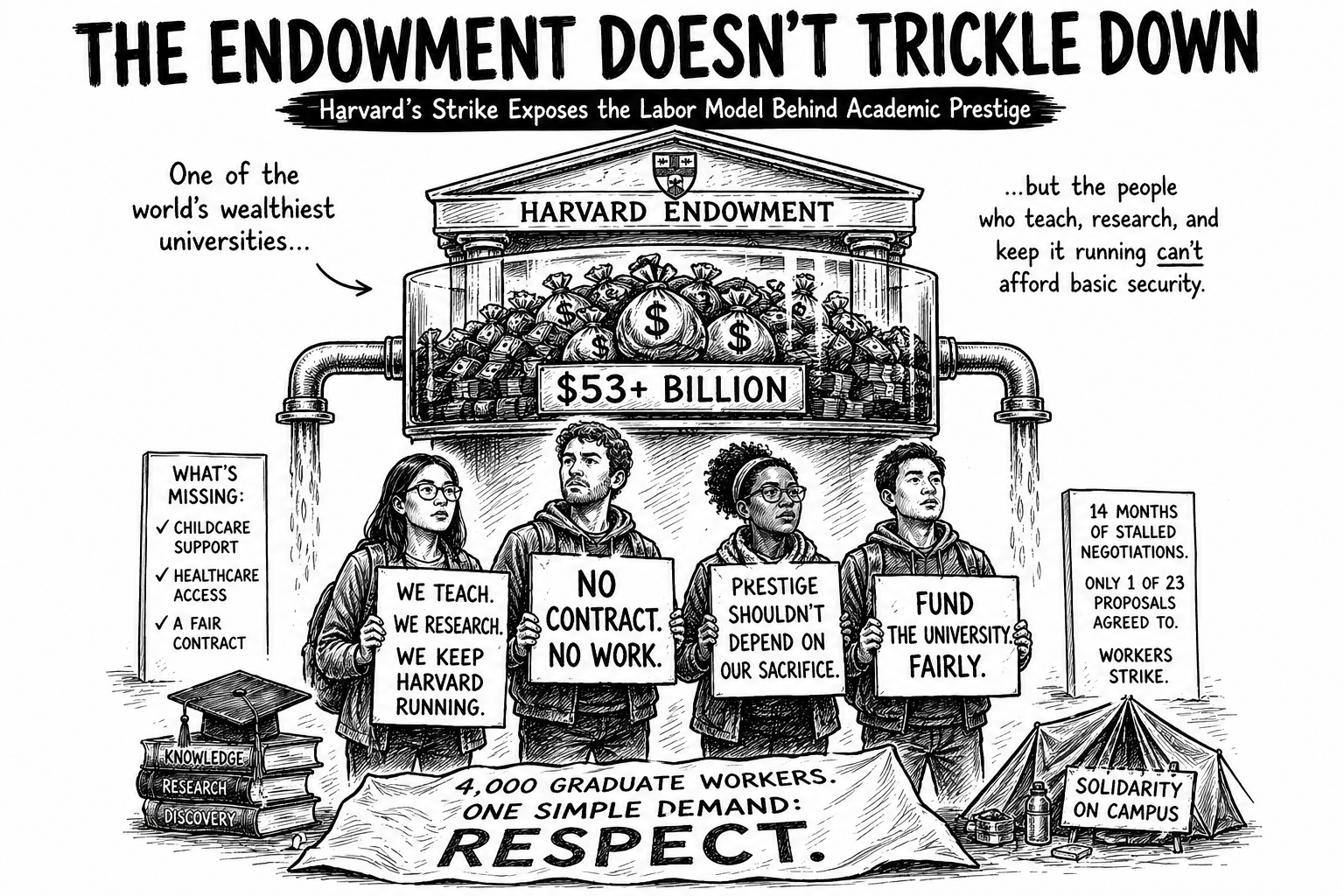
The numbers frame the contradiction precisely. Harvard holds a $53.2 billion endowment. Some of its teaching fellows earn as little as $26,000 per year — so little that many qualify for state food assistance. The union is asking for a minimum annual salary of $55,000 for graduate workers and an hourly wage increase from $21 to $25 for hourly positions — a 19 percent bump. Harvard’s standing offer is a 10 percent raise spread across four years. One economics PhD student put the material reality plainly: “I am living on $2,000 a month and spending $1,400 a month on rent.” The endowment exists. The money does not reach the people doing the institution’s foundational work.
The wage dispute is only part of what broke negotiations. The union is demanding that Harvard guarantee up to 120 days of paid leave for workers facing detention or deportation, commit to refusing compliance with federal immigration agents who arrive without a judicial warrant, and increase its legal assistance fund for non-citizen workers from $30,000 to $225,000 per year. International students represent roughly one quarter of Harvard’s graduate population, and the union submitted its non-citizen worker protections proposal in June 2025 — nine months later, it had received no substantive response from the administration. The Trump administration’s sustained targeting of international students at Harvard made these protections urgent in ways that extend well beyond contract language. As one third-year doctoral student in education described it: “I have spoken to a lot of students who have had family members who are detained and need help finding legal resources, and right now Harvard does not have enough resources to support them.”
The third sticking point is structural. The union reports that one in five members have experienced bullying, harassment, or discrimination in the workplace, and the administration’s counter-proposal on grievance procedures was worse than the existing contract language — removing explicit protections on the basis of protected categories and stripping access to union representation in harassment cases. The institution whose name is shorthand for academic excellence has offered its workers a weaker safety net than the one they already had.
This is not a story about one university’s budget constraints. Harvard is running a deficit for the first time in five years, but its endowment remains the largest of any university in the world. The deficit reflects spending choices, not resource scarcity. What the strike makes visible is the labor architecture underneath the institutional prestige — a system in which graduate workers perform essential functions, teach courses, conduct research, mentor undergraduates, and keep laboratories running, while occupying positions that are technically temporary and structurally vulnerable. The university maintains output and reputation through this arrangement. The workers absorb the financial and legal uncertainty it generates.
This is the same institution that has spent the post-affirmative action moment carefully recalibrating its admissions language to signal commitment to diversity while the enrollment data tells a different story — Black student enrollment falling from 18% to 14% in a single class cycle, the gap between stated values and structural outcomes widening even as the rhetoric of equity grows more precise. The pattern is consistent across both fronts. Harvard is practiced at performing commitment in its public posture while the mechanisms that would require real accountability — in admissions, in labor, in how it responds to its own workers’ most direct demands — remain negotiable. The language of institutional excellence travels. The infrastructure that would make that excellence equitably distributed does not.
Higher education is now the fastest-growing unionized sector in the country. Similar strikes have roiled the University of California system, Rutgers, Columbia, and Boston University in recent years. Harvard is not an outlier. It is the most legible example of a pattern that runs through elite academic institutions: prestige distributed upward, precarity distributed down. The strike does not disrupt that model so much as make it impossible to ignore. The richest university in the world is in a labor dispute with workers who cannot afford their rent. That sentence should not require explanation. The fact that it does is the story.