
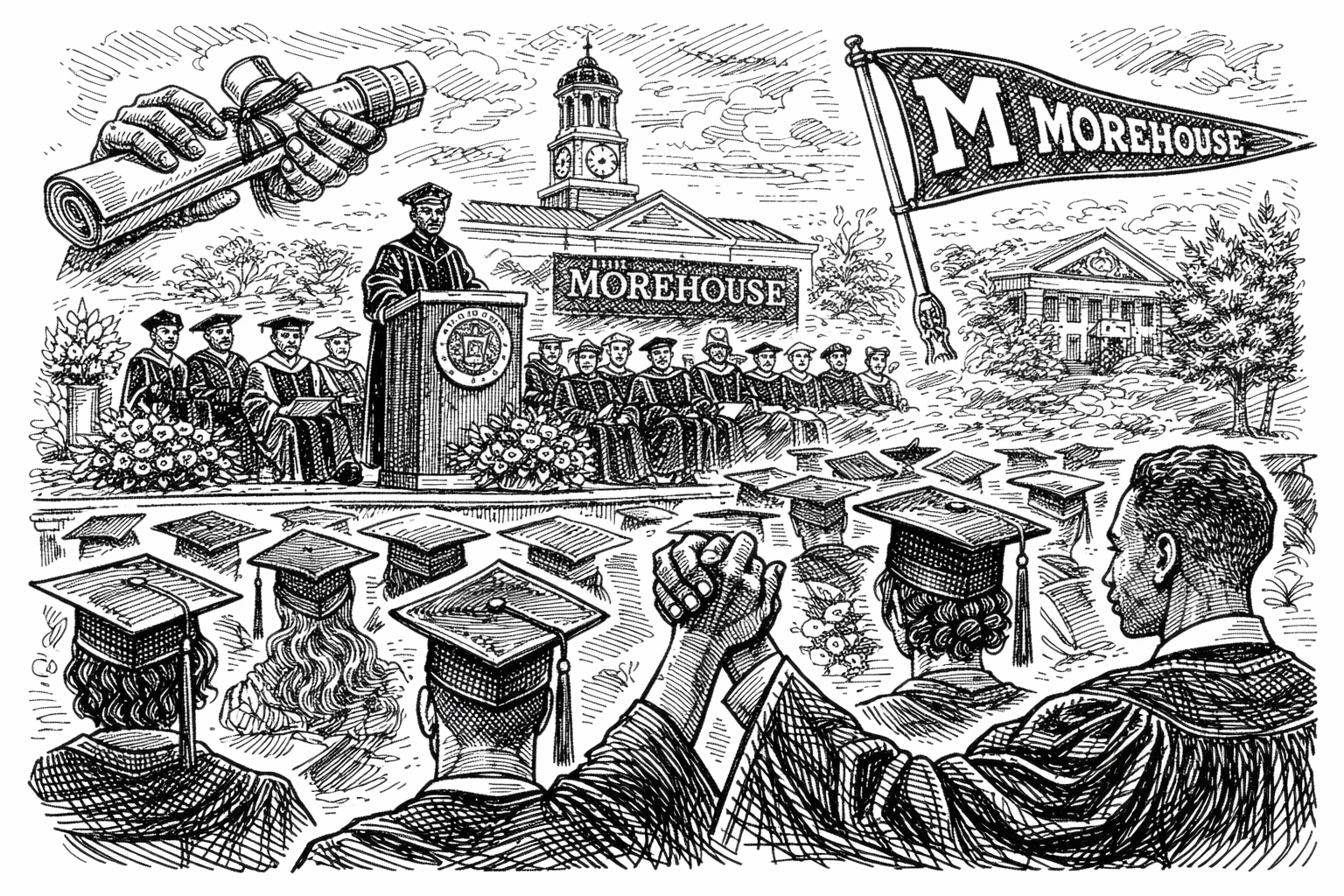
The unveiling of three portraits inside the Martin Luther King Jr. International Chapel at Morehouse College has not remained confined to campus conversation. It has moved quickly into a broader public debate, where questions about identity, masculinity, and institutional purpose are being reframed as concern.
On March 19, 2026, during the Bayard Rustin Crown Forum, Morehouse permanently installed oil portraits of Bishop O.C. Allen, Rev. Dr. Brandon Crowley, and Father Darrell Tiller — three openly Black gay clergy leaders — alongside existing images of MLK, Gandhi, and Abraham Lincoln. The scale of that gesture matters. This was not a ceremonial nod. It was an institutional declaration about whose legacy belongs on those walls.
Commentary circulating online, including from conservative figures like Vince Everett Ellison — whose platform has made Black cultural conservatism a recurring beat — frames Morehouse’s evolving posture toward LGBTQ+ inclusion as a threat to Black boys. The language follows a recognizable pattern: affirming queer identities within a historically Black men’s institution risks producing something other than a man. That framing is not new. Its persistence, however, reveals something deeper than disagreement. It reflects an ongoing contest over who holds the authority to define Black masculinity — and whether that definition is fixed or adaptive.
Bishop Allen addressed that question directly. In a statement following the unveiling, he described the moment as “quiet resistance and loud affirmation,” saying that faith, identity, and truth can coexist, and that Black queer people belong “not just in the margins of history, but on its walls.” That framing is significant. It does not position inclusion as a departure from Morehouse’s legacy. It positions it as a fulfillment of it.
What’s happening at Morehouse is not occurring in isolation. The institution has been building structural commitments for years. It began admitting trans men in 2020. In 2022, it launched the Black Men’s Research Institute, funded by a four-year grant from the Andrew W. Mellon Foundation, with an explicit mandate to study “diverse Black masculinities” across race, class, religion, gender, and sexuality — and to strengthen scholarship in areas related to LGBTQ history and culture. These are not symbolic gestures. They alter what the institution researches, teaches, and ultimately produces.
The reaction from some corners is less about policy and more about meaning. For certain Black parents and observers, Morehouse represents one of the last institutional spaces explicitly designed to cultivate a particular version of Black manhood — one organized around discipline, presentation, and a clearly legible social identity. Any expansion of that definition reads not as inclusion, but as dilution.
Students on campus have been answering that question for some time. Da’Marion Miller, a Morehouse senior and president of the campus LGBTQ+ organization Adodi, put the tension plainly: the college’s “Five Wells” — well-dressed, well-read, well-spoken, well-traveled, well-rounded — have historically applied only to students “who have conservative views on sexuality.” That is not a fringe observation. It names the architecture of the standard itself. Freshman LaQuinton Gaines framed it differently but arrived at the same place: “We don’t want to put masculinity in a box. The Morehouse man in 2023 is gay, straight, nonbinary, and maybe transitioning.”
That tension — between the Morehouse man as a preserved ideal and the Morehouse man as a living, contested identity — is what the portrait ceremony made visible. Two queer figures, Bayard Rustin and Pauli Murray, were already represented on those chapel walls before March 19. Allen, Crowley, and Tiller did not break into a straight institution. They extended a lineage that was already there, already honored, and still being debated.
What the current moment makes clear is that institutional change does not move quietly. It forces a renegotiation of meaning — often in public, often in conflict, and often at the expense of those who assumed the definition was settled. The portraits inside the chapel are one expression of that shift. The reaction outside is another.
Together, they reveal that the real story is not just about representation. It is about control over definition — and the particular discomfort that surfaces when institutions stop asking permission to expand it.