
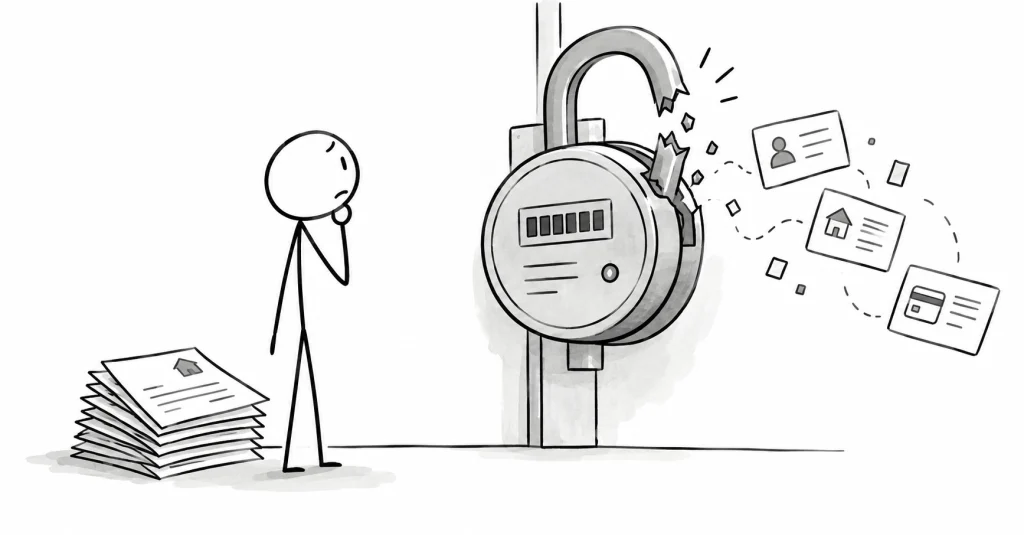
Georgia Power and Alabama Power account information was accessed through an online portal, exposing the personal-data obligations behind essential household services.
Roughly 400,000 utility customer accounts were affected by unauthorized access through Southern Company’s online customer portal, according to SecurityWeek’s October 7 reporting. Approximately 300,000 accounts belonged to Georgia Power customers and 100,000 to Alabama Power customers. Southern Company’s public notice also identifies Mississippi Power as affected, without supplying a separate customer count. The disclosed incident concerns account information. It does not establish a compromise of electricity operations. For households, the immediate change is practical: an account used to manage an essential bill now requires attention to a breach notification and possible misuse of personal details.
The Information Was Limited. It Was Still Personal.
The company’s customer incident notice says information accessed could include names, mailing addresses, phone numbers, email addresses, the last four digits of Social Security numbers and basic account details. It says bank account numbers, payment card numbers and driver’s license numbers were not accessed. Those boundaries help define the exposure and should remain clear in any coverage. They do not make the disclosed contact information inconsequential. A customer still needs to understand which details were involved in their own account, what the company has confirmed, and which questions remain unresolved by the investigation.
According to Atlanta News First’s October 5 report, Georgia Power said it took steps to stop the activity and notified law enforcement. The public notice says affected customers are receiving letters or emails and are being offered one year of free credit monitoring. SecurityWeek reported that the company had not disclosed when the intrusion occurred or how the attacker accessed the portal. That leaves a gap between knowing an incident happened and understanding its chronology. A clear timeline would help customers assess how long their information may have been exposed and when the company’s response began.
The Account Is Part of the Service
SSC’s analysis is that a utility’s digital account should be treated as part of the relationship customers depend on, alongside billing and service reliability. A household may use it to check a balance, update contact information or handle routine administration. The convenience comes with a requirement to entrust information to the provider. When that information is accessed without authorization, the customer must spend time understanding the notice and checking the account. The company controls the system and its investigation; the household controls only its response. That difference in control makes the quality of the company’s explanation especially consequential.
The incident also puts the credibility of future communications under pressure. If a customer receives an unexpected message about a utility account, the question becomes whether it is genuine. Southern Company’s own notice advises customers to confirm unsolicited contact through official channels and cautions against people pretending to represent Georgia Power. That advice is useful, but it adds another task to a relationship that was supposed to simplify bill management. The analytical concern is the cumulative burden: customers must assess messages, retain notices and monitor accounts while still managing the ordinary costs of keeping a household running.
Recovery Requires a Clearer Account of What Happened
Credit monitoring provides a defined service for a defined period, but the customer communication also needs to explain the limits of that response. The public notice does not promise that monitoring will prevent every possible misuse of contact information, and coverage should not imply that it does. Customers can use the company’s official website or the number on their bill to verify a notice and follow instructions specific to their account. The same principle applies to requests for payment: a message should be independently checked rather than trusted because it contains a familiar name, address or account-related detail.
The next stage of this story should focus on what the investigation establishes and how clearly those findings reach customers. Important disclosures include the incident’s timing, the access method, the final scope and the steps taken to address the weakness. The utility’s responsibility extends through that explanation, because households cannot independently reconstruct what occurred inside the provider’s systems. For SSC readers, the consequence is a familiar imbalance in digital life: institutions collect information to make services easier, then customers must help manage the fallout when that information is exposed. A complete response should reduce that burden through clear facts and accessible support.