
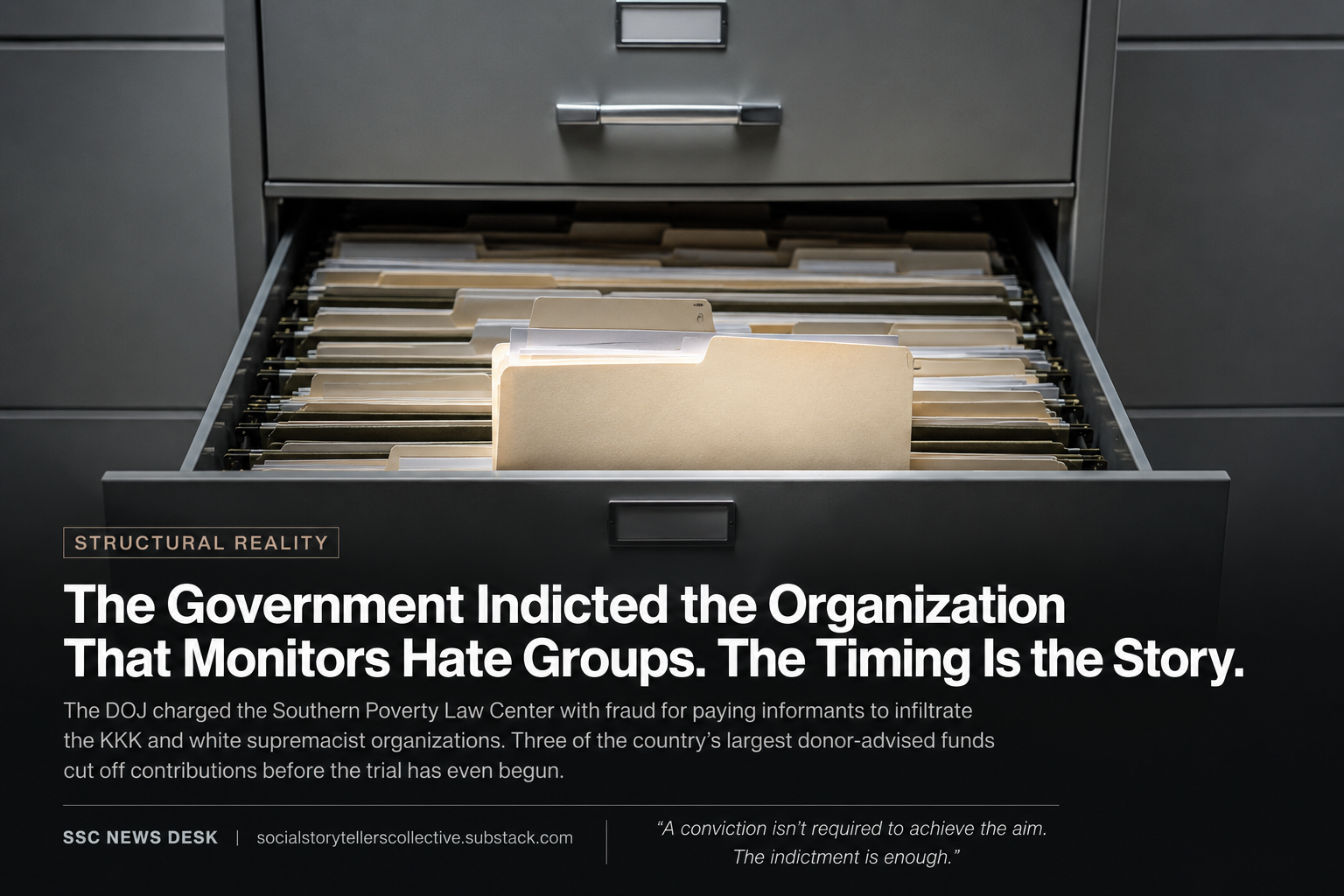
Three of the country’s largest donor-advised funds cut off contributions before the trial has even begun.
On April 21, 2026, the Department of Justice indicted the Southern Poverty Law Center — a 55-year-old civil rights organization founded in Montgomery, Alabama that has spent decades monitoring, exposing, and litigating against white supremacist groups, hate organizations, and domestic extremists — on 11 counts of wire fraud, false statements to a federally insured bank, and conspiracy to commit money laundering. Acting Attorney General Todd Blanche stood at the podium with FBI Director Kash Patel to announce the charges.
The allegation: between 2014 and 2023, the SPLC secretly paid more than $3 million in donor funds to individuals associated with violent extremist groups including the Ku Klux Klan, Aryan Nations, and the National Socialist Party of America — to infiltrate and monitor those organizations — without disclosing to donors that their money was being used this way. The DOJ framed it as fraud. The SPLC framed it as exactly what civil rights organizations have done since the 1980s to keep informants alive inside dangerous networks. “Taking on violent hate and extremist groups is among the most dangerous work there is,” SPLC interim CEO Bryan Fair said in a statement. “The actions by the DOJ will not shake our resolve.”
The legal argument the government is making requires accepting that paying confidential informants to infiltrate the KKK— a practice the SPLC began in the 1980s, in the years immediately following church bombings, state-sponsored violence against civil rights demonstrators, and the murders of activists — constitutes defrauding donors who gave money to fight extremism. The 14-page indictment offers few details on how the payments actually furthered the violent interests of the groups being infiltrated, or whether any donor has come forward to say they felt deceived. Legal experts reviewing the indictment have flagged that omission as a significant evidentiary gap that could spell trouble for the prosecution at trial.
The SPLC says its informant program saved lives. The FBI used that same informant intelligence for decades — and only ended its formal relationship with the SPLC last year, when Director Patel announced that the organization had become, in his words, “a partisan smear machine.” That relationship lasted through administrations of both parties for roughly 40 years. It ended when the current administration decided it had.
What happened before the trial even began is the part worth reading most carefully. Within days of the indictment, three of the largest donor-advised fund administrators in the country — Fidelity, Vanguard, and Schwab — cut off certain customer donations to the SPLC, citing the ongoing government investigation as the reason. No conviction. No verdict. No finding of guilt. Just an indictment from a DOJ run by a man who was the president’s personal defense attorney — and three major financial institutions moved to restrict the organization’s funding pipeline immediately.
That is the mechanism the ACLU is naming directly in its response to the case: a conviction is not required for the administration to achieve its aims. Lawyers are expensive. Time is precious. An accusation — even a legally thin one — can endanger an organization’s survival before a single witness takes the stand. The chilling effect on donors, on staff, on partner organizations watching what happens to the SPLC is the real product of the indictment. The trial is almost beside the point.
The SPLC indictment does not exist in isolation. It lands alongside the DOJ’s prosecution of peaceful ICE protest observers, the attempted deportation of Mahmoud Khalil for protected speech, the FCC’s threats against media companies for on-air content, the termination of research grants over prohibited word lists, and the punishment of law firms for representing clients the administration opposes. The convergence of enforcement agencies into roles beyond their original mandates is already visible in everyday life — ICE agents standing at TSA checkpoints is the same structural move, agencies deployed interchangeably until the arrangement stops feeling temporary. The ACLU — which won a 9-0 Supreme Court ruling just two years ago blocking New York State from abusing its power to punish the NRA — says it has never seen this kind of systematic use of government power to punish dissent in 106 years of operation. That comparison is not rhetorical. It is institutional memory.
The Southern Poverty Law Center has been in the Trump administration’s crosshairs specifically because of its role in documenting and naming right-wing extremism — including labeling organizations like Turning Point USA as part of the hard right, a designation that drew fierce conservative criticism for years. The indictment arrives in that context. Whether or not the legal case ultimately holds, the message it sends to every civil rights organization, every watchdog group, every nonprofit that has ever put a conservative organization on a monitoring list is already being received. The SPLC is the example. The audience for that example is everyone else.
Social Storytellers Collective | Structural Reality Read the full End of Day Closing Note — drops at 3PM CDT weekdays.