
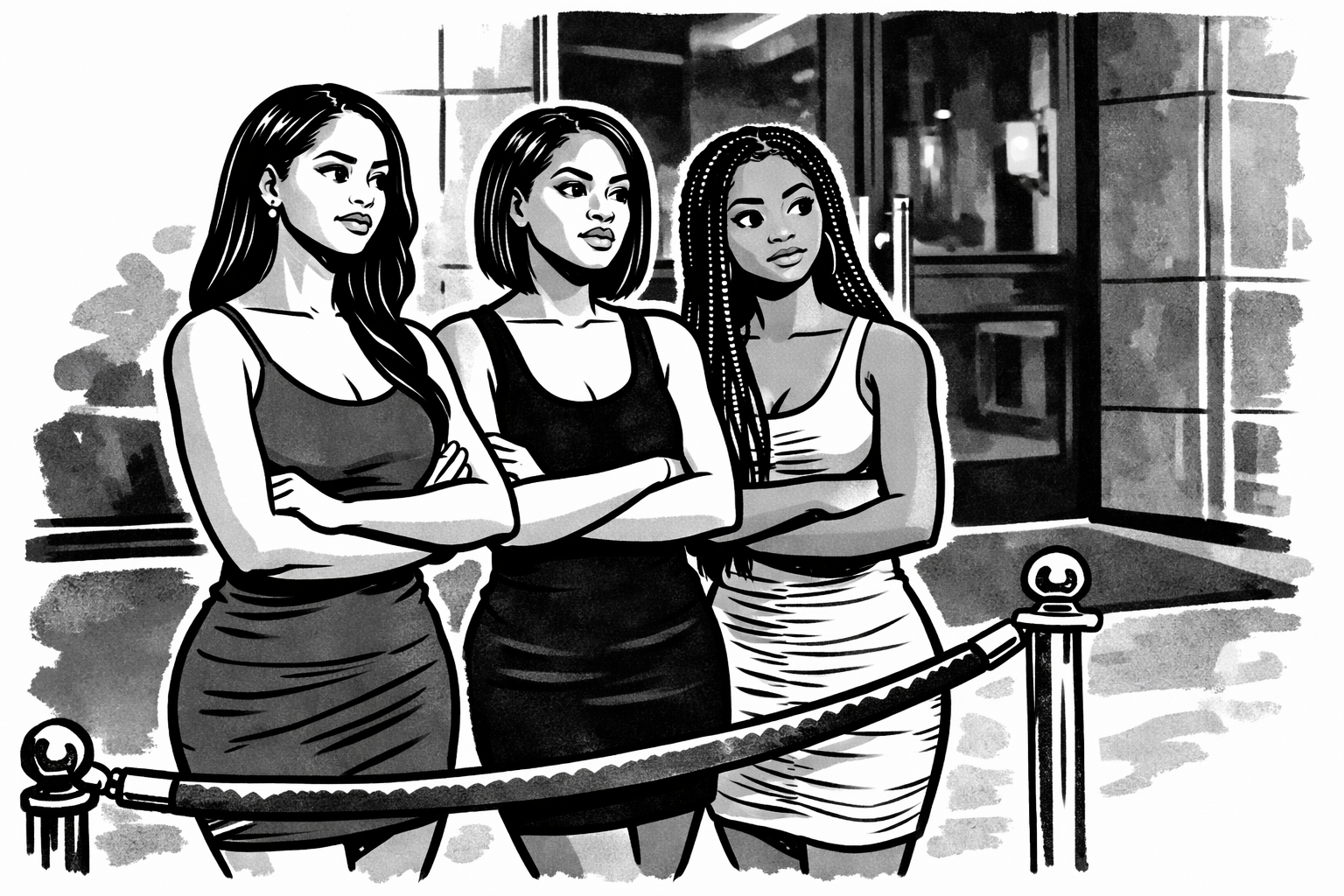
A group of Black women say their birthday dinner reservation at a Houston restaurant was denied at the door over a dress code violation, despite other non-Black patrons inside wearing comparable outfits. Video from the incident shows the women being told their dresses were “too short,” while footage from inside the restaurant appears to show other guests in similar attire. The group left and went elsewhere. The moment spread online and turned a local dispute into a broader conversation.
What followed is where the story expands. The response has not been unified. Some viewers pointed to selective enforcement, arguing that dress codes become discriminatory when applied unevenly. Others focused on the outfits themselves, suggesting the women simply didn’t meet the standard. And within the same comment threads, the conversation shifted — from policy to personal judgment, from the rule to the people it was applied to. Appearance gets critiqued. Blame gets assigned within the group. The question of whether the incident warranted concern gets raised at all. The dress code becomes secondary. The scrutiny moves to the individuals.
That shift is familiar. When enforcement is inconsistent, the conversation tends to move away from the system and toward the people it affected. Rather than resolving whether the rule was applied fairly, the focus becomes whether the individuals were appropriate enough to deserve access in the first place. Once that happens, the original question — was the standard applied equally — becomes harder to answer, because the standard itself is no longer what’s being evaluated.
That’s the mechanism worth naming. Selective enforcement doesn’t just produce unequal outcomes in the moment. It generates the conditions for a second round of scrutiny, aimed at the people who raised the concern rather than the institution that created it. The story stops being about the door. It becomes about who was standing in front of it — and whether they had the standing to object. As explored in The Silent Work, that second game — the one where the rules shift depending on who’s being watched — rarely announces itself. It simply runs alongside the first one, until you’re the one it’s being run on.
Why It Matters
Dress codes have long functioned as a legal and socially acceptable mechanism for gatekeeping. When applied consistently, they are policy. When applied selectively, they are something else. What this incident makes visible — and what the online response confirms — is that the burden of proof rarely falls on the institution. It falls on the people who were turned away. SSC has reported on how access in physical spaces is increasingly tiered by design — and how that tiering tends to be felt most acutely by the people it was never meant to include. A restaurant door is a different kind of threshold than a gym membership, but the mechanism is the same: the standard exists on paper, and the discretion lives everywhere else.