
Cardi B filed a motion in federal bankruptcy court on April 10 asking a judge to hold Tasha K in contempt, fine her for each future violation of their agreement, and potentially dismiss her bankruptcy case entirely. The motion lists at least 25 documented instances where Tasha K, born Latasha Transrina Kebe, posted content about Cardi B or her family after agreeing not to. A hearing before Judge Scott M. Grossman has been scheduled for May 6 in Fort Lauderdale.
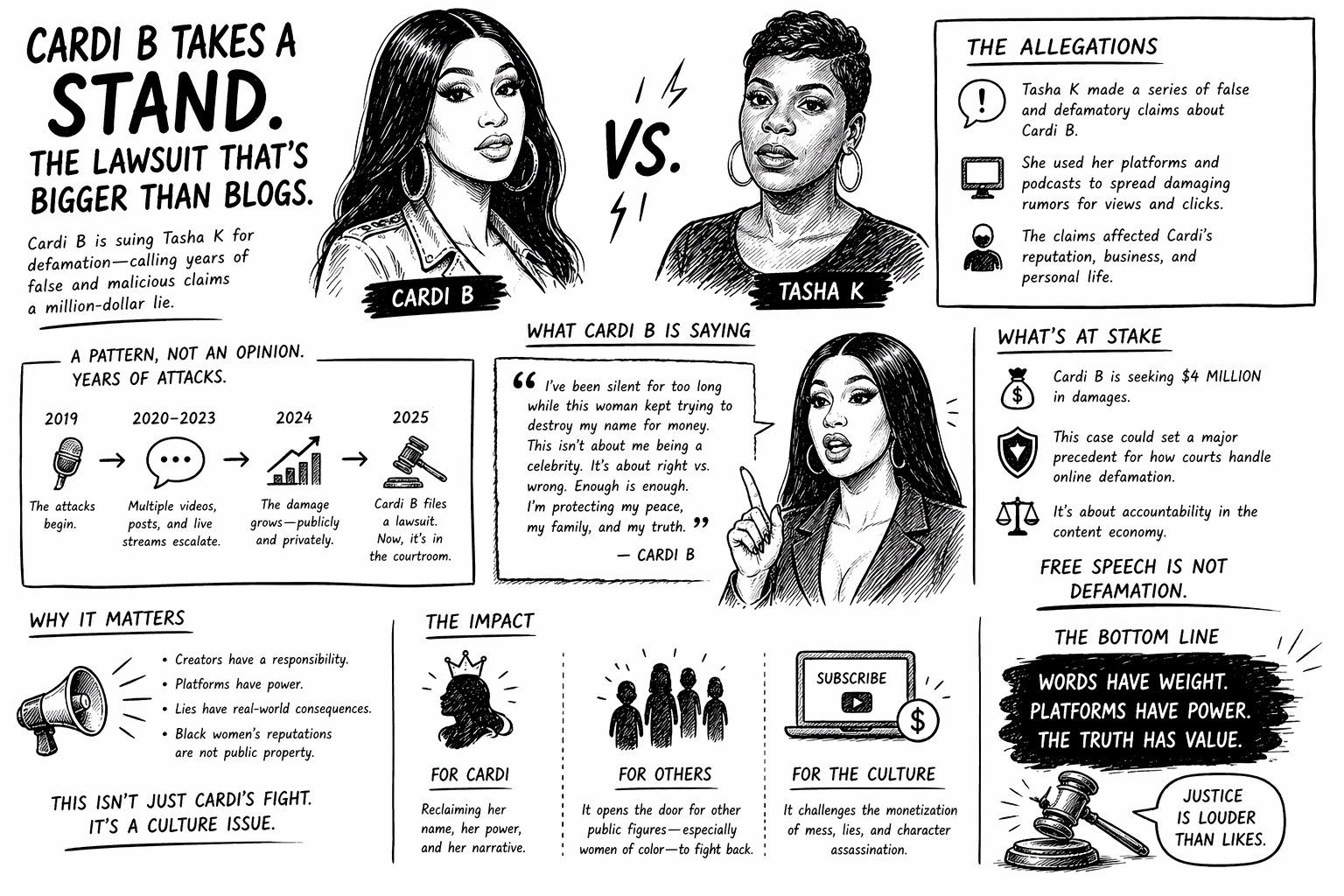
The backstory matters. A federal jury in Georgia ruled against Kebe in 2022, finding she had made false and defamatory statements about Almánzar involving drug use, STDs, and prostitution, and ordered her to pay roughly $4 million in damages. Kebe filed for Chapter 11 bankruptcy in 2023, claiming she still owed $3.4 million and had less than $60,000 in assets. The bankruptcy court confirmed a repayment plan in March 2025 requiring Kebe to pay approximately $1.17 million over five years, with the remainder of the judgment surviving the plan. As part of the deal — and in exchange for Almánzar agreeing to delay full collection — Kebe accepted a non-disparagement clause barring her from making any public statement about Almánzar, her family, or Offset, whether she names them directly or not.
What happened next is the story the new motion is telling. Kebe started violating the agreement almost immediately. In July 2025, she posted a YouTube livestream referencing Almánzar’s relationship with Stefon Diggs. In August, she posted on X inviting followers to guess who she was describing without naming anyone — the comments made clear the intended subject was Cardi B. In February 2026, she posted about Offset across five platforms simultaneously: Instagram, TikTok, Facebook, Threads, and X.
The violations escalated. Kebe appeared on The Morning Hustle, a nationally syndicated radio show, and discussed Offset extensively — describing her contacts with people in his circle, referencing a cease-and-desist letter he had previously sent her, and telling the audience she lost the defamation case because she was broke, not because of the evidence against her. She also publicly thanked Nicki Minaj for donating approximately $3,000 to a GoFundMe she launched to raise $3.5 million toward the judgment — a move the filing frames as a deliberate invocation of the Minaj-Cardi rivalry in front of a live audience of tens of thousands. The most recent violations listed are sixteen posts Kebe published between April 6 and April 10 — all tied to a shooting involving Offset outside the Seminole Hard Rock Hotel and Casino in Hollywood, Florida. The last of those posts went up less than an hour before the motion was filed. Rolling Stone
Cardi’s attorneys are asking the court to impose what they describe as “economically painful” sanctions — not just attorneys’ fees for the monitoring they have done since March 2025, but a financial penalty attached to every future violation at the moment it is published, not after it gets taken down. The filing states that Kebe “still believes that she is above the law, consequences, and is invulnerable” — and adds the detail that makes the conduct particularly difficult to defend: Kebe has openly admitted in public broadcasts that she intends to resume discussing Almánzar once her debt is paid off. That admission is not a legal technicality. It is a statement of intent made on the record.
Kebe’s legal team has framed the dispute differently. Her attorneys argue that the non-disparagement clause amounts to an overarching gag order that imposes unreasonable restrictions on her First Amendment rights and prevents her from earning a living as a social media creator, calling the sanctions motion an attempt to “silence debtor by ending her bankruptcy case and her career.” That argument has not yet been tested before Judge Grossman.
The First Amendment framing is worth examining on its own terms — and on SSC’s terms. The Cardi B case sits at the center of a set of questions this publication has been tracking across multiple beats: what accountability looks like when someone’s audience is their platform and their platform is their income, what happens when the legal system tries to impose enforceable limits on what can be implied rather than just what can be stated directly, and whether financial penalties at the scale a social media creator operates can actually function as deterrence or simply become another line item in the cost of doing business online.
Those questions do not have clean answers. The non-disparagement clause in a bankruptcy agreement is a contractual obligation, not a prior restraint — Kebe agreed to it in exchange for a structured repayment arrangement that benefits her. That is a meaningful legal distinction. But it is also true that a clause requiring a person to never reference someone indirectly, through coded language her audience clearly understands, is testing the outer limits of what courts can practically enforce in a social media environment designed to reward exactly that kind of oblique, plausibly deniable commentary.
The May 6 hearing is ten minutes on the court’s calendar. The questions it raises will take much longer than that to resolve.
Culture in Motion | The Critic’s Desk | News Desk