
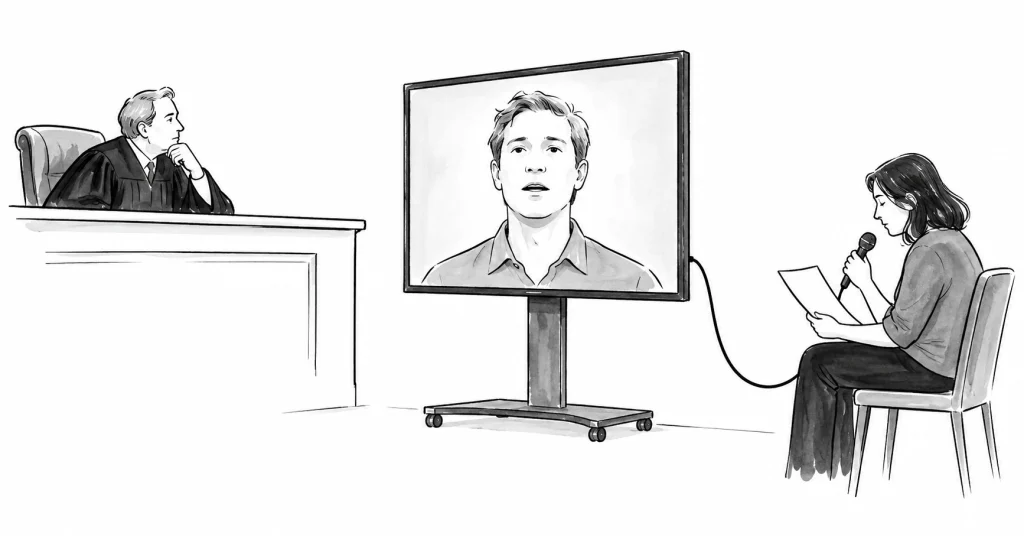
Christopher Pelkey’s family used artificial intelligence to recreate him delivering a victim-impact statement after his death. An Arizona appeals court has now drawn an early legal boundary around something AI makes increasingly possible: putting words into the mouths of people who can no longer confirm them.
When Gabriel Paul Horcasitas was sentenced for killing Christopher Pelkey, the court heard from someone who could not actually be there: Pelkey himself. His family used artificial intelligence to create a video in which a digital recreation of the 37-year-old appeared to address Horcasitas directly, offering a message of forgiveness after the 2021 road-rage shooting that ended his life. The sentencing judge responded strongly to it, saying, “I loved that AI,” and later sentenced Horcasitas to 10½ years in prison. Now the Arizona Court of Appeals has vacated that sentence and ordered Horcasitas to be resentenced. His manslaughter conviction remains intact.
The Family Could Speak for Pelkey. AI Made It Look Like Pelkey Was Speaking.
Victim-impact statements routinely give families an opportunity to describe a killing’s consequences and tell a court about the person they lost. Pelkey’s sister, Stacey Wales, went further. Using real footage and AI, the family created a version of Pelkey that appeared to speak in the first person. The simulation told Horcasitas that it was unfortunate they had met under those circumstances and suggested that, in another life, the two men might have been friends. It also conveyed the forgiveness that Pelkey’s family believed reflected his character.
The appellate court did not conclude that Wales was prohibited from expressing those beliefs. It focused instead on who appeared to be expressing them. The judges wrote that the video did not “reflect actual events” and represented what Pelkey’s sister imagined he would have said. Presenting those sentiments through a digital recreation of Pelkey, the court found, “erases the interpretive distance” between a family member describing the victim and an apparent statement from the victim himself. The court went further: “No disclaimer could cure that error.”
The Judge’s Reaction Became Part of the Problem
The case provides an unusually clear example of why synthetic media can become more than a presentation tool inside a courtroom. The sentencing judge did not treat the video simply as a technological illustration of the family’s testimony. He said he “loved” the AI presentation, described its message as “genuine” and referred to Pelkey’s apparent forgiveness as consistent with what seemed to be in the victim’s “heart.” The appeals court concluded there was “no question” the video played a role in the sentencing decision and determined that considering it made the proceeding fundamentally unfair.
That creates a boundary with implications far beyond one Arizona case. A relative saying, I believe he would have forgiven the defendant, clearly identifies the statement as the relative’s interpretation. A realistic simulation saying I forgive you removes that intermediary. The information may originate with the same family, but its apparent source has changed. Facial movement, voice, eye contact and first-person language give an interpretation the authority of testimony from someone who never actually gave it.
Courts Now Have to Decide What a Synthetic Person Is
The ruling arrives as AI systems make recreating a person’s appearance and voice increasingly accessible. That creates questions the legal system has barely begun to answer. A deceased person’s photographs, recordings and writings can provide enough material to construct new speech that sounds consistent with that person’s life without ever having been spoken by them. The resulting simulation can be emotionally persuasive precisely because audiences recognize the person rather than the family member, lawyer or software system making decisions about what the recreation should say.
The Arizona decision does not establish a nationwide prohibition on AI-generated representations of deceased victims. Nor does it resolve every possible use of synthetic media in court. Its narrower conclusion may prove more consequential: a court cannot simply treat an AI recreation as another format for information when the technology changes who appears to be delivering that information. Reuters reported that the decision represents a significant confrontation between rapidly developing generative-AI capabilities and longstanding sentencing protections. Reuters’ coverage of the ruling
The Technology Didn’t Just Recreate Pelkey. It Gave Him New Words.
Deepfake debates have often centered on deception: whether viewers can tell that an image, voice or video is artificial. The Pelkey case presents a harder problem because there was no secret that AI had been used. The sentencing judge knew he was watching a simulation. The legal problem remained because the emotional and rhetorical force of seeing the victim apparently address his killer could not be separated from the words the family had constructed for him.
That moves the debate from whether synthetic media should be labeled to whether some representations should exist in particular settings at all. Pelkey’s family had every right to describe the man they knew, his character and the forgiveness they believed he would have extended. What the appeals court rejected was technology collapsing the distance between “this is what we believe Christopher would say” and “this is Christopher saying it.”
Horcasitas will return to court for resentencing. But the more durable consequence may be the boundary Arizona’s appellate judges have started to draw. AI can reconstruct a face, reproduce a voice and generate words consistent with what someone might have believed. None of those capabilities establishes that the person actually said them. As synthetic versions of the dead become easier to create, courts—and eventually institutions far outside them—will have to decide when preserving someone’s likeness becomes something fundamentally different: speaking in their name.