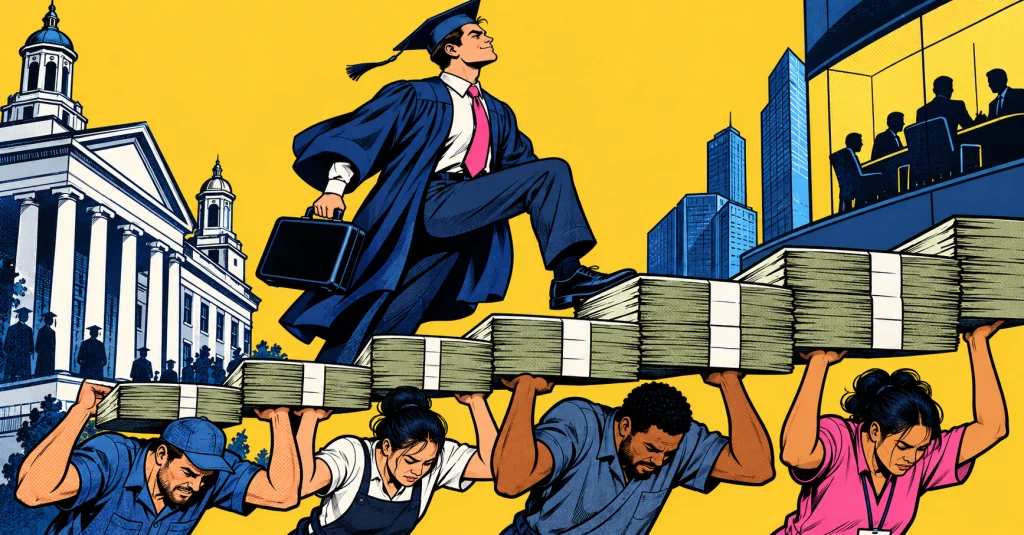
In a New York Times op-ed, Cambridge professor Chris Marquis argues that MBA programs train managers to put shareholders first and can’t be fixed. His critics say he goes too far. The real question is who pays for the way business leaders are taught to think.
It’s not often that someone argues for shutting down the industry that employs him. But in an op-ed published this week in The New York Times, Chris Marquis, a business school professor at the University of Cambridge who has also taught at Harvard and Cornell, argued that business schools as we know them shouldn’t exist. Law and medical schools, he wrote, train professionals to serve a broader social purpose. MBA programs, in his view, mostly mint highly paid managers trained to maximize profit, and the problem runs too deep to fix.
It’s a provocative argument, and it’s landing at an awkward moment for the degree. According to Bloomberg’s analysis, the financial return on many top MBA programs, measured by tuition against the pay bump graduates can expect, has declined over the past year. If the MBA is getting more expensive to justify for the people who earn it, Marquis is asking a harder question: what does it cost everyone else?
The Evidence Behind the Argument
The strongest part of Marquis’s case rests on research by Nobel-winning economist Daron Acemoglu. In a 2022 study, “Eclipse of Rent-Sharing,” Acemoglu and co-authors Alex He and Daniel le Maire found that when companies in the U.S. and Denmark came under managers with business degrees, wages fell and workers’ share of the company’s income declined. The firms didn’t grow faster, invest more or hire more to make up for it. In other words, business-educated managers didn’t make the pie bigger. They gave a larger slice to shareholders and a smaller one to the people doing the work.
That finding fits a pattern SSC has tracked for months. Labor’s share of income keeps falling even as the economy grows, and productivity keeps rising while workers ask what they’re getting back. Business schools didn’t create those trends on their own. But if the institutions training the people who run America’s companies teach them to treat wages as a cost to minimize rather than an investment, the classroom becomes part of the story.
Marquis also takes aim at the case study, the signature teaching tool of programs like Harvard’s. He argues case studies oversimplify messy business realities, leave out unflattering facts about the companies they feature and promote trendy management fads over evidence. His proposed replacement is multidisciplinary business programs that weigh decisions against “questions of history, democracy and ecological limits,” not just quarterly returns.
The Pushback
Not everyone is convinced the cure fits the diagnosis. Nicolai J. Foss, a professor at Copenhagen Business School, agreed with many of Marquis’s criticisms but questioned whether managers can realistically be taught to prioritize “social benefit,” a goal that’s hard to define and even harder to measure. He also challenged the idea that seeking profit is separate from creating value for society, since companies that make products people want, employ workers and pay taxes contribute to the public good by doing business.
That objection matters. Doctors and lawyers have clear professional duties to patients and clients, enforced by licensing boards and ethics codes. Business has no equivalent, and it’s not obvious who would decide what a manager owes society or how anyone would hold them to it. Shutting down business schools wouldn’t eliminate the demand for managers. It would just change where they learn the job, and possibly leave them with even less training on ethics and accountability than they get now.
Who the MBA Has Served
There’s another dimension the debate tends to skip. For many first-generation professionals and Black Americans, the MBA has been one of the few reliable doors into corporate leadership, offering a network, a credential and a path into rooms that were long closed to them. Abolishing business schools without a replacement could make that path narrower for the people who’ve had the hardest time getting through it, even as the degree grows more expensive and higher education itself is changing fast. Federal Pell Grants are starting to pay for eight-week credentials, and Harvard professors now have AI clones teaching their students.
That doesn’t mean business schools should be left alone. It means the most useful version of Marquis’s argument may be reform rather than abolition: teaching future executives that wages, worker retention and community impact belong on the balance sheet, not just in the ethics elective. Several schools already offer courses on stakeholder capitalism and sustainability, but critics say those offerings often sit at the edges of a curriculum still built around shareholder returns.
The Question for Everyone Else
Whether or not business schools survive in their current form, the debate raises a question that reaches well beyond campus: what should the people running companies be trained to value? For decades, the answer taught in many classrooms was shareholder value, full stop. The evidence that this approach has shifted money away from workers without making companies grow faster is hard to ignore, and so is the fact that the degree’s payoff is shrinking for the students themselves. If business schools can’t make the case that they produce leaders who create value for workers as well as investors, Marquis won’t be the last professor to ask whether they should exist at all.
Reporting sources: The New York Times, Nicolai J. Foss, Bloomberg, Daron Acemoglu, Alex He and Daniel le Maire, “Eclipse of Rent-Sharing” (2022), Morning Brew