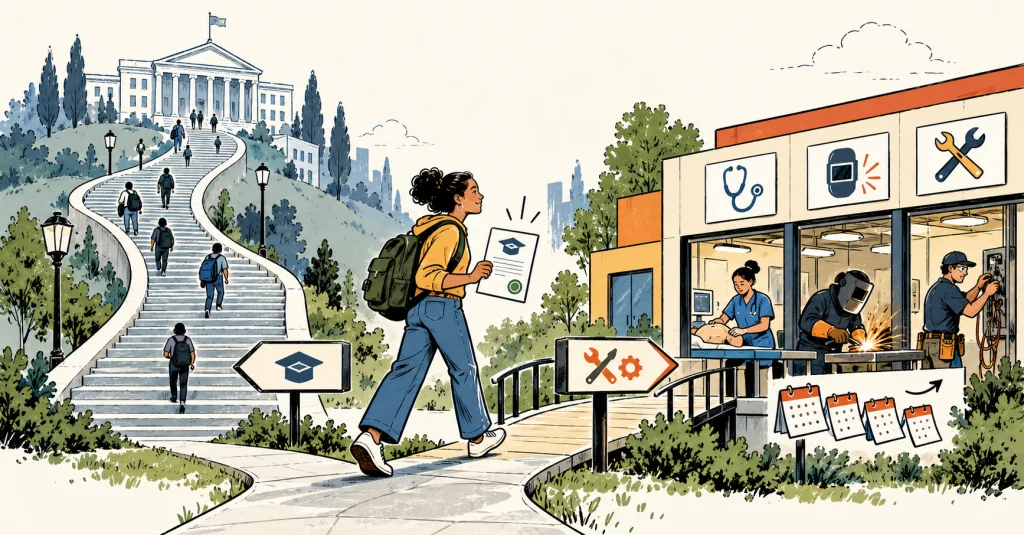
Workforce Pell is beginning to move from legislation into actual classrooms, giving low-income students access to federal aid for short-term job training that historically sat outside the traditional financial-aid system.
For decades, the Pell Grant has been one of the clearest symbols of the traditional college model: federal aid designed to help low-income students pay for higher education. That model is now expanding into something much shorter. Inside Higher Ed reports that Ivy Tech Community College in Indiana will begin using Workforce Pell Grants later this month for an eight-week clinical medical assistant program, making it one of the first colleges in the country to use federal Pell dollars for certain short-term career programs. Congress authorized the change in 2025, allowing Pell funding to flow to programs lasting roughly eight to 15 weeks rather than requiring students to enroll in longer academic programs. As of October 1, the U.S. Education Department had approved 21 programs across six states, including Indiana, Iowa, Florida, Nebraska, North Carolina and Texas.
Financial Aid Is Following a Different Kind of Student
The policy change recognizes something colleges and employers have been dealing with for years: not every student seeking better wages or a new career wants, needs or can afford to spend years completing a degree. Short-term credentials in fields such as nursing assistance, emergency medical services, welding and electrical work have become a growing part of the workforce pipeline, but students entering those programs have historically had far fewer federal financial-aid options. Workforce Pell begins to close that gap by allowing qualified students to use the same need-based federal aid that has long supported traditional college enrollment. At Forsyth Technical Community College in North Carolina, six programs have already been approved, including welding, certified nursing assistant training, emergency medical technician training and electrical line work. College leaders there are now trying to make sure prospective students understand that FAFSA is no longer only for people enrolling in conventional degree programs.
The change also exposes how deeply college infrastructure was built around semester-based education. Ivy Tech’s existing software cannot yet automatically process financial aid for an eight-week program, according to Inside Higher Ed. Financial-aid staff will initially have to identify eligible students manually, calculate awards based on financial need and program length, and then personally disburse the money. Ivy Tech hopes to automate the process as participation grows, but the early rollout shows that changing eligibility rules is only one part of changing the system. The machinery behind federal aid was built for credit hours, academic terms and traditional enrollment cycles. Workforce Pell asks that machinery to serve students whose training may begin and end before a conventional semester is even over.
From Degree Access to Skills Access
Iowa Central Community College had an easier transition because its systems already handled financial aid based on clock hours through an existing commercial-driver’s-license program. Its 14-week emergency medical technician program became the first Workforce Pell program approved nationally, according to Inside Higher Ed. That difference between institutions illustrates how uneven the rollout may be. Colleges already operating short-term workforce programs with compatible financial systems can move faster, while others will have to redesign internal processes before the new federal money can reach students. The federal government has expanded eligibility, but implementation still depends on state approval, institutional software, financial-aid staffing and student awareness.
The policy also changes what federal support for higher education is supposed to accomplish. Pell Grants were historically tied closely to the idea of college access. Workforce Pell moves part of that investment toward employment access, where the value of the credential is judged more directly by whether it leads to work and wages. That does not eliminate the role of traditional degrees, nor does every short-term credential qualify. But it creates a federally supported path for students who are measuring education in weeks rather than years.
For colleges, the challenge now moves from getting programs approved to getting students through the door. Forsyth Tech president Janet Spriggs told Inside Higher Ed that the priority is making sure the opportunity does not become a secret. That may prove as important as the policy itself. A new benefit changes very little if the students it was designed to help do not know it exists. Workforce Pell is therefore not simply a financial-aid expansion. It is one of the clearest signs yet that federal higher-education policy is beginning to treat short-term workforce training as part of the same public system that once revolved almost entirely around the college degree.