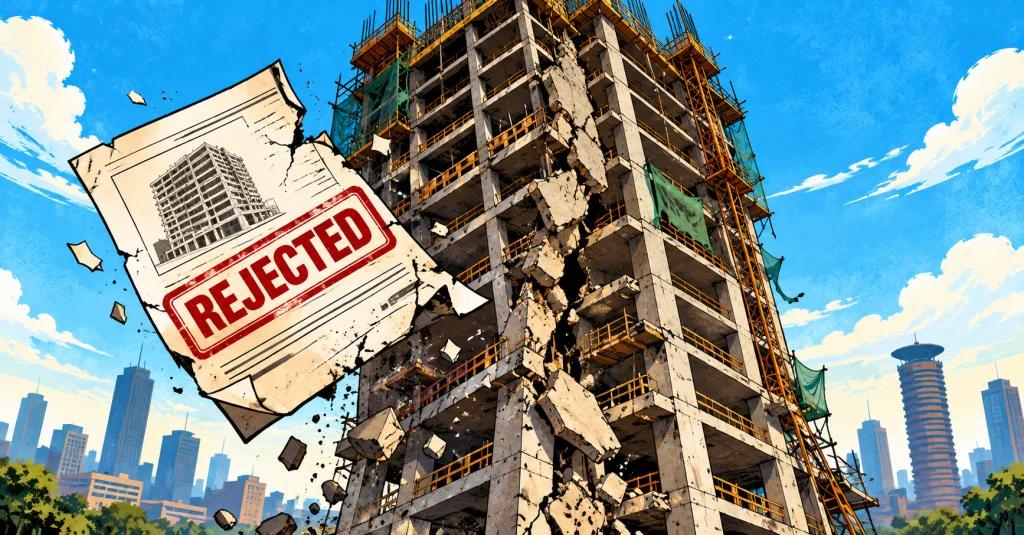
An 18-story building collapsed in Kenya’s capital after authorities reportedly rejected its construction plans. Now prosecutors are examining whether failures involving developers, building inspectors and government officials allowed a dangerous project to continue.
On Friday afternoon, a multistory building under construction in Nairobi’s Eastleigh neighborhood came crashing down, sending concrete and debris into a busy commercial district. Rescue workers searched the wreckage for people believed to be trapped beneath it, while families waited for news of missing relatives. By Monday, four people had been rescued alive, but the search was continuing. The collapse of the 18-story structure has become more than a construction disaster. It has raised serious questions about how a building of that size could reach such an advanced stage of development while its regulatory status remained in dispute.
Kenya’s Director of Public Prosecutions has now ordered the Directorate of Criminal Investigations to examine the circumstances surrounding the collapse, including possible failures by county officials, developers, contractors and construction professionals. As Mary Gathu reported for Citizen Digital on October 26, prosecutors are seeking to establish whether actions or omissions during the planning, approval, supervision or construction of the building contributed to its failure. No criminal responsibility has been established, but the investigation is already exposing conflicting accounts of what authorities knew and what they did before the structure fell.
The building was registered. That did not necessarily mean it was approved.
The National Construction Authority identified the project as a development on 9th Street in Eastleigh, registered on July 30, 2025. According to Citizen Digital’s reporting, the records named 9th Street Plaza Limited as the developer and Stromax Holdings E.A. Limited as the contractor. The project also had an architect and structural engineer listed in its registration records. Those details establish the identities of parties formally associated with the development, but they do not establish whether any of them violated construction rules or contributed to the collapse.
The more troubling issue involves the building’s approvals. Nairobi Governor Johnson Sakaja said the county approved a change in the property’s permitted use in October 2024 but subsequently rejected architectural plans submitted for the high-rise development. A change-of-use authorization can permit a property to serve a different purpose, such as mixed residential and commercial activity, without granting permission to construct a specific building. Sakaja maintained that the required construction approval had not been issued, even though work reportedly began in June 2025 and continued into the following year. Other early accounts described the building as having a county approval certificate, making the exact nature of the authorization an important point for investigators to resolve.
Environmental authorization has also come under scrutiny. Kenya’s National Environment Management Authority reportedly confirmed that the project lacked an environmental impact assessment license. According to Citizen Digital, the agency requested clearer architectural drawings from the developer in January 2026, but the necessary documentation was not subsequently provided. Separately, the building’s registration details were not visible in the National Construction Authority’s online portal during a search conducted immediately after the collapse, although the records appeared the following day. The authority said the project had been registered in July 2025. That discrepancy does not independently establish wrongdoing, but it makes the timeline and reliability of regulatory records relevant to the investigation.
Officials say they tried to intervene. Prosecutors say they never received the file.
As the investigation begins, a dispute has emerged over whether appropriate enforcement measures were taken before the collapse. Governor Sakaja has said county officials attempted to stop the construction and that suspects were arrested over alleged planning violations. He has also questioned how individuals reportedly detained in connection with the development were subsequently released. According to Capital FM’s October 26 reporting, the governor argued that county authorities depend on national investigative and prosecutorial agencies to pursue certain construction-related offenses.
The Office of the Director of Public Prosecutions, however, issued a statement Monday saying Nairobi City County had never forwarded an inquiry file concerning alleged wrongdoing by the developer, construction professionals or county officials. The distinction matters because an arrest, inspection or administrative warning does not necessarily result in a criminal investigation or prosecution. Investigators will need to establish what documents were created, which agencies received them, what enforcement actions were authorized and whether any intervention was sufficient to address the risks. The absence of a file at the prosecutor’s office does not, by itself, prove that county officials failed to act, but it leaves a significant gap in the public account of how the development was handled.
The competing explanations also illustrate the difficulty of assigning responsibility within a regulatory system involving multiple institutions. Local planning authorities may review land use and construction applications, national bodies maintain contractor and project registrations, environmental regulators review potential impacts, and law enforcement agencies investigate suspected offenses. Each institution has a distinct responsibility, but those divisions can complicate accountability when a project is allowed to progress despite unresolved compliance concerns. In Eastleigh, the investigation will need to reconstruct not only what happened at the construction site but also how information moved between the offices responsible for oversight.
What happens when construction continues despite warnings?
The building’s collapse has drawn attention to the relationship between private development and public enforcement in a rapidly developing urban environment. Construction projects depend on developers, architects, engineers, contractors and government inspectors performing different functions. A permit does not replace the need for inspections, and a completed inspection does not eliminate the responsibility to respond when construction practices depart from approved plans. If a project continues after an application is rejected or a violation is identified, regulators must have both the authority and the practical means to intervene.
The Eastleigh case raises questions that extend beyond whether the original design was structurally sound. Investigators must determine whether the building was constructed according to approved specifications, whether changes were made during construction, whether qualified professionals supervised the work and whether inspectors identified conditions requiring corrective action. They must also examine whether any official warnings resulted in meaningful enforcement. These are matters for engineering analysis, documentary evidence and witness testimony; the collapse alone cannot establish the precise mechanical cause or prove criminal negligence.
For the people living and working around the construction site, those institutional distinctions offer little reassurance after a disaster. An unfinished high-rise on a busy commercial street can expose construction workers, traders, neighboring businesses and pedestrians to risks they did not choose. They depend on the people responsible for design and construction to follow safety standards, and on public authorities to enforce those standards before a failure occurs. The consequences of weak oversight, if established, extend well beyond the boundaries of a development property.
An investigation will have to follow the approvals, not just the rubble
Kenya’s prosecution office has said investigators will examine the actions and omissions of all relevant parties and submit their findings for independent review. Under Article 157(4) of Kenya’s Constitution, the Director of Public Prosecutions can direct investigations into suspected criminal conduct. The office has indicated that prosecutions will follow where sufficient evidence establishes criminal culpability, regardless of an individual’s position or status. That commitment now places responsibility on investigators to produce a clear, evidence-based account of the development’s approval history, construction practices and enforcement record.
An effective investigation would establish when construction began, which plans were submitted and approved or rejected, what inspections occurred and whether the developer received enforceable orders to stop work. It would also clarify the reported arrests, any decisions to release suspects and the absence of an inquiry file at the prosecutor’s office. The evidence may identify failures by private parties, public authorities or both. It may also establish that some officials acted within their legal powers but lacked sufficient enforcement mechanisms. Those possibilities require different remedies, and the investigation should distinguish them rather than treating every agency involved as equally responsible.
As rescue operations continue and investigators examine the wreckage, Nairobi faces an immediate responsibility to determine what caused the structure to fail. But the larger accountability test concerns the months before October 23, when the building was still standing and opportunities may have existed to identify or prevent unsafe construction. The public record already contains disputed approvals, reported enforcement efforts and an inquiry file prosecutors say they never received. Establishing what those records reveal will be essential to determining whether this collapse was an unforeseeable structural failure or a disaster that effective oversight could have prevented.