
For many Latino families, the holiday season doesn’t start at Thanksgiving and end on New Year’s. It runs from Día de Muertos through Las Posadas to Día de los Reyes, alongside the American holidays. This year, families are trying to keep that whole calendar alive on far less money.
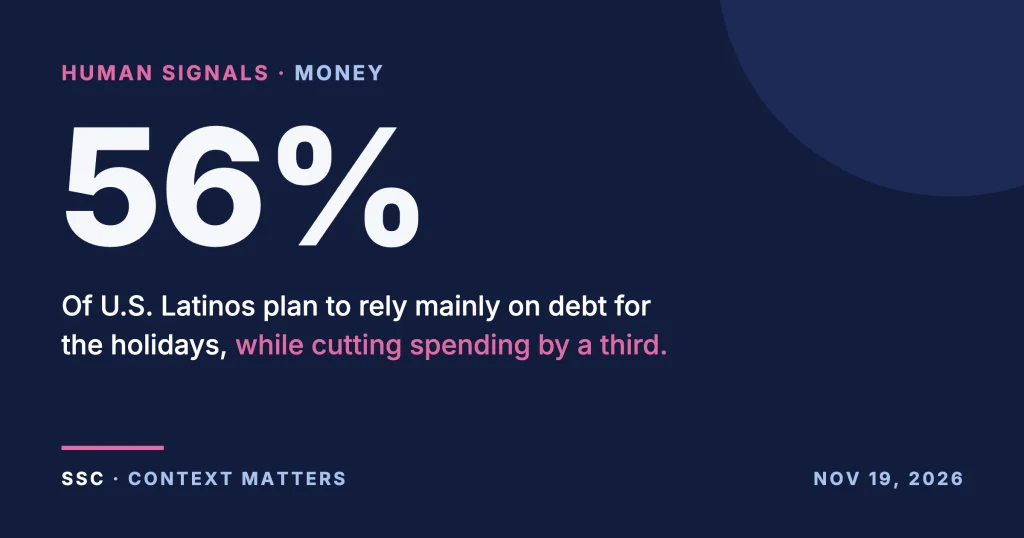
U.S. Latinos plan to spend an average of $1,821 this holiday season, down from $2,745 in 2025, a cut of about a third, according to a new BMO survey conducted by Ipsos. Seventy-one percent say they’ve grown more worried about inflation and the cost of living in the past three months.
Cutting the party to protect the presents
The cuts aren’t spread evenly. Families are slashing what happens around the celebration and protecting what goes under the tree. Spending on decorations fell 62%, to $56. Alcohol fell 50%. Travel fell 38%, and groceries and dining out each fell 33%.
Gifts held up far better. Toy and game budgets dropped just 5%. Clothing fell 13% and electronics 18%. The message is clear: the fiesta can shrink, but the regalos can’t.
Borrowing to keep traditions
The money still has to come from somewhere. More than half of U.S. Latinos, 56%, plan to rely primarily on debt to pay for holiday purchases. Seventy-four percent expect to carry at least some of that debt into 2027, compared with 59% of all Americans. The average carried over is $763.
Many are also working more. Forty-six percent of U.S. Latinos are taking on extra work to fund the holidays, compared with 35% of the general population.
The dual-holiday stretch
Nearly half, 48%, say they feel pressure to pay for both American and cultural holidays. That rises to 62% among Gen Z and 58% among people in multigenerational homes, where hosting falls hardest. Sixty-five percent of Latinos in multigenerational homes typically host, and 63% say hosting is a major driver of financial anxiety.
Most budgeting advice doesn’t account for a second holiday season. For these families, it’s not optional. It’s how culture gets passed down.
Gen Z refuses to cut back
The youngest adults are the exception to the pullback. Gen Z Latinos plan to spend $1,971, nearly flat from last year, while millennials are cutting their budgets by nearly 40%.
That choice has a price. Sixty-three percent of Gen Z Latinos feel obligated to match what loved ones spend on them, compared with 40% of all Americans. Fifty-eight percent are picking up extra work, and 53% are dipping into long-term savings. Two-thirds, 67%, say keeping holiday traditions alive is vital to their mental health and emotional well-being, even if it strains their finances.
That’s the core of this story. For a generation just starting out, holiday debt is the cost of staying connected to family and culture. It’s a trade many are making knowingly.
What to keep in mind
The survey comes from a bank, and BMO’s release promotes its own credit card and financial tools. The Latino findings rest on a sample of 754 Hispanic adults, with a margin of error of plus or minus 4.4 points, so small year-to-year changes should be read with care. The bigger patterns, a one-third cut in spending and a heavy reliance on debt, are well beyond that margin.