
It’s rarely the big moment that gets you. It’s the small ones. The text you send too quickly. The tone you don’t check. The decision to respond immediately instead of letting something sit. Most emotional mistakes don’t happen because people lack control. They happen because there’s no space between what they feel and what they do.
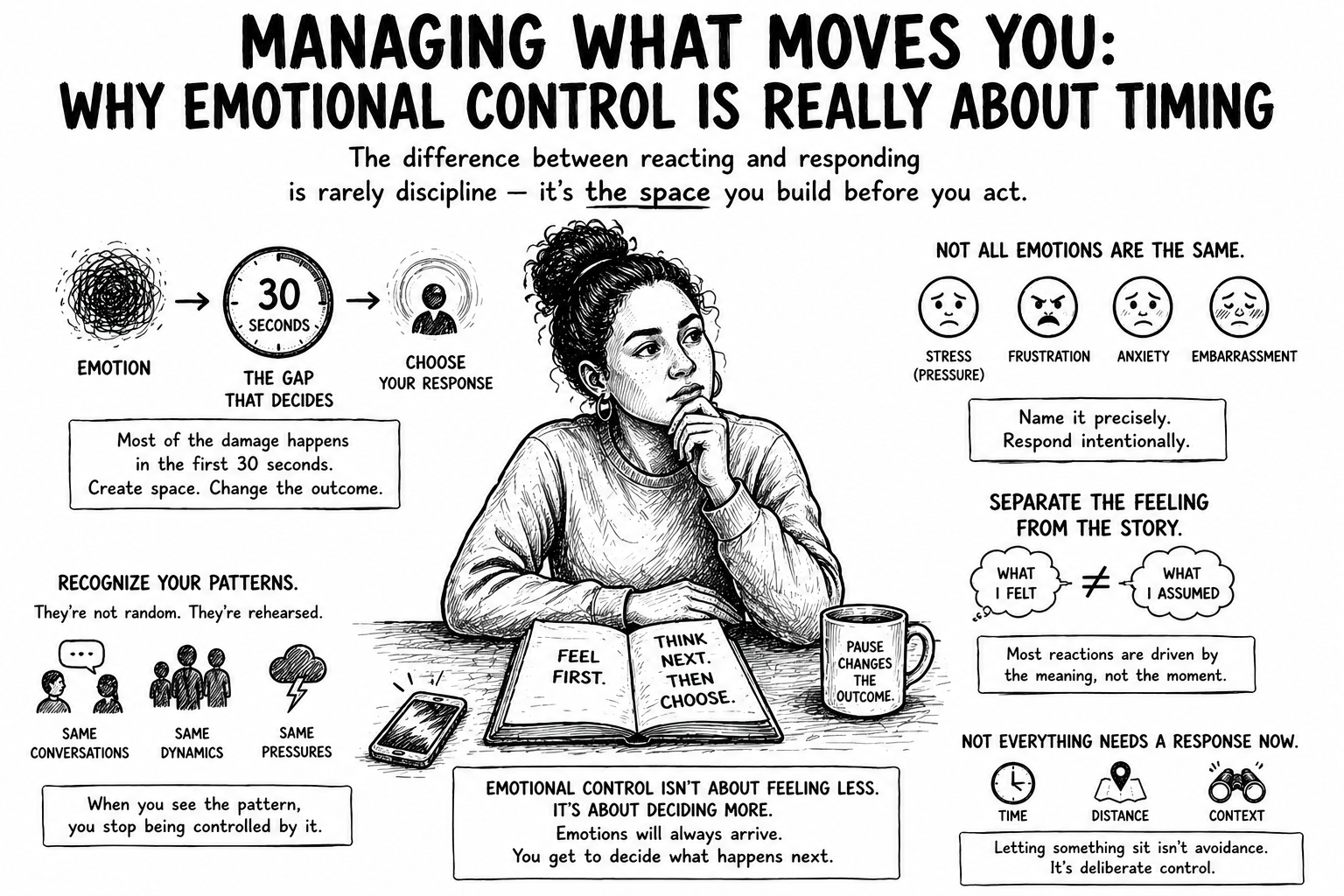
That gap is where everything is decided. Not in the emotion itself, but in how quickly it turns into action. Most people are operating without it. The environment doesn’t help — everything is immediate, messages, reactions, expectations. You’re conditioned to move at the speed of your emotion. The result isn’t just miscommunication. It’s a pattern of decisions made before you understand what you’re actually feeling.
The first shift is recognizing that not all emotions are the same, even when they feel similar. Stress can be pressure, frustration, anxiety, or embarrassment, and each one moves differently. When everything gets labeled the same, the response becomes automatic. Precision slows that down. When you can name exactly what you’re feeling, you create just enough distance to stop it from running the moment.
Most of the damage happens in the first 30 seconds. That’s where reaction lives — the follow-up message you didn’t need to send, the attempt to clear things up immediately, the assumption that the moment needs resolution right now. A pause is less about calming down and more about interrupting momentum. Even a short delay changes the outcome because it gives your thinking a chance to catch up to your feeling.
This is not theoretical. Building that pause is the kind of work that starts with recognizing you’ve been operating without it — often for years, often at the expense of the people closest to you. The path from suppression to awareness is rarely linear, and it rarely starts with discipline. It starts with deciding that what you’re losing by reacting is worth more than the release of reacting.
Patterns make this predictable. The same conversations, environments, and dynamics tend to produce the same reactions. Certain people, certain topics, certain pressures — your response isn’t random, it’s rehearsed. Once you start seeing that, you stop being surprised by your own reactions. That recognition alone creates more room than trying to manage emotions in real time ever will.
What complicates it is the story that gets attached to the feeling. A delayed reply becomes disrespect. A short response becomes dismissal. A change in tone becomes conflict. The emotion is real, but the interpretation expands it beyond what actually happened. Separating those two — what you felt versus what you assumed — shrinks the intensity. Most reactions aren’t driven by the feeling itself. They’re driven by the meaning assigned to it.
There is also a pressure to resolve everything immediately, as if leaving something open creates risk. It often creates the opposite. Acting too quickly closes off better outcomes. Not every emotion needs a response in the moment. Some need time, distance, or context. Letting something sit is not avoidance. It is the most deliberate thing you can do.
Emotional control is not about feeling less. It’s about deciding more. Emotions will always arrive — the question is whether they move through you or whether they decide what happens next. The people who seem the most composed are not the ones who feel the least. They’re the ones who’ve built enough space to choose.