CLIMATE | ACCESS
Eight people were hospitalized after severe turbulence forced a New York-bound flight to divert to Miami. The incident fits a broader pattern scientists have been warning about: warming is making some of the atmosphere’s most dangerous turbulence more common.
BY SOCIAL STORYTELLERS COLLECTIVE NEWS DESK
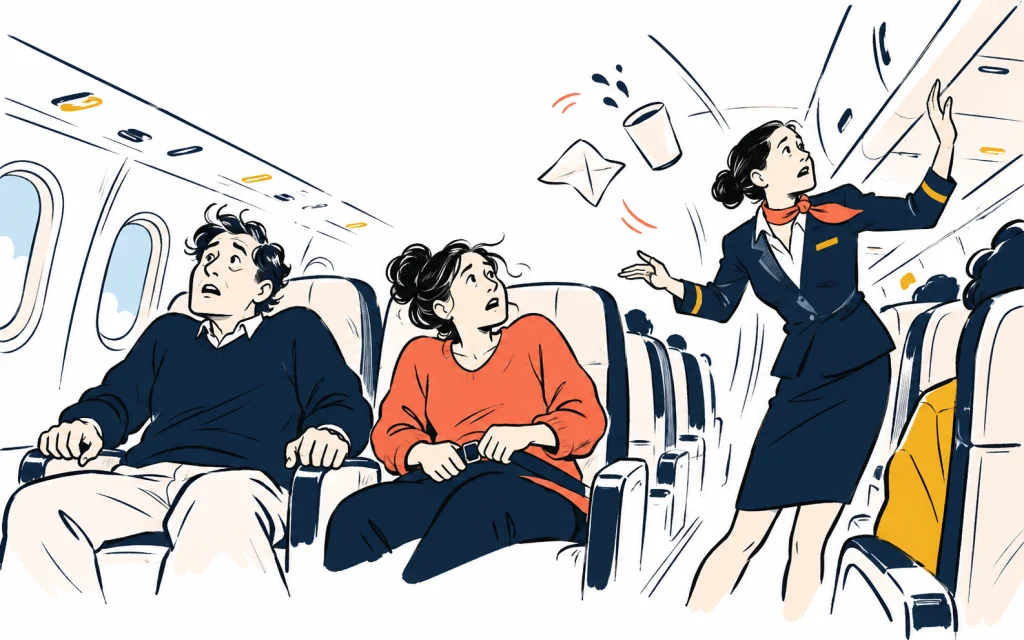
An Avianca flight from Medellín, Colombia, to New York encountered severe turbulence early Friday, injuring passengers and crew and forcing the Airbus A320 to divert to Miami International Airport. The FAA said Flight 42 landed safely at about 3:25 a.m. after the crew reported severe turbulence. Miami-Dade Fire Rescue transported eight people to hospitals, including one person who was taken to a trauma center with serious injuries. Avianca said six passengers and three crew members were affected.
Passengers described several intense periods of turbulence. Video from inside the cabin showed travelers using ice packs on their heads, while local television footage showed at least one flight attendant arriving at a hospital on a stretcher. Flight-tracking data showed the aircraft descending rapidly as it diverted toward Miami, but that descent should not be confused with a 25,000-foot uncontrolled plunge caused by turbulence; the public data show the aircraft changing altitude as it headed toward its diversion airport. What is clear is that the encounter was severe enough to injure multiple people and end the scheduled flight to New York.
The event is not evidence by itself that climate change caused this particular bout of turbulence. Turbulence can result from thunderstorms, weather fronts, mountains, jet streams and other atmospheric conditions, and investigators have not established the precise mechanism behind Friday’s encounter. But the larger trend is increasingly difficult to separate from a warming climate. A 2023 study published in Geophysical Research Letters found that severe clear-air turbulence over a typical point in the North Atlantic increased 55% between 1979 and 2020, rising from 17.7 hours a year to 27.4 hours. Moderate clear-air turbulence increased 37% over the same period, with significant increases also identified over the continental United States.
Clear-air turbulence is particularly important because it can develop away from thunderstorms and clouds, making it harder for pilots to see and for conventional onboard weather radar to detect. Researchers link the increase to stronger vertical wind shear around jet streams. As greenhouse gases warm the lower atmosphere while producing different temperature changes higher above it, the speed and direction of winds can vary more sharply with altitude. That creates conditions capable of producing stronger patches of unstable air along heavily traveled cruising routes. Researchers at the University of Reading say turbulence strong enough to pose an injury risk could become two to three times more frequent under high-emissions scenarios.
Airlines are already adapting to an atmosphere that requires more information in real time. The International Air Transport Association’s Turbulence Aware system collects automated reports directly from participating aircraft and distributes the data to other pilots and dispatchers. IATA said its system received more than 65 million turbulence reports from more than 3,300 aircraft in 2025, a 26% increase in data from the previous year. That increase does not mean turbulence itself rose 26%—the network is also expanding—but it illustrates how aggressively the industry is building infrastructure to identify rough air before another aircraft reaches it.
The operational burden extends beyond uncomfortable flights. The FAA says turbulence accounted for 152 of 420 accidents involving scheduled U.S. airlines between 2008 and 2022, or 36%, with every turbulence-related accident in that category producing at least one serious injury. Fatal accidents aboard large commercial airlines remain exceedingly rare. The more immediate danger is inside the cabin: people and unsecured objects can be thrown upward or sideways before there is time to react, which is why flight attendants—who may be standing or conducting service—can be particularly exposed. The FAA continues to recommend that passengers keep their seat belts fastened whenever they are seated, even when the seat-belt sign is off.
That is the emerging climate story of turbulence. Commercial aviation is not suddenly becoming unsafe, and every rough flight cannot be attributed to global warming. The change is subtler and more consequential: one of the background conditions airlines have always managed is shifting. Routes may require more forecasting, more altitude changes, interrupted cabin service and, in some cases, longer paths around unstable air. Friday morning’s Avianca flight will ultimately be investigated as one specific aviation event. But it arrived against a much longer signal in the atmosphere—one showing that the air aircraft move through is already becoming more turbulent in some of the world’s busiest flight corridors.