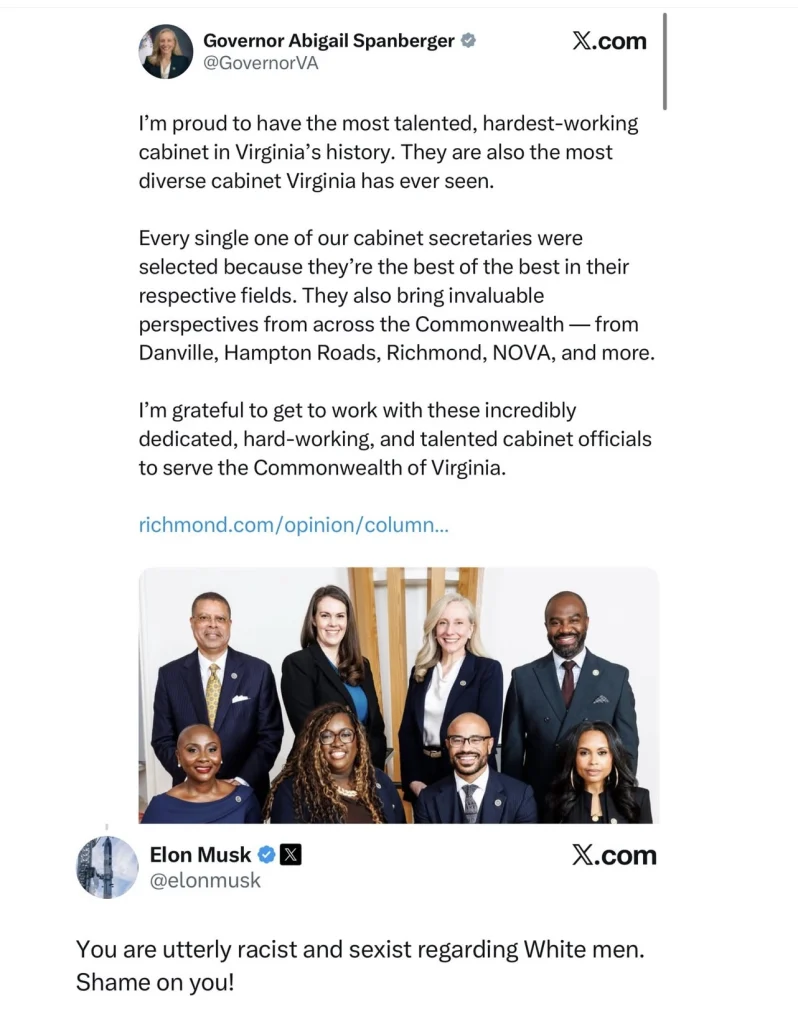
After Virginia Gov. Abigail Spanberger celebrated her administration’s diversity, Musk accused her of racism against white men. The photograph that set off the fight didn’t show her full cabinet.
By Social Storytellers Collective News Desk
October 31, 2026 | Policy · Culture in Motion | Analysis
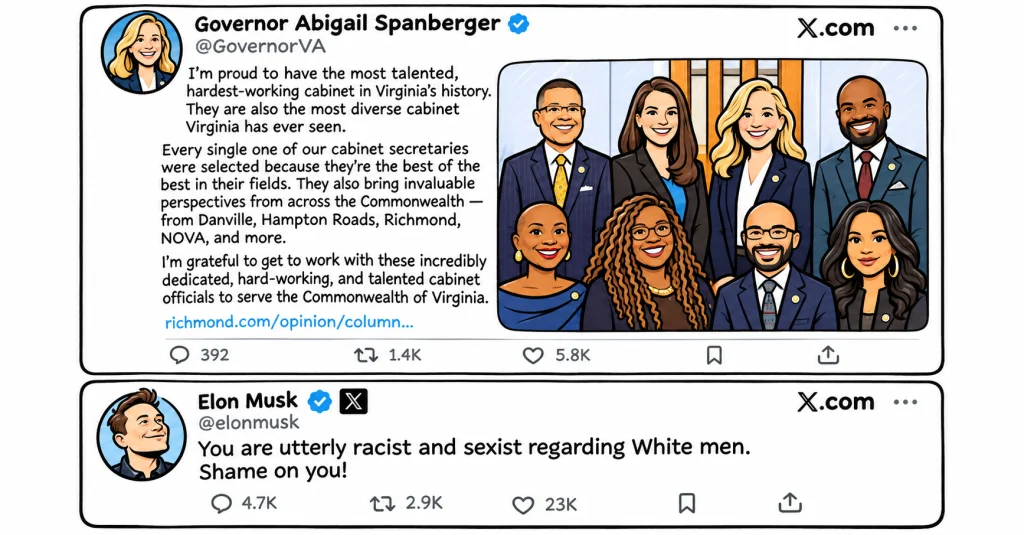
On Thursday, Virginia Gov. Abigail Spanberger posted a photograph on X of herself with eight members of her administration, most of them Black officials, and called it the most diverse cabinet Virginia has ever seen, as Newsweek reporter Taryn Pedler reported. In the same post, she wrote that every secretary was selected because they’re “the best of the best in their respective fields.” Within hours, the image had become a referendum on who belongs in government. Conservative commentator Katie Miller, wife of White House deputy chief of staff Stephen Miller, wrote that “30% of Virginia residents are White men. Zero represented here.” Elon Musk went further, telling the governor she was “utterly racist and sexist regarding White men,” WJLA reporter Jessica James reported.
The photo was never the full cabinet. A spokesperson for the governor told Newsweek the image came from a photo shoot for the Richmond publication Style Weekly and did not show every member. Several white secretaries were simply out of frame, including Finance Secretary Mark Sickles, Transportation Secretary Nick Donohue, Natural and Historic Resources Secretary David Bulova and Veterans and Defense Affairs Secretary Timothy Williams, as TheGrio’s Janeé Bolden noted.
How a picture becomes a verdict
Representation arguments run on what people can see. A cabinet roster is public record, but almost no one reads one, while a photograph travels in seconds. That gap lets a single frame stand in for an entire administration, and it rewards whoever reaches the biggest audience first. Musk owns X, the platform where Spanberger posted, and his reply carried the accusation to an audience far larger than the governor’s before her office had explained where the photo came from.
The standard behind the complaint matters too. Miller measured a partial photo against the share of white men in Virginia’s population, a yardstick that would make almost any small group photo look like exclusion. Applied consistently, it would flag a corporate board, a newsroom or a campaign staff any time one group happened to be out of frame. Applied the way it was here, it turned a room of Black officials into proof that white men had been pushed aside.
Who holds the record
Virginians are entitled to scrutinize appointments: who holds which secretariat, what each one controls and how they were chosen. That scrutiny runs on the appointment record, and the record shows white men leading major parts of state government, from finance to transportation. The photograph didn’t, and for a news cycle, the photograph won.
That’s where power moved in this episode. A state government’s documented roster lost the argument to one image and a reply from the man who owns the feed it ran on. Black officials appointed to run state agencies were recast in a single post as evidence of someone else’s loss, and their qualifications, which the governor put front and center, never entered the conversation their critics started.
What comes next
Expect this to become a routine test for elected officials who campaign on diversity, and an especially sharp one when the faces in the frame are Black. Every celebratory photo is now evidence that critics can measure against census figures, and the office that answers fastest with the full roster will control the story. Governments that publish complete, current appointment records alongside their pictures will spend less time defending photographs, and the ones that don’t will keep losing arguments to a single frame.