
Part of The Access Shift — an ongoing series examining how access is being quietly reshaped across American life.
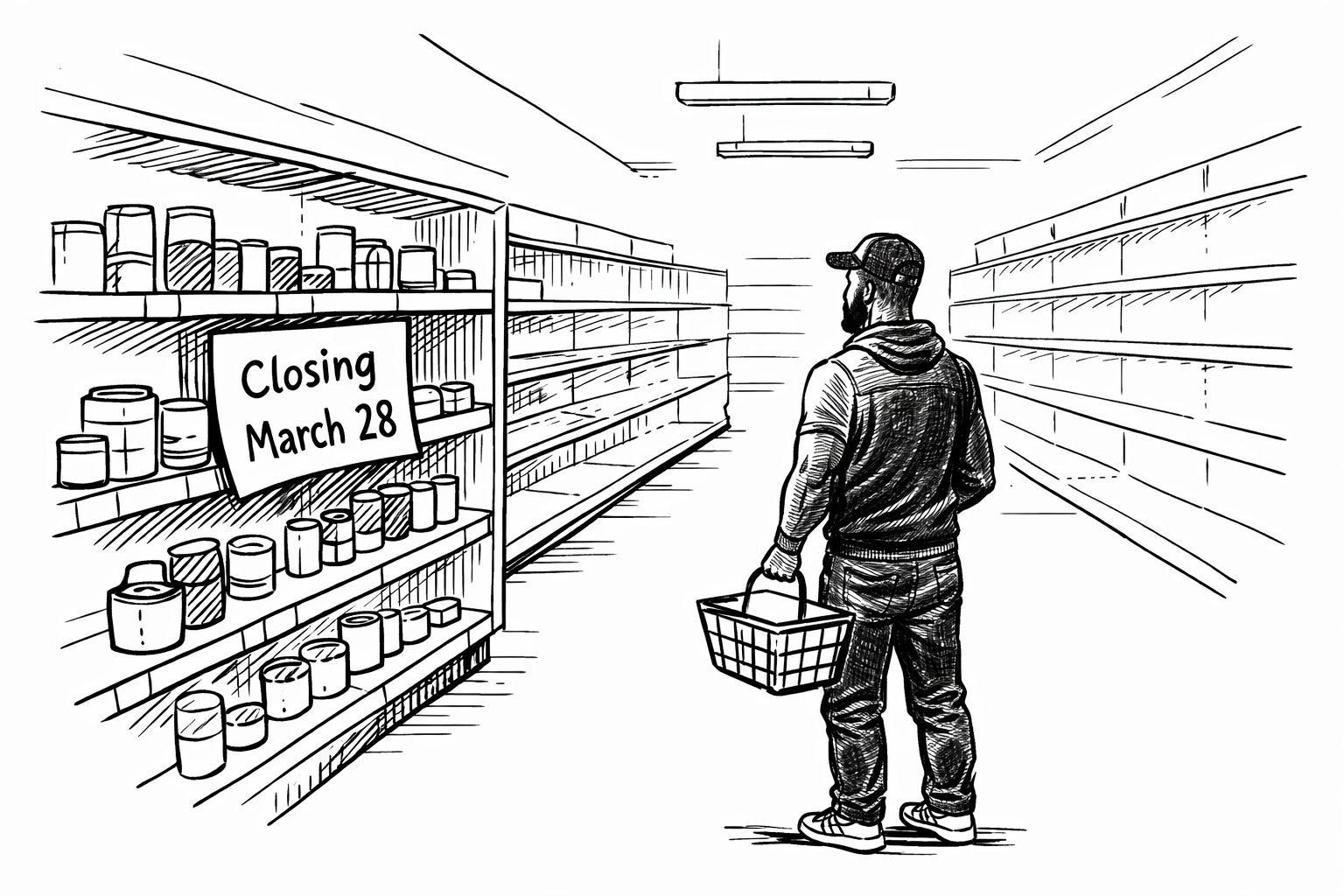
The shelves were already half-empty before I even saw the sign.
I had gone to my neighborhood Kroger on a Saturday afternoon to pick up something simple — an ingredient for dinner, a five-minute errand. I had deliberately skipped H-E-B. The parking, the crowds, the energy it takes to move through that store at peak hours — none of it felt worth it for one item. Kroger was closer, quieter, more manageable. It was the kind of store you don’t think about until it’s gone.
Except it already was, in the way that matters. Signage throughout confirmed what the shelves were already telling me: closing day, March 28. What I was walking through wasn’t a grocery store running low on stock. It was a store mid-disappearance — still lit, still staffed, still occupying the space it had always occupied, but no longer being replenished. The infrastructure was there. The intention had already left.
This isn’t an isolated closure. Kroger has announced plans to shut approximately 60 stores nationwide over 18 months under what the company calls a “footprint optimization” strategy — a corporate phrase that means, in plain terms, that some communities are no longer worth the investment. Not because they lack residents or purchasing power. Because they no longer fit the model. Some stores have already closed. More are quietly phasing out in markets across the country, in the particular invisible way that things disappear when no single moment marks their ending.
What I keep thinking about is that this particular store was not in a food desert. Within minutes there are alternatives — H-E-B, Whole Foods, both well-stocked and well-trafficked. By the conventional measure of grocery access, this neighborhood registers as fine. I don’t think that’s the right measure anymore, and I don’t think it was the right measure before I walked into that half-empty store.
Not all access is the same. I didn’t avoid H-E-B because it was unavailable. I avoided it because of the friction — the parking, the Saturday volume, the particular kind of exhaustion that comes with navigating a high-density store in the middle of the day when you have one thing to get and limited time to get it. Kroger occupied a specific role that H-E-B and Whole Foods do not: not the cheapest option, not the most premium, but manageable in a way the others weren’t. It was the middle — and the middle, it turns out, is exactly what is being squeezed out.
This is how grocery retail is reorganizing itself right now. Chains are rationalizing toward the poles — strong price efficiency on one end, curated premium experience on the other — and what sits between those two pressures becomes harder to justify internally. Not because no one needs it, but because it no longer fits the financial model that corporate strategy is built around. The stores that close are not always the ones in the most obviously vulnerable places. Sometimes they are the ones that served a quieter, less legible need — convenience without spectacle, access without abundance, a middle register that the market has decided it can no longer afford to maintain even when the community it serves clearly still needs it.
The people who absorb that loss unevenly are worth naming. Working parents who cannot spend forty-five minutes navigating a packed H-E-B on a weeknight. Elderly residents for whom a smaller, closer store is not a preference but a physical reality. Lower-income households who shop in smaller quantities more frequently and need a store that is near and manageable rather than comprehensive and overwhelming. These are not demographics that show up in footprint optimization models. They are the people the middle was quietly serving — and they are the people left to redistribute themselves across options that were not designed with their specific friction in mind.
What unsettled me most that Saturday wasn’t the closure itself. It was how invisible the process was. The store was open. The lights were on. If you weren’t paying close attention to the shelves, you might not have known anything was changing. That is how most of these shifts happen — not with announcements or visible disruption, but with gradual thinning, a slow withdrawal of intention from a space that still looks operational until the day it simply isn’t. The infrastructure of access disappears before the access itself does, and by the time the absence is undeniable, the moment to respond to it has already passed.
Access isn’t only disappearing in places that lack resources. It is being reshaped in places that have them — reconfigured around models of demand that don’t account for everything people actually need, only for what those needs look like when filtered through the logic of return on investment. The question worth asking isn’t just whether a store exists nearby. It’s what kind of store it is, who it realistically serves given the friction of actually using it, and what fills the space — or quietly doesn’t — when it closes. The shelves told the story before the sign did. They usually do. The question is whether we are paying attention before the lights go out.
Why This Matters
This moment reflects a broader shift in how access is structured. What’s changing isn’t just where stores exist, but which types of access are sustainable. As pressure builds on both ends of the market, the middle—once defined by flexibility and convenience—is becoming harder to maintain. The result isn’t always the loss of access, but a narrowing of how it’s experienced. Even in areas with multiple options, the disappearance of in-between spaces signals a system that is becoming more selective about what it preserves—and what it leaves behind.
The gradual redefinition of who systems are designed to serve.
Across sectors—from public infrastructure to healthcare to everyday spaces—access is no longer assumed. As costs rise and systems face increasing pressure, services once built for broad reach are becoming more selective, more conditional, and less universal. The Access Shift explores how these changes are unfolding in real time—and what they reveal about who is included, who is left out, and how the structure of everyday life is quietly being reshaped.