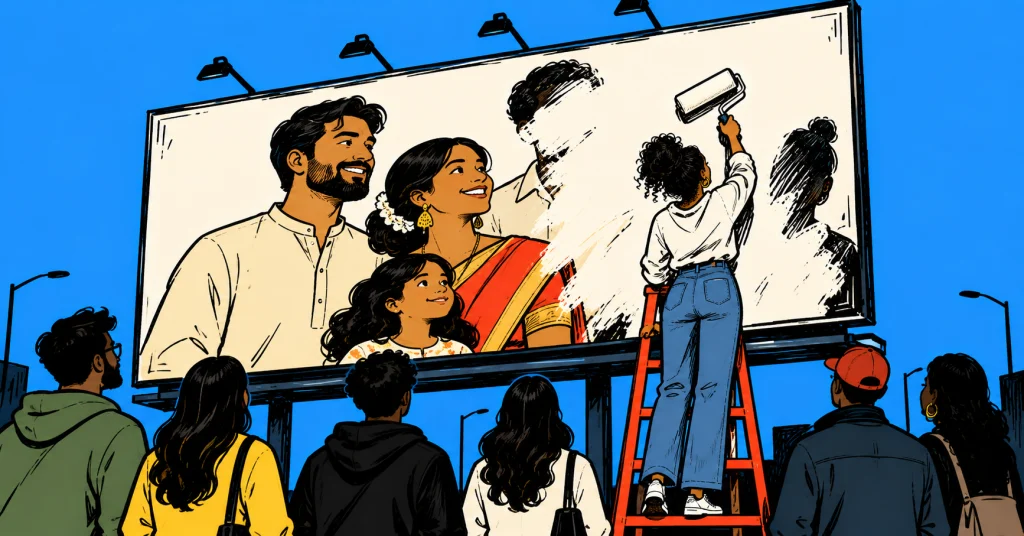
Across India’s advertising industry, campaigns featuring interfaith families, changing gender roles and cultural inclusion have drawn boycotts and public anger. The bigger story may be what happens before those ads ever reach an audience.
Before a commercial ever airs, someone decides which family it will show, what language its characters will speak and which relationships the audience will recognize. A marketing team might pitch an interfaith couple celebrating a holiday, a daughter pushing back on an old family expectation or a household whose traditions look different from the ones national ads usually show. Then another question enters the room: could this idea set off a backlash big enough that the company pulls it?
That calculation is becoming more visible in India, where the festive advertising season leading up to Diwali has turned into a recurring flashpoint over religion, tradition and gender. In an Oct. 19 analysis by Manifest, advertising executives described growing pressure to weigh creative ambition against reputational risk. Their concern goes beyond whether individual campaigns survive. It’s that the possibility of outrage is starting to shape which stories brands are willing to tell at all.
The industry has learned from experience. In 2020, jewelry brand Tanishq withdrew its Ekatvam ad, which showed a Hindu woman’s baby shower hosted by her Muslim in-laws, after a wave of online attacks and threats against a store. In 2021, Fabindia pulled a festive campaign after critics objected to its use of an Urdu phrase for a Diwali collection. Not every brand backed down. When Surf Excel’s 2019 Holi ad, featuring two children of different faiths, drew boycott calls, Hindustan Unilever kept it running. But the withdrawals are the ones the industry remembers.
Advertising Has Become a Cultural Battleground
Brands have always made choices about representation. What’s different now is how fast an online campaign can turn a commercial into a national controversy. A small but highly active group can generate enough noise to make an advertiser rethink a campaign, especially once boycott hashtags start trending. That doesn’t mean the loudest critics speak for most consumers. Executives in the Manifest report warned that online outrage can look far larger than the public sentiment behind it, leaving marketers to guess whether they’re facing a genuine cultural concern, a real creative mistake or a coordinated pressure campaign.
There are good reasons for brands to listen. Ads can misrepresent religious customs, exploit cultural imagery or lean on stereotypes, and public criticism can expose those failures. Brands have also learned that listening to online crowds can pay off. SSC reported this week on how Chipotle has turned internet conversations into a marketing engine. But responding to real criticism is different from deciding that any portrayal of an unfamiliar family, a minority identity or a changing social role is too risky to air. Advertising shapes cultural visibility. Families see versions of themselves in commercials, children absorb ideas about relationships and traditions from the media around them, and brands help decide which kinds of everyday life look normal, aspirational or worth celebrating. When advertisers keep choosing only the safest portrayals, the public sees a narrower version of its own society.
The Cost of Playing It Safe
Fear of backlash becomes a business calculation long before a campaign reaches the public. A company paying for production, media buys and celebrity partners can see controversy as an avoidable financial risk, and agencies respond by pitching familiar ideas less likely to draw fire. Hayden Scott, creative head for Virtue Asia in India, told Manifest that efforts to strip out anything potentially uncomfortable can leave advertising generic. His point captures something hard to measure: self-censorship doesn’t leave a withdrawn ad behind, because the ad was never made.
The pressure isn’t unique to India. In the U.S., Bud Light’s partnership with a transgender influencer and Target’s 2023 Pride collection both triggered boycotts that cost the companies sales and reshaped how other brands approached similar campaigns. American advertisers now navigate fights over racial representation, LGBTQ+ inclusion, gender roles and corporate diversity programs, often with different groups demanding opposite things. The two countries’ religious, political and cultural landscapes are very different, but both show how advertising has become a stage for arguments that governments and communities haven’t settled. Backlash has even become its own business, as SSC reported when we found that the influencer backlash is becoming a business opportunity.
The stakes also reach the creative workforce. A campaign that portrays a family outside the dominant cultural story creates work for actors, writers, directors and agencies whose experiences are often missing from mainstream marketing. When brands avoid those stories, the people who would have told them lose opportunities too. It’s the same question SSC raised about whether fashion is really embracing every body or just the ones that feel safe to sell.
Whose Culture Becomes Too Risky to Show?
The challenge for the industry isn’t to ignore cultural sensitivities. It’s to judge criticism fairly without letting intimidation or the threat of an organized backlash decide who belongs in commercial storytelling. That takes more discipline than pulling every campaign that draws heat. Companies need to understand what the complaint actually is, who’s raising it and whether the ad caused real harm, and they need to decide whether their public commitments to representation can survive predictable disagreement.
The incentives for caution are powerful. A pulled ad is visible proof that controversy has consequences, while an ad that was never commissioned leaves no record at all. The cultural cost builds quietly, through stories that go untold and communities that see themselves less often. A brand can avoid controversy by showing audiences only what they already expect to see. But advertising does more than sell products. It reflects and shapes assumptions about family, tradition, identity and belonging, and when companies stop portraying the society around them, audiences may never know what disappeared from the screen.
Reporting source: Manifest