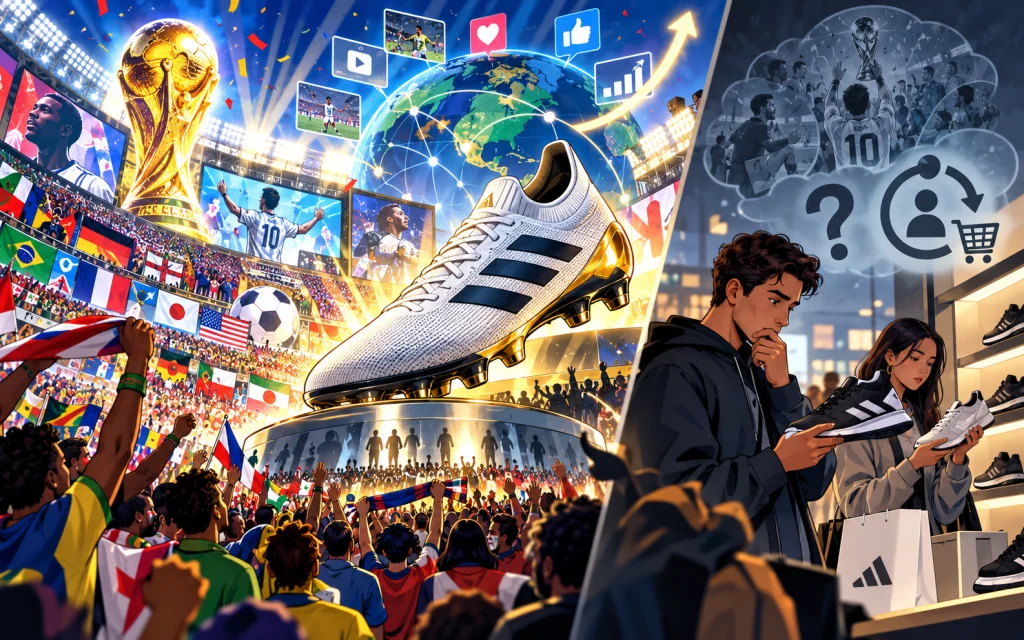
The sportswear giant invested heavily in the world’s biggest soccer tournament and has since reported record quarterly results. But the real test is whether an expensive moment of cultural relevance can produce customers who stay long after the excitement fades.
Imagine spending nearly a billion dollars making sure your brand is impossible to ignore. Your logo appears on the jerseys of international soccer stars, your advertisements feature some of the world’s most recognizable celebrities, and your products are everywhere during one of the most-watched sporting events on the planet. Millions of people see your campaigns, fans celebrate your merchandise, and your brand dominates conversations for weeks. Then the tournament ends, the cameras disappear, and consumers return to their everyday shopping habits. What happens next?
That is the question Adidas is confronting after its massive investment in the 2026 FIFA World Cup. According to an October 19 Wall Street Journal report, the company spent approximately $1 billion on marketing during the second quarter, a 30% increase from the previous year. The campaign included supplying jerseys for 14 national teams, organizing fan experiences, and featuring celebrities such as Timothée Chalamet alongside soccer stars Lionel Messi and other athletes. The spending initially concerned investors, but Adidas defended the strategy as an investment in the brand’s future rather than a campaign designed exclusively to produce immediate sales.
The financial picture has since improved. On October 20, Adidas announced preliminary third-quarter revenue of €7.25 billion, up 9% from the previous year, and operating profit of €1.01 billion, an increase of 37%. The company also raised its full-year operating profit forecast to approximately €2.5 billion. Those results demonstrate substantial commercial momentum, although they do not independently establish how much of that growth came directly from World Cup advertising. Adidas also received approximately €200 million in U.S. tariff refunds, which contributed to its stronger profitability.
The Difference Between Being Seen and Being Chosen
Adidas has demonstrated that it can command attention. During the World Cup, its marketing generated more than nine billion views and 400 million engagements across the brand’s digital ecosystem, according to company figures. More than 250,000 people also participated in its soccer-themed fan experiences.
Those numbers are impressive, but they measure exposure and interaction rather than lasting loyalty. Someone can watch an advertisement, like a social media post, or attend a branded event without ever purchasing a product. Even someone who buys a World Cup jersey may have no intention of becoming a regular Adidas customer.
That distinction matters because marketing success is increasingly reported through numbers that can appear more meaningful than they actually are.
Nine billion views demonstrate extraordinary reach, but they do not represent nine billion individual consumers. Engagement shows that people interacted with the campaign, but it cannot tell us whether those interactions changed their purchasing habits.
The commercial challenge is converting temporary attention into a relationship that survives after the event.
The World Cup Created Buzz. Did It Change Minds?
Early consumer research suggests the impact may have been uneven.
Morning Consult found that Adidas experienced a modest increase in brand buzz among American consumers during the tournament, but those gains largely returned to normal afterward. Men’s favorability and purchase consideration improved slightly and remained elevated into September. Among women, the results were less encouraging, with purchase consideration declining over the period examined.
That creates an interesting tension between financial performance and consumer perception.
Adidas can report strong quarterly sales while independent research suggests its enormous marketing campaign did not produce an equally dramatic improvement in how consumers feel about the brand.
Both findings can be true.
World Cup merchandise can generate substantial revenue in the short term, while longer-term brand loyalty takes additional time to develop. International sales performance can also differ from consumer sentiment in the United States.
Marketing investments should therefore be evaluated through multiple measures, including profitability, customer acquisition, repeat purchases, brand consideration, and market share over time.
A successful event does not automatically create a successful long-term strategy.
Celebrity Power Is Expensive. Consumer Loyalty Is Harder to Earn.
The World Cup campaign reflected Adidas’s ability to combine sports, entertainment, fashion, and popular culture. Its roster of athletes and entertainers helped the company reach audiences beyond traditional soccer enthusiasts.
But celebrity visibility is not the same as consumer commitment.
I find this especially interesting because brands increasingly compete to associate themselves with cultural moments that already command enormous public attention. A major sporting event offers a ready-made audience, and celebrities can make the connection feel exciting and relevant.
Yet consumers are not obligated to reward that investment with loyalty.
A young shopper who sees Lionel Messi wearing Adidas during a tournament might still choose Nike, Hoka, New Balance, or another competitor when purchasing their next pair of sneakers. Price, comfort, personal style, product performance, and recommendations from friends may ultimately matter more than the most memorable commercial.
Adidas is also competing in a market where established companies no longer dominate consumer attention as easily as they once did. Smaller and specialized brands have developed loyal audiences by emphasizing product experience, performance, comfort, and lifestyle identity.
That competition makes it harder to assume that the company with the largest marketing budget will necessarily maintain the strongest customer relationships.
Marketing Should Build Something That Lasts
Adidas CEO Bjørn Gulden has defended the spending as an investment in the company’s future. That perspective has merit. Brand development rarely follows a neat quarterly schedule, and companies that focus exclusively on immediate returns can undermine the long-term relationships they need to remain competitive.
Marketing also does more than drive direct sales. It can strengthen brand recognition, support retail relationships, introduce new products, and associate a company with experiences consumers value.
Still, I believe companies should be careful about confusing cultural presence with cultural relevance.
A brand can appear everywhere during a major event without becoming more meaningful to the people it hopes to reach. Lasting relevance requires consistent products, credible storytelling, an understanding of changing consumer preferences, and experiences that give customers reasons to return.
That is where the real work begins after the World Cup.
Adidas now has an opportunity to determine whether the visibility generated by its campaign can help sustain interest in its running shoes, lifestyle footwear, apparel, and other products throughout the year.
The company has already demonstrated strong financial performance, and its October 20 results offer encouraging evidence of commercial momentum. But separating the return on its marketing investment from other contributors to growth will require more than one successful quarter.
The Billion-Dollar Question
There is something revealing about an industry in which a company can spend nearly $1 billion on marketing and still face uncertainty about whether it meaningfully changed consumer preferences.
That does not necessarily make the investment excessive. The World Cup offers unusual global reach, and Adidas has longstanding commercial relationships with the sport.
But it demonstrates why marketing effectiveness cannot be measured solely by campaign impressions, celebrity appearances, social media engagement, or even a temporary increase in sales.
The strongest brands need consumers who choose their products when there is no tournament, no celebrity campaign, and no major cultural event demanding their attention.
Adidas may ultimately demonstrate that its World Cup investment helped rebuild long-term brand strength. Its latest financial results provide evidence that the business is performing well, but the durability of the campaign’s influence remains to be established.
For marketers, the lesson extends beyond sportswear.
Buying attention can be extraordinarily expensive. Earning a place in consumers’ everyday lives requires something more.
The World Cup gave Adidas a global audience. The lasting return will depend on what the brand does with that attention after the world stops watching.