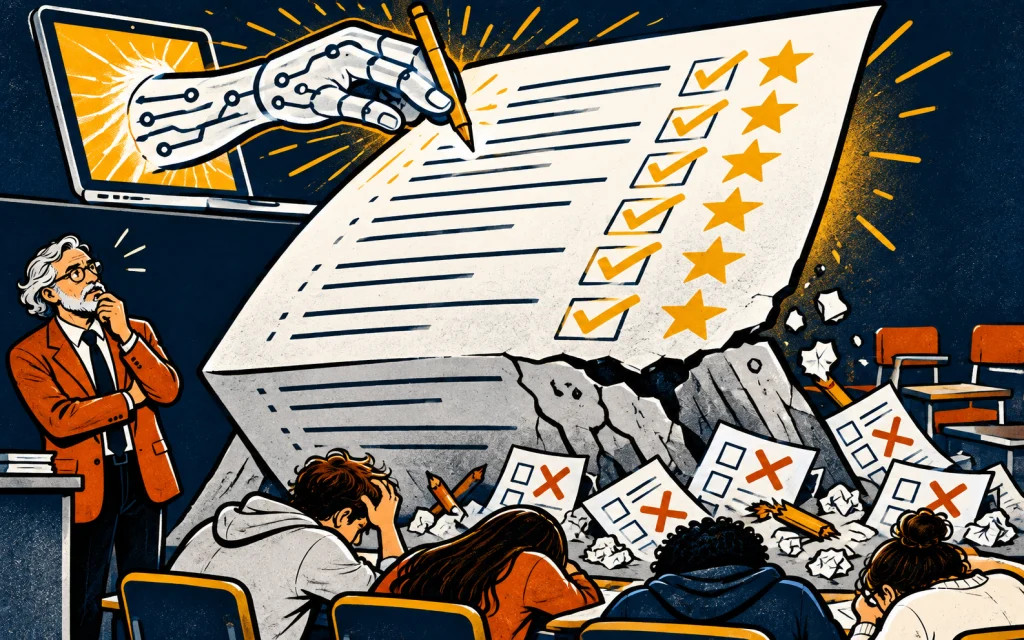
Imagine grading a college exam and discovering that nearly half the students earned perfect scores. For a professor, that might ordinarily be cause for celebration. But at Brown University, economics professor Roberto Serrano became suspicious when 40 students scored 100 on a take-home midterm in his advanced mathematical economics course. Some answers closely resembled responses generated by ChatGPT, prompting concerns about widespread AI-assisted cheating. According to EL PAÍS, Serrano believes at least 50 students cheated. When he required an in-person final exam, the class average plunged from 96 to 48, and 22 students who had previously earned perfect midterm scores did not show up. The results raise troubling questions about how much students are actually learning when artificial intelligence can complete increasingly sophisticated academic work.
What makes the situation especially unsettling is why Serrano offered take-home exams in the first place. Following a deadly campus shooting in December 2025, he wanted to ease the pressure on students still coping with the trauma. Now, after 34 years of teaching, he plans to eliminate take-home exams and stop counting assignments that students could complete using AI. His experience exposes a growing contradiction in higher education: universities are embracing artificial intelligence as a teaching tool while struggling to protect the integrity of the work students submit. AI can help students understand difficult concepts, but when it replaces the intellectual effort required to master them, an impressive grade may reveal very little about actual knowledge. The challenge facing universities is no longer simply detecting cheating. It is determining how to measure learning in a world where students can outsource the thinking itself.