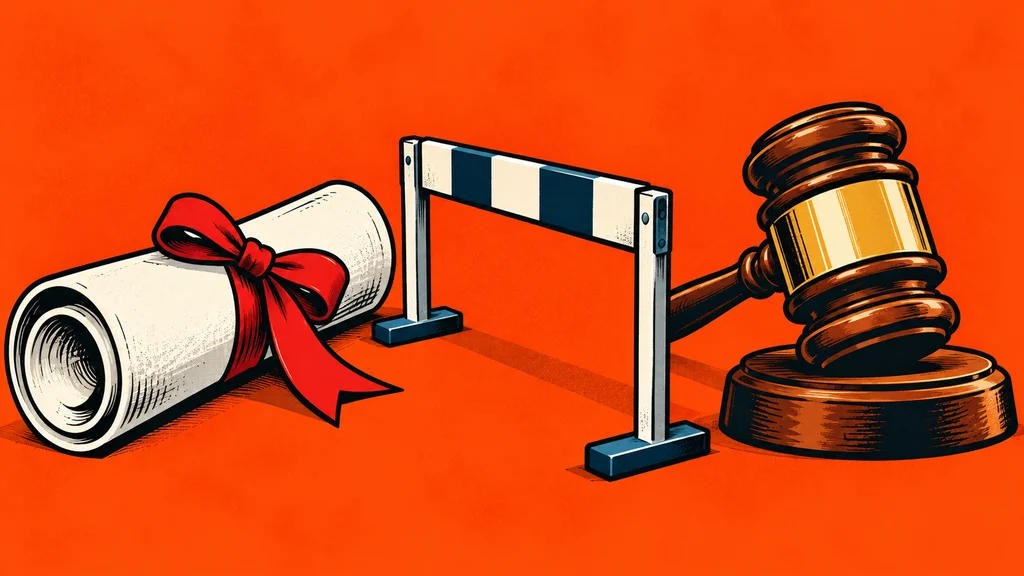
The controversy surrounding White House press secretary Katie Zacharia raises a broader question about professional titles: when does a degree or honor justify the title that comes with it, and when does the title communicate credentials a person does not actually possess?
Katie Zacharia graduated from Pepperdine University’s law school in 2011, took the California bar exam that year and did not pass. She did not take the exam again and is not licensed to practice law in any U.S. jurisdiction. Yet she has publicly described herself as a lawyer, appeared on television providing legal analysis and previously held a job titled general counsel. Pasted text
That has produced a straightforward but surprisingly complicated question: if someone earns a law degree but never becomes licensed, is it ethical to call that person a lawyer?
Zacharia says she was advised that it was acceptable. She told USA Today that before appearing on television she consulted with Pepperdine’s president and was told not to identify herself as an attorney or use “esquire,” but that she could call herself a lawyer. She said she received similar advice from other legal professionals and emphasized that she was offering legal analysis, not legal advice. Pasted text
Several legal ethics experts interviewed by the publication rejected that interpretation. Their argument is that, in ordinary American professional usage, “lawyer” and “attorney” both communicate something more than having completed law school: they communicate that a person has been admitted to practice law. Pasted text
That is where the ethical question becomes more important than the semantic one.
A law degree is not the same credential as a law license
Graduating from law school means someone has earned a professional academic degree, usually a J.D. It does not by itself authorize that person to practice law.
California’s own regulatory language is useful here. The State Bar defines a “lawyer” as someone licensed or admitted and eligible to practice law in a U.S. jurisdiction, or in certain circumstances a foreign jurisdiction. The State Bar also states plainly that only authorized attorneys may practice law in California and warns against people who hold themselves out as attorneys without the required license.
There are exceptions for lawyers licensed elsewhere who are permitted to perform certain work in California, including some federal and multijurisdictional practice. Those exceptions do not change the underlying principle: legal practice depends on authorization, not simply education.
That matters because professional titles carry information. Calling yourself a physician, architect, certified public accountant or licensed therapist does more than describe what you studied. It signals to the public that you crossed the professional or regulatory threshold associated with that occupation.
“Lawyer” generally functions the same way.
The ethical problem is what the audience reasonably believes
There is a meaningful difference between saying “I graduated from law school” and “I am a lawyer.”
The first statement precisely describes an educational accomplishment. The second can reasonably lead listeners to believe that the speaker possesses the professional credential normally associated with the term.
That does not mean every casual use of “lawyer” by a law-school graduate automatically constitutes illegal unauthorized practice. The legal question depends on the jurisdiction, the context and what the person is actually doing.
The ethical question is broader.
If a speaker knows that most people hear “lawyer” and understand it to mean someone licensed to practice law, using the title without immediately disclosing the absence of licensure can create an impression that is technically arguable but materially incomplete.
That concern becomes stronger when the title is being used to establish authority.
Zacharia did not merely use the term in casual conversation. USA Today reported that she described herself as a lawyer during television appearances where she offered legal analysis, that a previous social-media biography identified her that way and that President Donald Trump’s announcement of her White House appointment described her as an “attorney.” Pasted text
Her LinkedIn profile also listed a previous role as general counsel for Fix California, although a source familiar with the position told USA Today that the job was a senior advisory role that did not involve developing legal strategies or providing legal advice. Pasted text
In those settings, the title does more than describe education. It can increase perceived expertise.
Honorary doctorates raise the same question from another direction
The argument is not unique to law. A similar debate occurs when people who have received honorary doctorates begin using “Dr.” before their names.
Honorary doctorates are real honors conferred by universities. Harvard, for example, awards honorary Doctor of Laws, Doctor of Science, Doctor of Humane Letters, Doctor of Literature and other degrees to recognize distinguished achievement and contributions. Yale follows a similar tradition.
But an honorary doctorate is different from an earned Ph.D., Ed.D., M.D. or other doctoral degree. The recipient typically has not completed the formal academic program, research, examinations or dissertation associated with earning the degree.
That does not make the honorary degree illegitimate. It means the credential represents something different.
Universities sometimes address honorary-degree recipients ceremonially as “Doctor,” particularly during the degree-conferral itself. The problem arises when the recipient adopts “Dr.” as an ongoing professional title in a context where an audience could reasonably assume an earned doctorate.
That is the same underlying ethical issue raised by the lawyer question: what information does the title communicate to people who hear it?
A person can truthfully say, “I received an honorary doctorate from a university.” Someone who finished law school can truthfully say, “I have a J.D.” Neither statement minimizes the achievement.
But “I am Dr. Smith” or “I am a lawyer” may communicate something more specific about training or professional status.
Context changes the ethical stakes
There is also an important reason not to make this analysis absolute. Titles operate differently depending on context.
A university introducing an honorary-degree recipient as “Doctor” during commencement is participating in a ceremonial tradition. A recipient placing “Dr.” before their name while advertising expertise to clients or audiences is making a different kind of representation.
The same applies to law.
A law-school graduate discussing the legal education that informs their work is different from someone invoking “lawyer” while presenting legal analysis to a national television audience. Likewise, a person may have legitimate legal expertise without being licensed to represent clients in court.
The more a title is being used to establish authority, expertise or trust, the stronger the obligation becomes to explain what sits behind it.
That produces a more useful standard than simply asking whether a dictionary or adviser can justify the terminology.
If someone hears “doctor,” are they likely to assume an earned doctorate? If someone hears “lawyer,” are they likely to assume bar admission?
If the answer is yes, then the ethical issue is whether the speaker has allowed the audience to walk away with a materially inaccurate understanding of their qualifications.
There is also a difference between being wrong and being deceptive
Intent matters.
Someone may genuinely have been told that completing law school permits the use of “lawyer.” An honorary-degree recipient may have repeatedly been introduced as “Doctor” by the university that bestowed the degree and eventually adopt the honorific without intending to mislead anyone.
Those circumstances are different from deliberately choosing a title because it makes the person appear more credentialed than they are.
That is why the ethical analysis should not begin and end with accusations of fraud.
A better question is whether the person corrects the ambiguity once it becomes apparent.
Zacharia has now publicly acknowledged that she did not pass the bar and is not licensed to practice law. That disclosure gives audiences information they may not have had when she was previously identified simply as a lawyer or attorney. The remaining debate is whether the original use of the title was sufficiently clear in the first place.
A watchdog group has pushed the issue beyond ethics. Campaign for Accountability filed a complaint with the State Bar of California asking it to investigate whether Zacharia violated California law by repeatedly holding herself out as a lawyer. The complaint is an allegation, not a finding that she violated the law. Pasted text
Professional titles work because they are shorthand
This is ultimately why the debate matters beyond one White House official.
Professional titles save people from having to investigate every credential from scratch. “Doctor,” “lawyer,” “CPA,” “architect” and similar terms allow an audience to make quick assumptions about education, licensing and expertise.
That shorthand only works if people generally agree on what the title means.
An honorary doctorate remains an honor without being presented as an earned doctorate. A J.D. remains a significant academic accomplishment without being presented as admission to the bar. Neither credential becomes less meaningful simply because the person describes it precisely.
For someone who completed law school but never became licensed, “law-school graduate,” “J.D.” or “legally trained” communicates the achievement without creating the same ambiguity. An honorary-degree recipient can identify the doctorate and the institution that awarded it without leaving the impression that the degree was earned through doctoral study.
The ethical test, then, may be simpler than the argument over terminology makes it appear.
The question is not merely, Can I defend calling myself this?
It is: What will a reasonable person believe about my qualifications when I do?
If the full explanation materially changes that understanding, the explanation probably belongs next to the title.