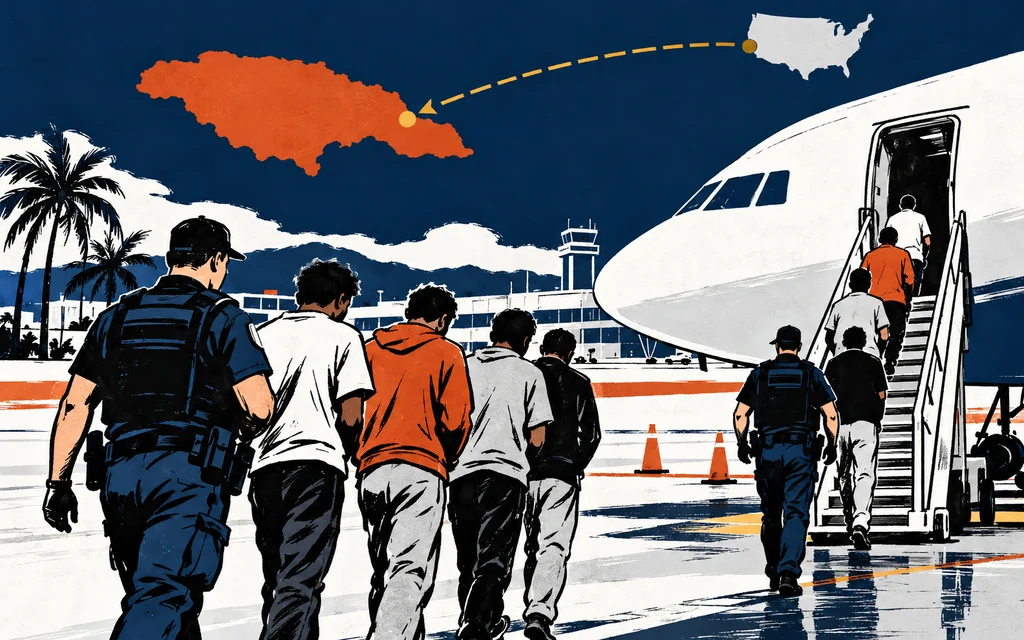
Twenty-two migrants were transferred to Kingston under a new U.S.-Jamaica agreement. The arrangement shows how quickly third-country deportations are becoming infrastructure rather than an exceptional immigration measure.
The United States sent 22 migrants to Jamaica this week even though Jamaica was not their country of origin, putting into operation a new deportation agreement at the same time the Supreme Court is preparing to decide whether the broader policy is lawful. Jamaica says the arrangement is temporary: the migrants are supposed to pass through the country before eventually returning to their home countries or another destination. But the first flight changes the policy from an agreement on paper into another functioning route in a growing U.S. system for removing migrants to countries with which they may have no prior connection.
Under the agreement, Jamaica can receive as many as 25 third-country nationals every two weeks. The Jamaican government says it can reject individuals proposed for transfer, that people with criminal records will not be accepted and that transfers are supposed to pause if more than 10 people remain in Jamaica awaiting onward movement. Jamaica also says the program will not be financed by its government. The International Organization for Migration is expected to support migrants while they are in the country and help arrange their departure.
The Deportation System Is Expanding Before the Court Rules
The flight matters because Jamaica is not an isolated case. The Trump administration has increasingly used agreements with third countries as destinations or transit points for migrants who cannot—or, according to the government, should not—be returned directly to their countries of citizenship. Other governments, including several in Africa, have already participated in similar arrangements. Reuters reported last week that Human Rights Watch had documented 536 people transferred to third countries between January 2025 and August 2026.
That means the operational system is expanding faster than the legal question surrounding it is being resolved. On September 29, the Supreme Court stayed a lower-court ruling that had restricted the administration’s third-country removal policy, allowing removals to continue while the case proceeds. The justices also agreed to hear the underlying challenge, Department of Homeland Security v. D.V.D., and scheduled oral arguments for December 9. Justices Sonia Sotomayor, Elena Kagan and Ketanji Brown Jackson said they would have denied the administration’s request for a stay.
The case asks questions larger than whether the administration can put someone on a particular flight. The Court will consider whether the government’s guidance for third-country removals violates federal immigration law, the Due Process Clause or U.S. obligations associated with protections against torture. It will also examine whether lower courts had jurisdiction to impose broad relief against the policy. Until those questions are resolved, the administration has permission to keep using the system.
Jamaica Is Calling It Transit. That Still Creates Responsibility.
Jamaica has emphasized that it is not accepting the migrants for permanent resettlement. Its government describes the program as a controlled transit mechanism, with screening, intelligence checks and limits on how many people can enter at once. That framing is important domestically: Jamaican officials have repeatedly sought to reassure residents that the agreement does not amount to an open-ended commitment to absorb U.S. deportees. Opposition figures have nevertheless questioned why the full agreement has not been publicly released.
Transit, however, is still a consequential role. Once another country agrees to receive deportees, even temporarily, U.S. immigration enforcement no longer depends solely on a migrant’s country of citizenship agreeing to take that person back. It creates an additional route. The receiving country becomes part of the logistical chain, with responsibility for screening, temporary accommodation, security and eventually moving the person somewhere else.
SSC identified this broader fight earlier this month when we examined the Supreme Court’s new term and the immigration cases testing the boundaries of federal authority. The Jamaica flight shows why that case is no longer an abstract dispute about executive authority. While the justices prepare to hear arguments, the network they are being asked to judge is already growing.
The question before the Court in December will concern statutes, jurisdiction and constitutional protections. The question developing outside the courtroom is more practical: how many countries can be incorporated into a deportation system before the Court determines what protections the people moving through it are actually entitled to?