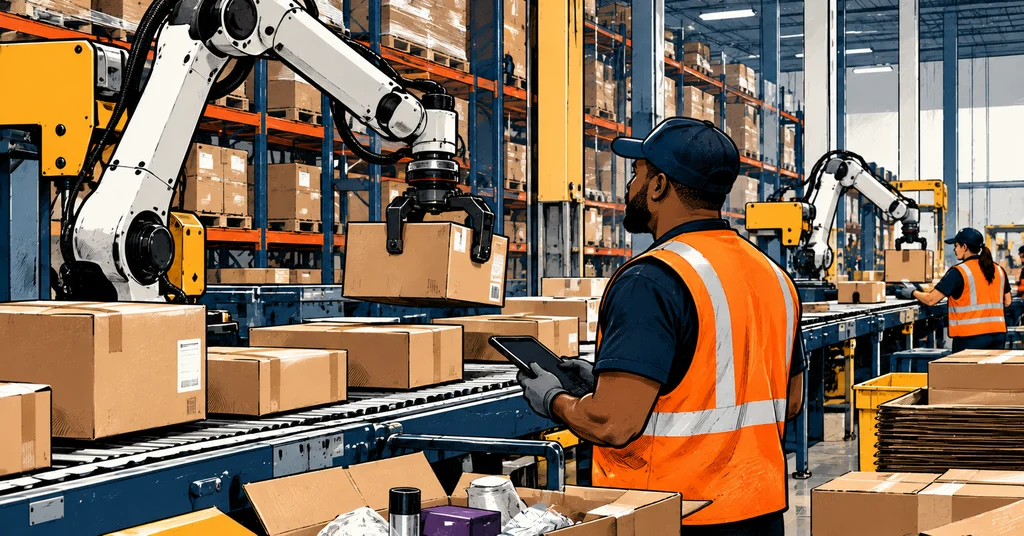
Walmart is discovering that warehouse automation does not happen simply because a company buys enough robots. A Wall Street Journal investigation published October 9 describes repeated technical and financial obstacles in the retailer’s effort to automate roughly 200 U.S. supply-chain buildings. The machines can struggle with cardboard boxes, oversized goods and the routine act of unpacking items for individual shipments. The stakes extend beyond engineering: Walmart’s distribution network supports thousands of stores and employs more than 140,000 warehouse workers, according to the Journal. A system meant to reduce handling time is now forcing the retailer to redesign packaging, maintenance routines and jobs around what machines can actually do.
The Costs Are Showing Up During Installation
One revealing expense is electricity. The Journal reported that monthly power bills at some automated grocery facilities can exceed $800,000 during peak periods, versus approximately $250,000 for more manual operations. These are reported examples, not a companywide average or proof that every automated site costs more to operate. Symbotic, one of Walmart’s robotics partners, also told the newspaper that the share of its robots under repair at a given time had improved to about 5%, down from under 10% last year. Better reliability is progress, but even a small failure rate can matter when the equipment is tightly connected and one stoppage delays work elsewhere in the building.
Walmart’s own announcements describe why the company continues investing. At its new Stockton, California, fulfillment center, opened October 8, the retailer said automation reduces a traditional 12-step fulfillment process to five steps. The site covers more than 900,000 square feet and is expected to create more than 1,000 jobs as it ramps up. Walmart also says the next-generation network will help it reach 95% of the U.S. population with next-day or two-day shipping. Those are company-reported capabilities and projections, not independent measures of realized productivity at every location. They explain the economic logic: more inventory moving through the same footprint, with fewer touches between a customer’s order and delivery.
The Worker Does Not Simply Disappear
Automation can remove repetitive physical tasks while creating demand for technicians, engineers and workers who can troubleshoot complex systems. But a change in job composition is not a guarantee of equal opportunities for people already employed. Warehouse workers accustomed to loading, sorting and moving merchandise may need paid training to qualify for remaining jobs. Others may see schedules, productivity targets or staffing patterns change. Walmart says its Stockton facility is hiring, and the Journal reported that executives expect attrition and growth to absorb much of the transition. Neither claim establishes that every existing worker will be unaffected.
The supplier economics are consequential too. Symbotic reported $721 million in fiscal third-quarter 2026 revenue, a 22% increase from a year earlier, and $55 million in net income compared with a prior-year loss. Those figures show a growing robotics supplier, not proof that Walmart’s individual warehouse projects have met their promised returns. The relationship requires both sides to deliver: Symbotic needs reliable deployments and Walmart needs systems that handle the awkward variety of real retail goods. A profitable technology vendor can coexist with an expensive installation for its customer.
A More Complicated Productivity Story
This is a useful counterpoint to the assumption that deploying automation immediately converts payroll savings into higher margins. A robot does not work in isolation. It needs compatible packaging, reliable power, software, maintenance and human intervention when a product falls outside the expected pattern. The company may spend more in one category while saving in another, and the benefits can arrive years after the capital outlay. SSC’s earlier report on Apple’s paused support-job automation plan examined a different workplace where management had to weigh the promise of replacing tasks against operational realities.
Walmart’s next test is not whether robots can move products in a demonstration. It is whether a network of hundreds of facilities can sustain promised throughput while protecting service, controlling new operating costs and offering a credible transition for its workforce. The company is pursuing automation for commercially understandable reasons: faster delivery, more capacity and less dependence on labor-intensive handling. Its difficulties show why the path from an impressive machine to a durable business model is longer than a product launch. The workers, suppliers and shoppers tied to that network will experience the consequences of how the rollout actually performs.