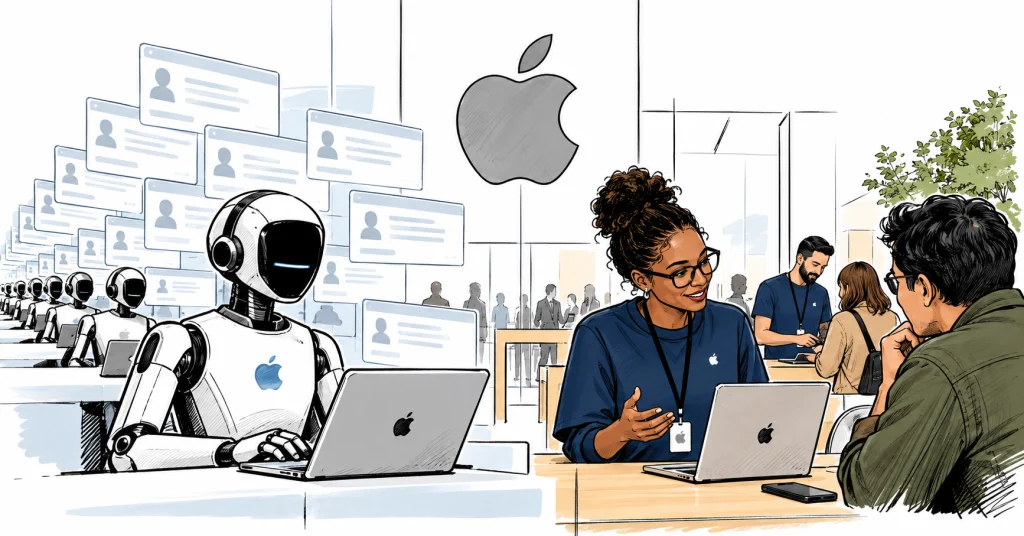
The plan is on hold. The more revealing part is that one of the world’s largest technology companies got far enough to model what customer service would look like without thousands of people.
Apple reportedly considered eliminating roughly 5,000 AppleCare support jobs and shifting some of that work to artificial-intelligence agents before putting the plan on hold. The company is not currently moving forward with the large-scale cuts, according to reporting based on Bloomberg’s account of an internal overhaul under CEO John Ternus. Apple has, however, already introduced a generative-AI assistant into its U.S. and Canadian AppleCare phone system, where customers can use the automated service before being transferred to a human adviser.
That sequence is more instructive than a completed layoff would have been. Companies have spent the past several years telling workers that AI will augment jobs, remove repetitive tasks and free employees to handle more complicated work. Apple’s deliberations show the next stage of that argument: employers are beginning to calculate how many people an AI system might allow them not to employ at all. A workforce reduction does not have to happen for the calculation itself to reshape hiring, staffing and investment decisions. Customer service was part of the product
AppleCare is particularly revealing because support is not peripheral to Apple’s business model. Customers paying premium prices for devices are also buying into an ecosystem built around stores, repairs, technical guidance and access to people who can solve problems when a device stops working. Automating a warehouse task and automating the conversation a customer has when a $1,000 phone fails are different operational decisions, even when the same cost logic sits behind both.
The technology is already moving into that interaction. Apple’s generative-AI phone assistant can answer questions and walk callers through troubleshooting steps, while still allowing escalation to a human adviser. That makes AppleCare a live test of the hybrid model many employers are now exploring: machines handle the predictable questions, people take the exceptions. The unresolved question is how many human advisers remain necessary once the automated system becomes competent enough to absorb a significant share of routine demand.
Ternus is simultaneously examining a broader effort to make Apple faster and leaner. Reuters reported that Apple has already reduced staff in parts of Siri, Vision Pro and AI software engineering while considering fewer layers of middle management and more direct connections between engineers and senior executives. The company is also reassessing how AI can automate internal work as it tries to accelerate product development. A plan can change employment before it happens
The AppleCare proposal is on hold, and that fact should not get buried. There are no 5,000 AppleCare layoffs currently moving forward based on the reporting available Wednesday. But companies do not need to execute every automation plan for AI to affect employment. They can slow hiring, leave vacancies unfilled, consolidate teams or raise the amount of work expected from each remaining employee once executives believe machines can absorb part of the workload.
For workers, that may be the more consequential phase of AI adoption. The transition does not always arrive as a dramatic announcement that a machine has taken someone’s job. Sometimes it begins inside a spreadsheet, where a company compares the cost of people with the expected capacity of software and discovers that an organization built for 5,000 workers might someday be designed for far fewer.