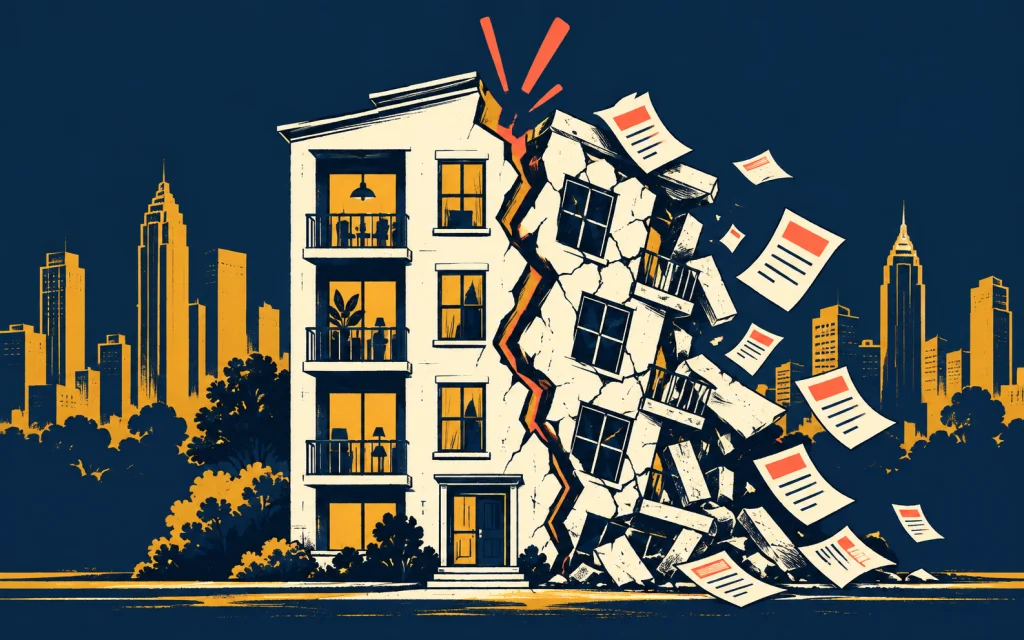
We keep asking whether America is in a recession. Atlanta’s eviction crisis suggests we may be asking the wrong question. The economy can keep growing while millions of households experience something that feels remarkably like contraction.
There is a strange ritual in American economic life where we wait for economists to give us permission to believe what people are already experiencing. We debate whether the country is technically in a recession, point to unemployment rates and GDP estimates, watch the stock market reach another milestone and then wonder why voters remain convinced something is wrong. Meanwhile, in five core counties around Atlanta, landlords filed 142,047 eviction cases from June 2025 through May 2026. Fourteen percent of renter households received at least one filing, and more than a third of households that were filed against had been subjected to repeat filings. Atlanta does not prove the United States is in a recession. It does show why that distinction is becoming less useful to the people trying to survive this economy.
As Social Storytellers Collective reported yesterday in “Atlanta’s Eviction Crisis Is Exposing Who Can No Longer Afford to Stay”, the numbers are not simply a story about housing. Black residents make up roughly 53% of renters in the five-county area but account for 69% of eviction filings. The filing rate is 24%, the highest among the cities and states included in Eviction Lab’s tracking system. Those numbers require an important qualification: a filing is not the same thing as a completed eviction, and repeated cases mean 142,047 filings do not represent 142,047 different families. But the correction does not make the economic signal disappear. It makes the signal clearer. A housing market in which thousands of renters repeatedly reach the point where landlords begin legal removal proceedings is showing us how little financial margin many households have left.
That is what makes Atlanta a microcosm rather than an outlier. Nationally, unemployment remains 4.2%, low enough that economists can reasonably describe the country as near full employment. Layoffs are not occurring at recessionary levels. But hiring has slowed, workers are moving between jobs less frequently, real disposable-income growth has remained weak, and September produced just 29,000 new jobs. Consumer confidence has deteriorated as well. People with lower incomes and smaller stock portfolios have reported some of the sharpest declines in sentiment. We have built an economy in which the aggregate numbers can remain defensible while the household experience becomes increasingly difficult to defend.
Perhaps that is why the recession debate feels so detached from daily life. A recession is a useful macroeconomic concept, but a family does not pay rent with GDP. A renter facing a filing does not experience unemployment at 4.2%; that renter experiences the $300 that is missing before rent is due. A worker who still has a job but cannot find a better-paying one does not necessarily experience the labor market as strong. A household that spent the last several years absorbing higher food, insurance, housing and borrowing costs does not suddenly feel restored because inflation has slowed from its peak. The economy can expand statistically while economic security contracts personally. Atlanta is showing what happens when enough households reach that line at the same time.
This is also why the November 3 midterm elections may tell us more about the economy than another argument over whether the word “recession” technically applies. Eighty-four percent of registered voters say the economy is very important to their midterm vote, according to Pew. AP-NORC found that just 17% of adults approve of Donald Trump’s handling of the cost of living and only 26% approve of his handling of the economy overall. Democrats currently hold an advantage over Republicans on whom voters trust more to address the cost of living, but even that should not be mistaken for broad confidence: only about two in 10 voters believe either party is focused on helping people like them.
That last number may be more important than either party wants to acknowledge. Elections are often treated as ideological verdicts when they can just as easily become household balance-sheet votes. A voter may know nothing about quarterly GDP and still know that groceries cost more, the credit card is carrying a balance, the landlord raised the rent and changing jobs no longer feels as easy as it did a few years ago. Recent polling shows voters increasingly blaming the Trump administration for high prices, while resistance to tariffs has grown as their costs become more visible in businesses and household budgets. If Republicans lose ground in November, the temptation will be to explain it entirely through Trump, Iran, immigration or partisan turnout. The economy running underneath those issues may provide the simpler explanation: people vote differently when they believe their standard of living is moving backward.
Atlanta should therefore be read as a warning, not an anomaly. When 142,047 eviction filings can coexist with low unemployment, rising markets and economists debating whether the economy remains fundamentally sound, something important is happening between the national indicators and the household ledger. We may never receive the clean recession declaration that makes everyone agree the economy is in trouble. We may instead be living through something more fractured: growth for people holding assets, instability for people living close to the edge, and a widening gap between what the economy says about itself and what households say about the economy. The midterms will not settle that argument. But they may be the first national count of how many Americans have already made up their minds.