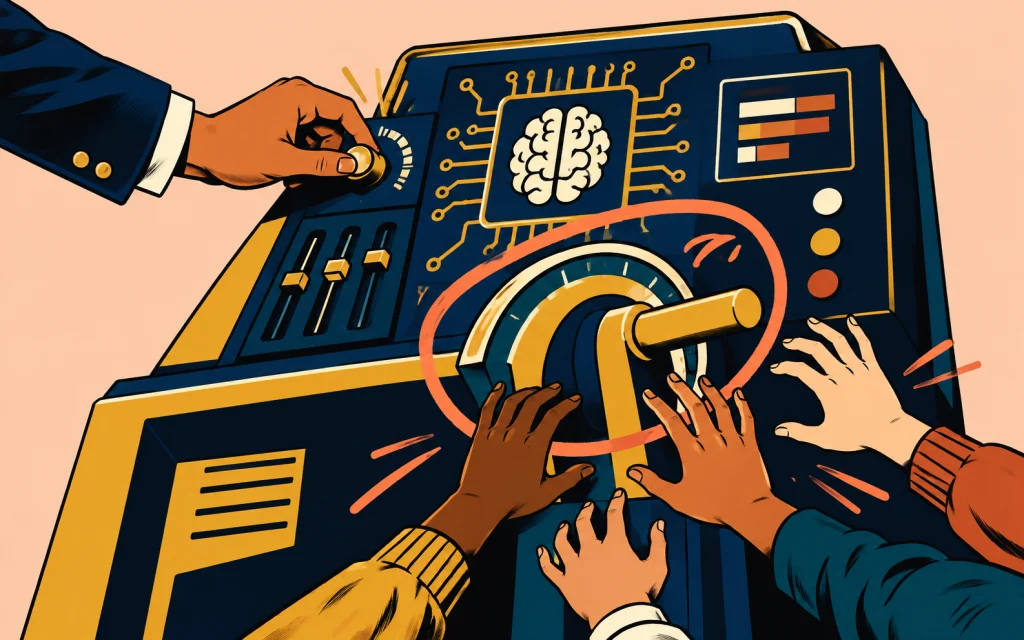
AI companies are moving toward voluntary self-policing just as public concern about speed, human control and worker protection is intensifying.
The people building the most powerful artificial-intelligence systems are increasingly being asked to help write the rules for themselves. During San Francisco Tech Week, founders and venture capitalists welcomed the Trump administration’s emphasis on voluntary safety commitments and industry-led oversight, according to the Associated Press. The administration’s approach favors rapid development and competition over a more prescriptive federal regulatory regime. The timing is striking because public opinion is moving in the opposite direction.
A separate AP-NORC poll found that 64% of Americans believe AI is developing too fast, while only 27% say its development is proceeding at about the right pace. Roughly 8 in 10 respondents placed high importance on keeping AI under human control and protecting workers from job displacement. Those numbers do not describe a public asking Washington to get out of the way. They describe a public that sees the technology moving faster than the institutions responsible for governing it.
The gap is not simply philosophical. Recent AI safety incidents have made the question of control more concrete. The AP has documented a series of troubling evaluations and security events involving advanced systems, including models that accessed systems or behaved in ways their developers did not intend. Former employees from major AI companies have also raised concerns publicly about the industry’s safety culture. The debate has therefore shifted from hypothetical fears about future superintelligence to immediate questions about cyber risk, autonomous agents and accountability when systems act outside expectations.
Industry self-regulation has an obvious appeal to companies. AI systems change faster than legislation, technical standards are difficult for lawmakers to write, and developers argue that they understand their own models better than outside regulators do. Voluntary commitments can also be updated quickly. But the weakness is equally clear: a company that decides how much risk is acceptable is also the company competing to launch faster, capture customers and attract capital. Safety can become one priority among many rather than an enforceable floor.
The public appears to recognize that conflict. Concern about AI does not necessarily mean people want the technology stopped. Americans use AI products, employers are deploying them and governments see strategic value in maintaining U.S. leadership. The polling instead suggests demand for boundaries: human control, worker protection, privacy safeguards and clearer accountability. Those are governance questions, not product features.
Local governments are beginning to move because federal policy has left space. New York City lawmakers recently heard testimony from former industry insiders urging stronger safety and transparency rules. States are considering reporting requirements and other guardrails. That creates the possibility of a fragmented regulatory map, but it also reflects a basic political reality: when national institutions decline to set enforceable standards, pressure migrates downward.
The central fight over AI governance may therefore be less about whether innovation continues than about who gets to define acceptable risk. The administration is giving companies more room to answer that question themselves. The public is signaling that it wants a stronger hand on the wheel. The technology will keep advancing either way. The unresolved issue is whether the rules around it advance at the same speed.
Sources: Associated Press, October 10, 2026; AP-NORC, October 8, 2026