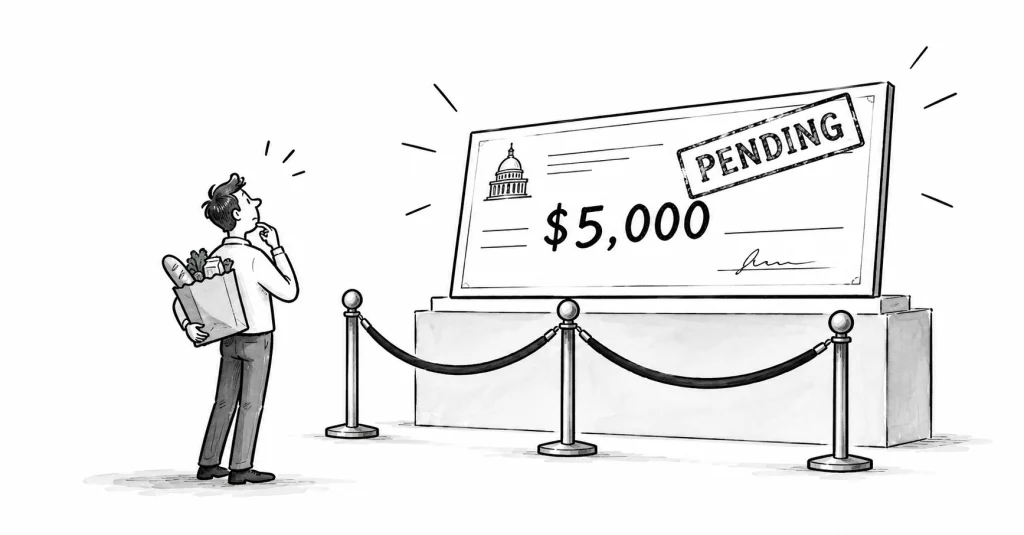
The proposed “Trump Dividend” would cost approximately $1.2 trillion and depends on Republicans retaining control of Congress. With less than a month until the midterms, there is still no legislation, payment schedule or established funding mechanism.
POLICY | BUSINESS & ECONOMY
A $5,000 payment to approximately 245 million adult Americans would cost the federal government roughly $1.2 trillion, or about 16% of annual federal spending. That is the scale of the promise Donald Trump made at the Republican midterm convention in Dallas on September 9, when he announced what he called the “Trump Dividend.” The proposed payment would go to every adult U.S. citizen, provided Republicans retain control of both the House and Senate in the November 3 elections. Trump repeated the pledge in an October 3 video, linking the money to tariff revenue and economic growth. But nearly a month after the original announcement, the administration has not presented legislation, identified a payment date or demonstrated how the federal government would finance the program. For households confronting persistent costs for groceries, housing and healthcare, the announcement offers a substantial potential benefit. Whether it becomes an actual payment is a separate question.
The $1.2 Trillion Funding Question
Trump has suggested that tariffs could provide the money, describing the payments as a return on the administration’s economic policies. The arithmetic presents a significant obstacle. According to FactCheck.org’s analysis of Treasury data, the United States collected approximately $264 billion in net tariff revenue in 2025, compared with $79 billion in 2024. After accounting for refunds associated with tariffs invalidated by the Supreme Court, net collections totaled approximately $64 billion through July 2026. Marc Goldwein of the Committee for a Responsible Federal Budget estimated that tariffs were generating less than $200 billion annually, meaning more than six years of collections would be needed to cover a single round of $5,000 payments. That calculation also assumes the money would not be used for existing spending commitments or deficit reduction.
An Election Condition Is Not a Payment Authorization
The White House has promoted the dividend as an economic benefit that would follow continued Republican control of Congress. In its September 10 announcement, the administration characterized the proposed payments as a way for Americans to share in national economic gains. However, winning an election would not itself authorize the Treasury to distribute $1.2 trillion. Congress would still need to approve the spending or establish another lawful funding mechanism. Lawmakers have not advanced such legislation, and fiscal conservatives have raised concerns about adding to federal deficits. Economists interviewed by FactCheck.org also warned that a large, deficit-financed payout could increase inflationary pressure and borrowing costs, potentially offsetting some of the financial relief recipients would receive.
The Requirement to Spend the Money in America
Trump has attached another condition to the proposal: recipients would have to spend their payments within the United States. That requirement introduces questions about implementation and enforcement. Would the government issue ordinary checks, direct deposits or restricted payment cards? Would purchases from foreign-owned businesses operating in the United States qualify? What would happen if recipients saved the money or used it to pay existing debts? None of those questions has been resolved. During an October 7 exchange reported by Roll Call, Trump expressed confidence that the spending restriction could be managed but did not identify a specific enforcement mechanism. Without a defined structure, the proposed dividend remains a political commitment rather than an operational government benefit.
Other Payments Are Already Reaching Selected Americans
The $5,000 proposal also arrives alongside smaller payments the administration has begun distributing. According to Reuters’ October 7 reporting, the government announced $90 payments for approximately 20.8 million Medicare Part B enrollees and distributed $500 payments to roughly 950,000 people who purchased qualifying health insurance through HealthCare.gov. These programs have narrower eligibility requirements and existing administrative mechanisms. They should not be confused with the proposed universal adult dividend. Most Medicare beneficiaries will not qualify for the $90 payment, and most Affordable Care Act marketplace customers will not receive the $500 payment. The difference illustrates why a public announcement, an authorized benefit and an actual payment must be evaluated separately.
The Promise Meets the Household Budget
A $5,000 payment could help households address overdue bills, replenish savings or absorb rising expenses, but its practical value depends on whether the proposal becomes law and how it is funded. Trump previously discussed $2,000 tariff dividends and a $5,000 payment tied to government efficiency savings, neither of which resulted in the promised broad distribution. The current proposal is more explicitly connected to an election outcome, and its financial requirements are considerably larger than the smaller benefit programs already underway. For Americans trying to make financial decisions today, the relevant facts are straightforward: no $5,000 dividend has been authorized, no distribution date has been established and no application process exists. The next development to watch is not another campaign announcement but whether Congress receives a concrete funding proposal that can withstand budgetary and legal scrutiny.