
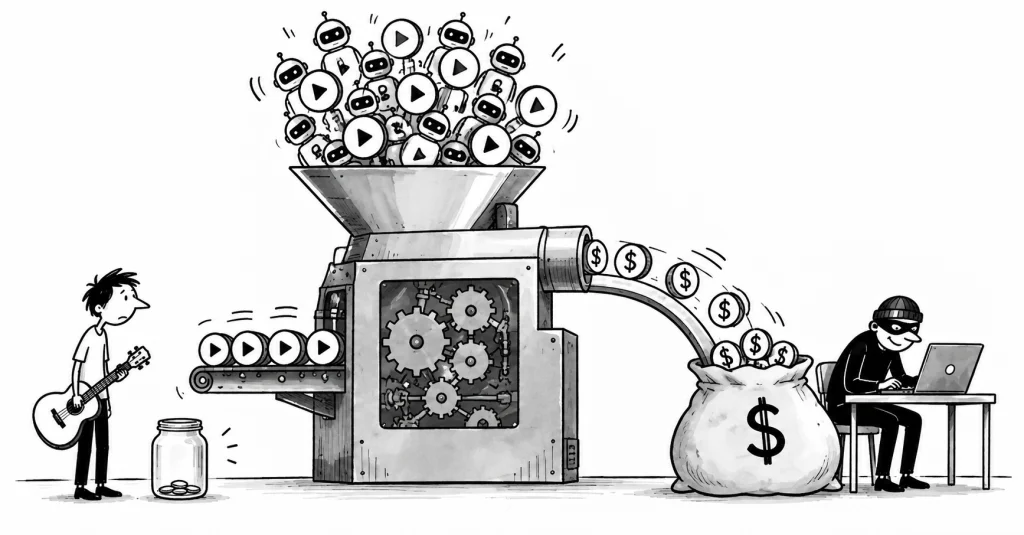
An 18-month sentence in an AI-assisted streaming fraud case exposes how fabricated listening can redirect money away from working musicians.
Michael Smith, a North Carolina musician, was sentenced on October 6 to 18 months in federal prison and ordered to forfeit $8,091,843.64 for a music-streaming fraud scheme, according to the Justice Department’s sentencing announcement. The case has moved from a March guilty plea to a concrete penalty. Its cultural consequence lies in the payment system the scheme manipulated: recorded listening activity helps determine where streaming royalties go. When that activity is manufactured, the apparent audience can produce financial rewards without the underlying relationship between an artist and a real listener.
The Audience Was Automated. The Payments Were Not.
Prosecutors described a scheme operating from 2017 to 2024, using fraudulent accounts and software to repeatedly stream music Smith controlled. At times, he used as many as 10,000 bot accounts, with activity spread across a large catalog to avoid attracting attention to a single song. AI-generated music supplied material at the scale the operation required. The criminal conduct was the fraud used to obtain royalties. The sentence does not establish that creating music with AI is itself illegal, and that boundary is essential to understanding what the court punished and what the case reveals about platform safeguards.
SSC Premium · Free with signup
Keep reading. It’s free.
This is a Premium story from Social Storytellers Collective. Enter your email to unlock the rest right now, and get the End of Day Closing Note seven nights a week. Already a subscriber? Use the same email and you’ll go straight back to the story.
Free. Unsubscribe anytime. Premium readers also hear first when The Deep View membership opens.