
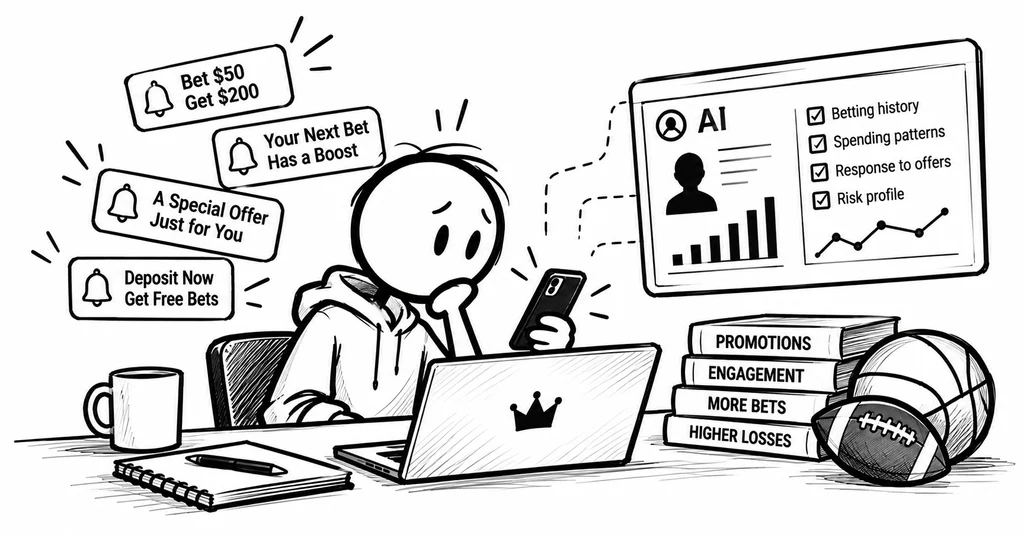
Investigations and a new federal lawsuit are challenging how the sports-betting company uses customer data, promotional incentives and technology intended to identify harmful gambling behavior.
A federal lawsuit filed September 30 alleges that DraftKings used artificial intelligence to identify customers likely to lose money and encourage them to continue betting. The complaint, brought by West Virginia resident Daniel Vest in Massachusetts federal court, claims the company targeted vulnerable customers with promotional offers rather than using their betting histories to intervene when gambling became risky. Vest alleges he received at least 70 promotional messages in approximately 30 days. DraftKings denies the allegations, but the case follows separate investigations by The New York Times and ProPublica that have raised questions about the relationship between customer protection and profitability in the rapidly expanding online gambling industry. The controversy now extends beyond one company, with Massachusetts regulators examining how sportsbooks use artificial intelligence.
When Customer Data Becomes a Business Strategy
The controversy began with a September 19 New York Times investigation examining how DraftKings uses machine learning to determine which customers receive promotional incentives. Reporters interviewed more than 40 former employees and reviewed internal documents, presentations and betting records. According to the investigation, the company developed a model that evaluated how customers responded to bonuses and promotional offers, including whether those incentives produced additional betting losses. One internal measure, described as customer elasticity, helped determine which bettors were most likely to increase their activity when offered incentives. Former employees told the newspaper that customers considered more responsive could receive additional promotions, while those less likely to generate returns received fewer.
The investigation also described a separate effort to develop technology capable of identifying customers at risk of gambling addiction. Former employees said a predictive model designed to assign risk scores was sidelined, even as promotional targeting continued. DraftKings disputed the characterization, explaining that the proposed responsible-gambling model lacked sufficient evidence of effectiveness and that the company relied on other safeguards. That disagreement exposes a consequential question about how businesses prioritize competing applications of the same technology. Customer behavior can reveal opportunities to increase revenue, but it can also provide early indications of financial distress or compulsive activity. Whether companies use those signals to encourage spending, prevent harm or accomplish both deserves scrutiny.
A Reporter Tests the Safeguards
A separate ProPublica investigation published September 26 provided another perspective. Reporter Jake Pearson spent 10 weeks deliberately gambling in ways associated with problematic behavior to evaluate how DraftKings responded. During the experiment, he repeatedly chased losses, placed increasingly large wagers and received promotional incentives. After losing approximately $1,800 in one night, he was invited to audition for the company’s VIP program the following day. He eventually received a personal representative and continued receiving betting incentives despite behavior that gambling researchers identified as concerning. The experiment ended with $10,702 in losses, according to Pearson’s reporting.
DraftKings maintained that its responsible-gambling safeguards operated appropriately during the experiment. The company offers deposit limits, temporary account restrictions, self-exclusion options and notifications encouraging customers to evaluate their gambling activity. Its responsible-gaming leadership also emphasized that Pearson’s individual experience could not establish how the platform treats every customer. Still, the investigation documented instances in which promotional messages followed warnings about gambling behavior, illustrating how consumer-protection features can coexist with marketing designed to increase engagement. In an October 6 follow-up, ProPublica examined what the experiment revealed about the design and oversight of online betting platforms.
Regulators Enter the Conversation
Massachusetts regulators are now reviewing the use of artificial intelligence by DraftKings and other licensed sportsbooks. The state has rules restricting the use of customer data and technologies reasonably expected to make gambling more addictive. The Massachusetts Gaming Commission’s review followed the Times investigation, while Vest’s proposed class action seeks damages, refunds and restrictions on the alleged targeting practices. Neither the lawsuit nor the regulatory inquiry establishes that DraftKings violated the law. CEO Jason Robins has publicly challenged the Times reporting, arguing that the company does not use AI to target customers because they lose money or exhibit problem-gambling behavior. He has also defended its responsible-gaming team and the company’s existing safeguards.
The implications extend beyond sports betting. Retailers, financial platforms, subscription services and digital advertisers increasingly use behavioral data to predict when customers will spend, disengage or respond to incentives. In gambling, however, the financial relationship is unusually sensitive because additional customer losses can translate directly into company revenue. The DraftKings controversy illustrates why transparency around algorithmic decision-making cannot be limited to whether a system accurately predicts consumer behavior. Regulators and consumers also need to understand what companies do with those predictions, what protections exist when customers demonstrate vulnerability and whether those protections can meaningfully interrupt revenue-generating activity. As the legal and regulatory reviews continue, those questions will help determine how accountability develops across an industry built around continuous digital engagement.