
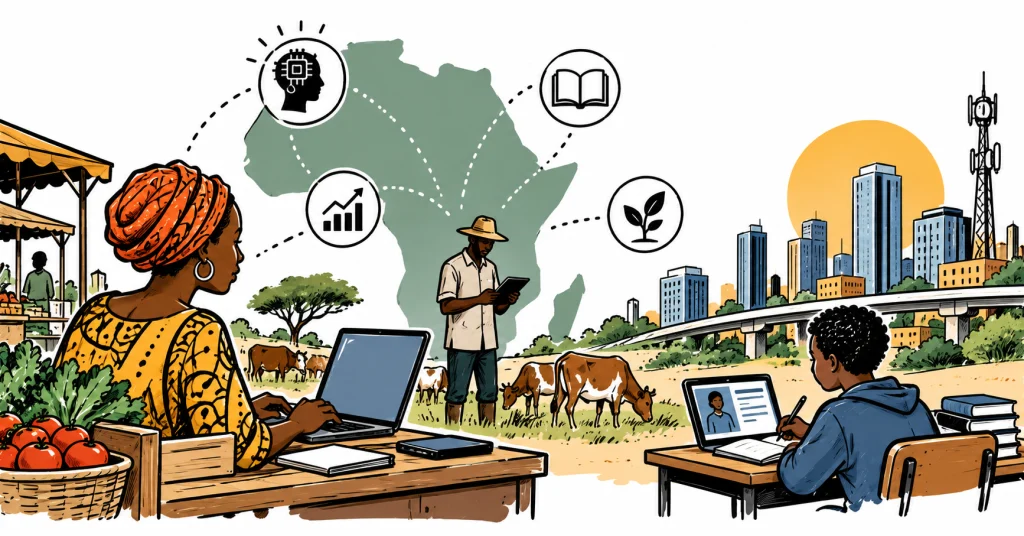
The World Bank sees affordable, locally adapted AI as a route to higher productivity. Whether families benefit depends on who can use the tools—and who keeps the value they create.
Sub-Saharan Africa’s economy is projected to grow 4.3% in 2026, but per-capita income growth is expected to reach only about 1.8%. Those figures describe an expanding economy whose gains remain too slow to reduce poverty substantially. In Reuters reporter Duncan Miriri’s coverage of the World Bank’s October 6 outlook, the bank identifies artificial intelligence as one route to stronger productivity and job creation. The opportunity centers on affordable tools for everyday work: helping students learn, farmers manage livestock disease and small businesses handle accounting. These are proposed applications, rather than evidence that AI has already delivered widespread household gains.
The World Bank’s regional announcement also forecasts median inflation rising from 3.7% in 2025 to 5.5% this year as fuel, fertilizer and food costs increase. That pressure reaches households through essential purchases and businesses through operating expenses. Per-capita income is an average, so its growth does not establish that every family is better off. The combination makes the development challenge concrete: national output can rise while employment opportunities remain scarce and the cost of maintaining a household increases. Productivity improvements must translate into earnings, affordable services or lower costs to change that experience.
Small Tools, Practical Returns
The bank’s emphasis on locally adapted, low-bandwidth AI applications points toward a development strategy built around existing needs. Consider the possible mechanism: a business owner spends less time reconciling accounts, a farmer identifies a problem earlier, or a teacher gains support preparing lessons. Each improvement could preserve income, reduce losses or free time for other work. Those benefits would depend on accuracy, affordability and whether the user can act on the information. Better advice has limited economic value when a farmer cannot obtain treatment or a business cannot secure the supplies needed to fulfill an order.
Shared data-center capacity and stronger data-protection laws could help adoption, World Bank Africa chief economist Andrew Dabalen told Reuters. Pooling computing resources could spread infrastructure costs, but the terms of access would determine how broadly that benefit travels. Small firms need services they can afford and understand, while public institutions need dependable systems and safeguards for the information they hold. If infrastructure primarily serves large companies, investment could raise their efficiency without extending the same opportunity to smaller competitors. The distribution of computing access becomes part of the distribution of economic opportunity.
Electricity Comes Before Adoption
The foundations remain uneven. In its August assessment of AI and developing economies, the World Bank reported that nearly one-third of rural schools in Sub-Saharan Africa lack reliable electricity and more than two-thirds lack dependable internet access. A low-cost application still requires a usable device, power and sufficient connectivity. Without those conditions, schools and businesses already equipped to adopt technology could advance faster while others remain excluded. Spending on AI therefore needs to be assessed alongside investments that make ordinary digital participation possible.
The same assessment stresses local-language data, skills and evidence about which projects deliver results. Those requirements shape who gains influence over the technology. Local developers and institutions need the capacity to adapt tools, evaluate their performance and negotiate workable contracts. Governments purchasing systems need ways to measure improvements beyond the number of accounts created or applications launched. A tool that saves time could benefit workers through higher earnings, employers through lower costs or customers through cheaper services. Adoption alone cannot establish which outcome occurred, and greater efficiency does not automatically produce additional jobs.
Measure the Gain Where People Live
If affordable AI reaches smaller businesses, rural communities and public services—and produces verified improvements—it could help make growth more useful to households. If access concentrates among firms and institutions already well equipped, the technology could widen differences within a growing economy. The next investment cycle should be judged through outcomes people experience: business income, agricultural losses, learning, service costs and employment. Sub-Saharan Africa’s stronger forecast creates an opening. Turning it into shared prosperity requires the infrastructure, institutions and economic arrangements that let people retain the benefits of becoming more productive.