
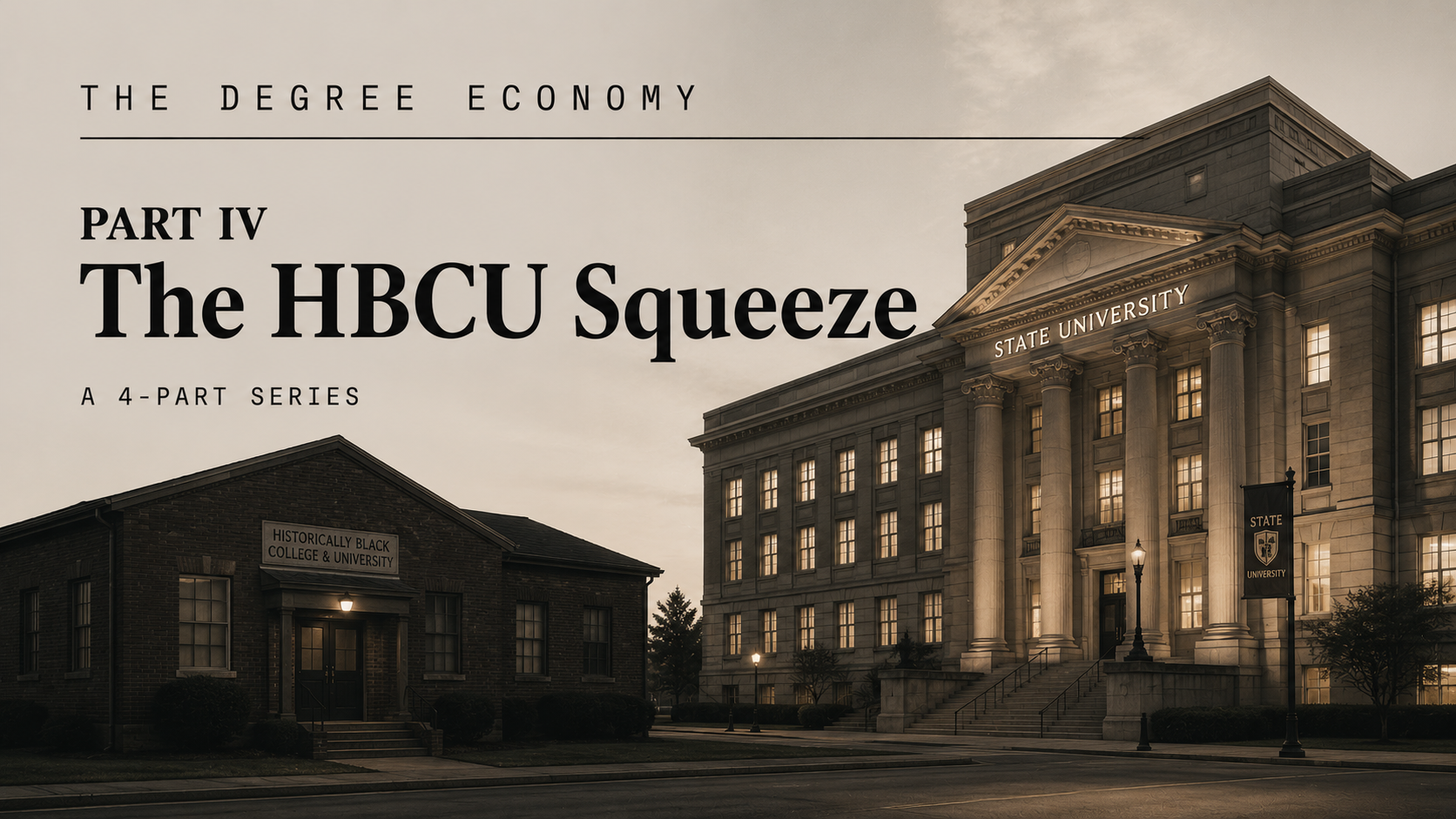
HBCUs produce 40% of Black engineers in America. 80% of Black judges. 40% of all Black members of Congress. They do this while educating students using far less money per capita than predominantly white institutions — and while operating without the endowment cushions, alumni donor networks, and federal research funding streams that make financial resilience possible at schools like Harvard, Michigan, or UCLA.
Now the MBA fire sale has arrived. And HBCUs are not leading it.
The schools offering dramatic tuition cuts — Purdue, UC Irvine, Johns Hopkins, Washington University — are mid-tier institutions with enough financial flexibility to absorb the short-term revenue loss from a discount strategy. They are betting that lower prices will stabilize enrollment, attract working professionals, and position them favorably against the online MBA programs eating into their market from below. The bet may or may not pay off. But they have the institutional margin to make it.
HBCU business schools are operating in a fundamentally different environment. Their student populations are disproportionately Pell Grant-eligible, first-generation, and from lower- and middle-income Black families — the same families whose financial capacity is being compressed by federal workforce reductions, DEI rollbacks, and the economic instability the broader series has documented. These students are not choosing between a $129,000 MBA and a $99,000 MBA. Many of them are choosing between graduate school and financial survival.
The federal funding picture for HBCUs in 2025 and 2026 is complicated — and deliberately so. The Trump administration announced a one-time $500 million boost to HBCUs and tribal colleges in September 2025. The announcement was celebrated in some corners. What the headline obscured was that the funding came directly from the elimination of $350 million in grants previously supporting Hispanic-Serving Institutions — a redistribution of constrained resources between underserved communities, not new investment in either. The broader 2026 budget proposed a 14.4% cut to Title III funding, the primary federal mechanism for helping HBCUs improve educational quality, management, and financial stability. Howard University — the nation’s only federally chartered HBCU — faced a proposed $64 million cut just two days after Trump told a national audience that HBCUs had “nothing to worry about.”
Nearly half of all HBCUs have been targeted for federal funding terminations under the current administration, according to the Center for American Progress. The programs at risk are not peripheral. They include the Strengthening HBCUs Program, Federal Work-Study, Second Chance Pell, STEM education support, and the administrative capacity grants that allow under-resourced institutions to function at all. Some smaller HBCUs have already begun contingency planning — identifying essential programs and developing strategies to support students if their financial aid is disrupted.
This is the squeeze. On one side: a tuition-cutting market that rewards institutions with the financial flexibility to discount without destabilizing their operations. On the other: a federal funding environment that is withdrawing the support HBCUs depend on to serve the students most affected by the broader economic restructuring this series has documented.
The private HBCU scholarship ecosystem is also contracting. Many private organizations ended their HBCU-specific scholarship programs following Trump administration guidance challenging DEI initiatives at publicly funded institutions. The Thurgood Marshall College Fund and the HBCU Endowment Fund are still operating — but the broader scholarship landscape for HBCU students is narrower than it was three years ago, in a moment when HBCU students need it most.
The deeper structural problem is that the MBA fire sale is accelerating a bifurcation in graduate business education that HBCUs were already losing. The top-20 programs — Harvard, Wharton, Booth — are holding or raising rates and maintaining their prestige premium. The mid-tier schools are discounting to compete. HBCU business schools are competing on neither dimension. They cannot match the prestige signal of elite programs, and they cannot sustain deep discounts without federal and philanthropic support that is being systematically withdrawn.
What that means in practice: the students most likely to benefit from an HBCU business school education — Black students from lower- and middle-income backgrounds, first-generation graduate students, working professionals in underserved communities — are being squeezed out of the market at exactly the moment when credential upgrades matter most. The fire sale is happening around them. The conditions that would make it usable for them are deteriorating.
There is an argument that HBCUs should be building something different from the traditional MBA entirely — credentials designed for the economy that is actually arriving, not the one that existed when the MBA was invented. Some are trying. The challenge is that building new programs requires resources, and resources are what is being withdrawn.
HBCUs were built to do the impossible under impossible conditions. They have done it before. The question this series has been building toward is not whether they are capable. It is whether the institutions and systems surrounding them — federal government, private donors, corporate partners, accreditors, the MBA market itself — are willing to sustain the conditions that make that capability matter.
The fire sale is on. The schools with the most to lose from a credentialing collapse are the ones with the least capacity to respond to it. And the students who most need the credential to work are the ones whose access to it — and whose economic environment around it — is being compressed from every direction simultaneously.
That is The Degree Economy. Not a story about business schools cutting prices. A story about who the credential was always designed to serve — and who has always had to fight the hardest to make it work for them.
This is Part IV of The Degree Economy, a Social Storytellers Collective series. The full series is available at socialstorytellers.substack.com.
— SSC