
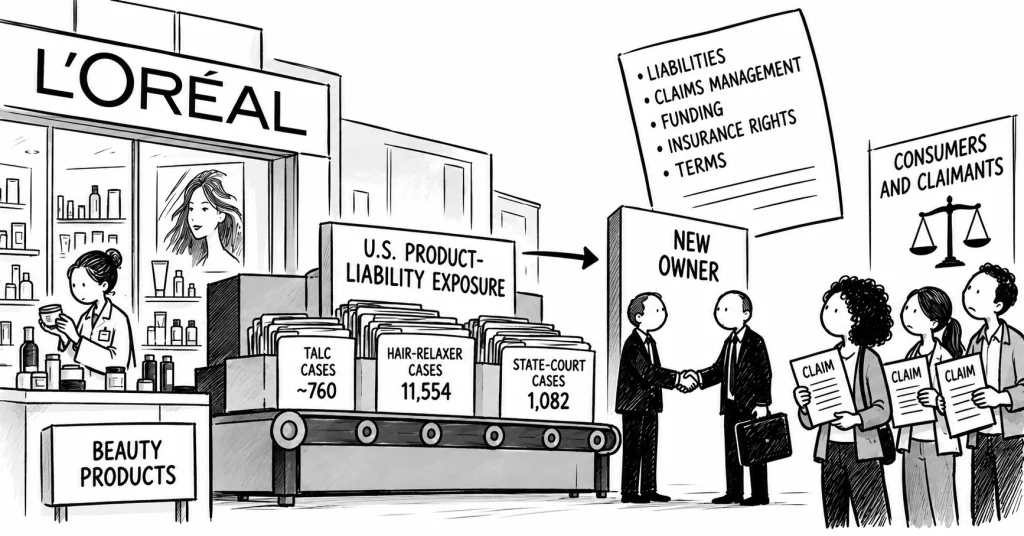
Advisers are examining how to separate U.S. product-liability exposure from the beauty company’s operations. For claimants, the terms would determine who manages the cases and what resources stand behind them.
L’Oréal disclosed approximately 760 pending U.S. talc-related proceedings as of June 30, alongside 11,554 federal hair-relaxer proceedings and 1,082 state-court actions. Now, Wall Street Journal reporters Alexander Gladstone, Andrew Scurria and Jodi Xu Klein report that its U.S. subsidiary has hired restructuring advisers to examine options for chemical-related liabilities. One reported option would place liabilities in a separate entity and sell it to an outside investor. The company is exploring a transaction; the reporting does not establish that it has completed one. L’Oréal disputes the underlying product-liability claims, which remain allegations rather than established findings that its products caused the asserted illnesses.
The proposed mechanism would separate the business selling products from an entity responsible for managing specified litigation. Reuters’ account of the Journal’s reporting identifies law firm Weil Gotshal & Manges and investment bank Ducera Partners as advisers. It says they are examining a sale outside Chapter 11, including a structure resembling an earlier Honeywell transaction. L’Oréal and the advisers did not immediately respond to Reuters’ requests for comment. The scope, funding and legal terms of any eventual deal are therefore unresolved. Those details would determine whether separation changes the administration of claims, financial responsibility or both.
The Liability Becomes Something an Investor Can Price
A potential buyer would evaluate uncertain future costs: legal defense, settlements, judgments and the timing of payments. Cash, insurance rights or other assets accompanying a transaction could provide resources to meet those obligations. That creates a business proposition around managing the difference between available funding and eventual costs. For the operating company, the attraction is reducing uncertainty and management demands. For claimants, the priority is different: preserving a viable route to compensation if they establish their cases. The same transaction can therefore offer corporate predictability while raising practical concerns about the resources supporting future payments.
Liability sales already have a corporate precedent. In a 2021 announcement filed with the Securities and Exchange Commission, industrial company ITT said it sold a subsidiary holding legacy asbestos liabilities and associated insurance assets to Delticus. ITT contributed approximately $398 million in cash to the subsidiary at closing. Delticus assumed operational management, including claims administration and insurance recovery. That example shows why the assets transferred alongside liabilities are central to understanding a deal. It also shows that a liability transaction involves an operating claims-management business, alongside accounting changes for the seller.
A New Corporate Structure Cannot Establish Product Safety
L’Oréal’s 2026 half-year financial report treats the litigation categories separately. The talc cases concern allegations of asbestos particles in certain cosmetics; the hair-relaxer cases concern ingredients alleged to have caused health problems. The report says some talc claims have been dismissed and others settled, with none involving its subsidiaries having reached trial at that point. It describes discovery in the hair-relaxer litigation as ongoing. A restructuring would address how exposure is organized and financed. It would not itself resolve the evidence, establish causation or decide the merits of individual claims.
For consumers pursuing cases, the practical test would be the financial and legal protections behind any separation. Relevant terms would include which claims are covered, how much funding accompanies them, what insurance remains available and whether additional financial support exists if costs exceed expectations. Our reading is that accountability must be assessed through those arrangements rather than the transaction’s headline. A well-funded claims entity could offer dedicated administration. An inadequately funded one could create collection concerns. The current reporting does not establish which outcome a L’Oréal transaction would produce.
If L’Oréal advances the proposal, scrutiny will shift from whether liabilities can be sold to what claimants retain after the sale. Investors will examine the price of uncertainty; consumers will need clarity about the resources available to resolve their cases. As more companies consider separating legacy exposure, the durability of those resources could become an increasingly important part of product accountability. The decisive evidence will be in the transaction terms—and whether funding remains sufficient when claims come due.