
As we explored in When the Target Boycott Ends, the real test of economic activism is rarely the moment of declared victory. It’s what gets built in the silence that follows.
“Spend in the Black” is one of the more serious attempts to answer that question — and it doesn’t ask corporations anything.
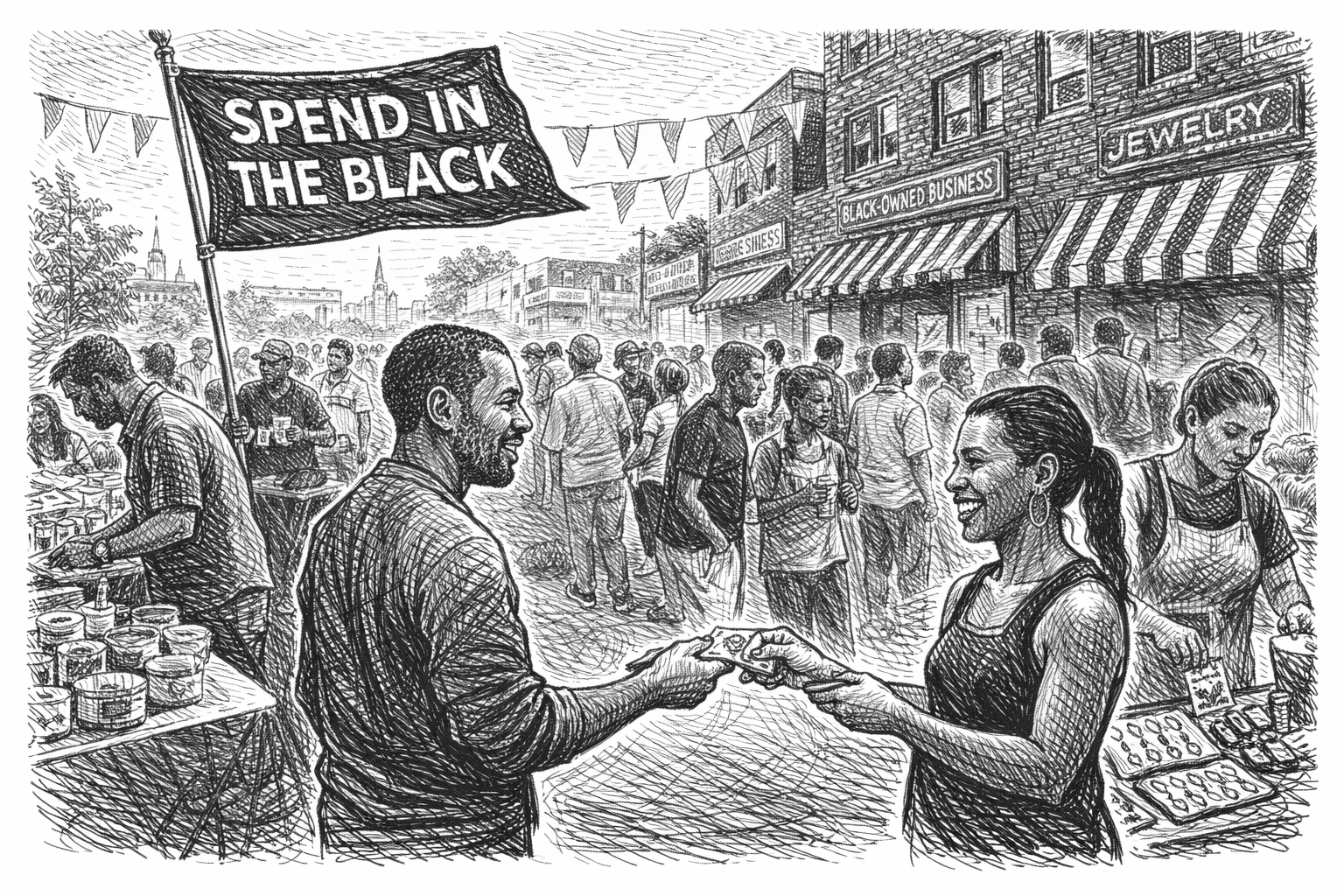
Tomorrow, on April 4, Salem Baptist Church of Chicago is transforming 75th Street and King Drive on the city’s South Side into what organizers are explicitly calling a Black Wall Street. More than 100 Black-owned businesses will line the corridor — food, coffee, jewelry, beauty products, handmade goods — in a marketplace designed not just to celebrate Black entrepreneurship but to demonstrate what concentrated Black consumer dollars can do to a neighborhood economy in a single afternoon. According to Alderman William Hall, who helped organize the event, “Spend in the Black” generates between $500,000 and $1 million in spending across three blocks in one day.
That number is worth sitting with. Black buying power is projected to reach $2.1 trillion in 2026 — a 71% increase since 2010. The resource is not the problem. The direction it travels is.
Boycott economics is organized around withdrawal. You stop spending, the institution feels it, pressure accumulates, something shifts. That logic works — the Target campaign demonstrated it. But withdrawal is ultimately dependent on the institution on the other end of the pressure. The outcome still lives inside a corporate boardroom. What “Spend in the Black” is proposing is a different architecture entirely: not pressure directed outward, but investment directed inward. Not asking companies to change, but building something that doesn’t require them to.
Rev. Dr. Charlie E. Dates, Salem Baptist’s senior pastor, has been deliberate about the theological framing. This is ministry as marketplace. As we explored in Gen Z and the Renegotiation of Black Faith, young Black Americans are not abandoning belief — they are stepping away from institutions that stopped feeling like safety. “Spend in the Black” is a bet that the church can respond not by asking them back, but by meeting them somewhere new. That framing is not incidental. Black churches have historically been among the most durable economic organizing structures in Black America — not because they were designed as financial institutions, but because they already had what economic movements require: trust, density, and the capacity for collective action that doesn’t need a crisis to activate.
The honest answer is that it’s still being tested. One day, one corridor, one city is a proof of concept. The history of Black economic corridors is also a history of what happens when concentrated Black wealth becomes visible enough to attract the wrong kind of attention — Tulsa’s Greenwood District being the most devastating example. That history doesn’t argue against building. It argues for building with clear eyes about what durability actually requires.
What’s different now is the scale of the organizing infrastructure and the clarity of the argument being made. The boycott proved that Black consumers can move in the same direction when the conditions are right. “Spend in the Black” is asking whether that same discipline can be directed not at a corporation, but at a corridor — and whether the habit, once built, can outlast a single event. Wellness culture figured this out years ago: take what people are already doing, give it structure and language, and the behavior compounds Nothingmaxxing. The same principle applies here. Consumer habits redirected intentionally don’t just generate revenue — they generate identity.
The Target boycott asked a company to be worthy of Black consumer dollars. “Spend in the Black” is asking whether those dollars can build something that belongs to the community before anyone else is invited to weigh in.
That’s a different kind of power. And it’s the question that matters most now that the boycott conversation has moved on.