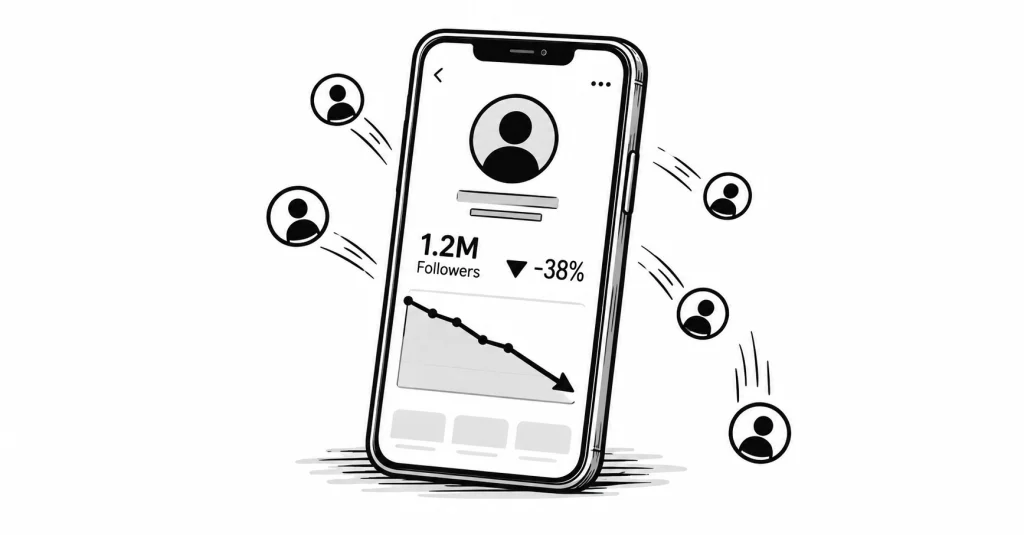
Reports say the actor lost roughly 200,000 Instagram followers after comments about American work ethic triggered a wider argument about Black Americans, immigration and who gets to critique whom.
Da’Vinchi’s comments on Cam Newton’s Funky Friday podcast did not remain a debate about laundry or work ethic. They became an audience test. After the actor described Americans as having been “incompetent for a really long time” and argued that overseas actors may be more focused on their craft, social-media users began circulating screenshots showing his Instagram following declining. Primetimer reported that the BMF and All American actor had lost roughly 200,000 followers amid the backlash. Hollywood Unlocked separately highlighted the apparent decline as criticism continued spreading across social platforms.
The number should be handled cautiously. Public Instagram counts are rounded at Da’Vinchi’s scale, and SSC has not independently reconstructed his account history closely enough to establish an exact loss attributable solely to this controversy. What is clear is that the unfollowing became part of the response itself. People were no longer only disagreeing with what he said. Some were withdrawing the attention that gives a celebrity’s social-media platform commercial and cultural value.
The Backlash Moved Beyond the Original Comment
The controversy began with Newton asking Da’Vinchi about foreign actors landing American roles. Da’Vinchi suggested producers may see overseas performers as more disciplined or more focused on the work than on celebrity, then broadened his argument to American culture more generally. He said children in the United States are often overly protected and pointed to adults who struggle with basic household tasks that he said he could perform by childhood. Newton challenged the framing in the interview, arguing that American culture is organized around efficiency rather than simple laziness.
But once clips circulated, the argument narrowed around Black Americans. Critics heard Da’Vinchi, who was born in Brooklyn to Haitian parents, using an immigrant-success framework to explain supposed deficiencies in the population whose stories helped make his career possible. TheGrio framed the dispute around the long history of describing Black Americans as lazy or unqualified while overlooking the structural conditions that shaped their economic position. The Black Information Network reported that critics also objected to broader comments from the interview about slavery and history.
Da’Vinchi later said in a Threads exchange that his comments had been a generalized statement and that he should have been more specific, according to the Black Information Network. That clarification did not immediately end the criticism. The advocacy group Freedman Nation added him to a boycott list, while commentary across Black social media continued connecting his remarks to a broader argument over diaspora identity and Black American lineage.
An Unfollow Is Small. At Scale, It Becomes Economic.
For celebrities, follower counts are not simply popularity scores. They help determine reach, engagement, promotional value and how attractive someone appears to brands, producers and partners looking for access to an audience. Losing one follower is meaningless. Losing tens or hundreds of thousands in the middle of a controversy is a visible sign that part of the audience is choosing to stop participating in the relationship.
That is especially relevant in Da’Vinchi’s case because much of his visibility has come through stories rooted in Black American culture. BMF dramatizes the Detroit-based Black Mafia Family, while All American is built around Black American characters and communities. Critics therefore are not reacting only to an abstract opinion about Americans. They are asking whether an actor who profits from Black American stories understands the audience and history surrounding them.
SSC has already been tracing this broader dynamic in our reporting on the diaspora wars and the push for clearer Black American lineage delineation. The recurring argument is increasingly about whether “Black” is being used as though it describes one interchangeable community when ancestry, culture and historical claims differ substantially. Da’Vinchi’s interview became another flashpoint because an argument that began with nationality and work ethic quickly became a dispute about which Black population was being described—and from whose perspective.
Social Media Is Becoming a Form of Consumer Response
The follower decline is useful because it shows how cultural disagreement can move one step closer to material consequence without becoming a traditional boycott. People do not need to organize a formal campaign. They can stop following, stop streaming, stop buying tickets or stop giving attention to a personality whose public identity no longer aligns with them.
That does not mean losing followers will damage Da’Vinchi’s career. There is no evidence yet that employers, studios or advertisers have changed their relationships with him, and follower losses can stabilize or reverse. It also does not establish that the people unfollowing him represent Black Americans generally. Social-media reactions are highly visible without necessarily being representative.
But the episode does demonstrate how quickly audience relationships can change. A podcast appearance generated clips. The clips became a diaspora argument. The argument became a debate over history and lineage. Now the response is showing up in the audience itself.
Da’Vinchi’s comments may eventually fade from the timeline. The more durable signal is that audiences increasingly understand their attention as something they can withdraw. In a media economy built partly on influence, that makes an unfollow more than a gesture. At sufficient scale, it becomes part of the business consequence.
Sources: Funky Friday with Cam Newton episode description and reporting on the original exchange; TheGrio and Black Information Network coverage of the backlash; Primetimer and Hollywood Unlocked reporting on the apparent follower decline.