
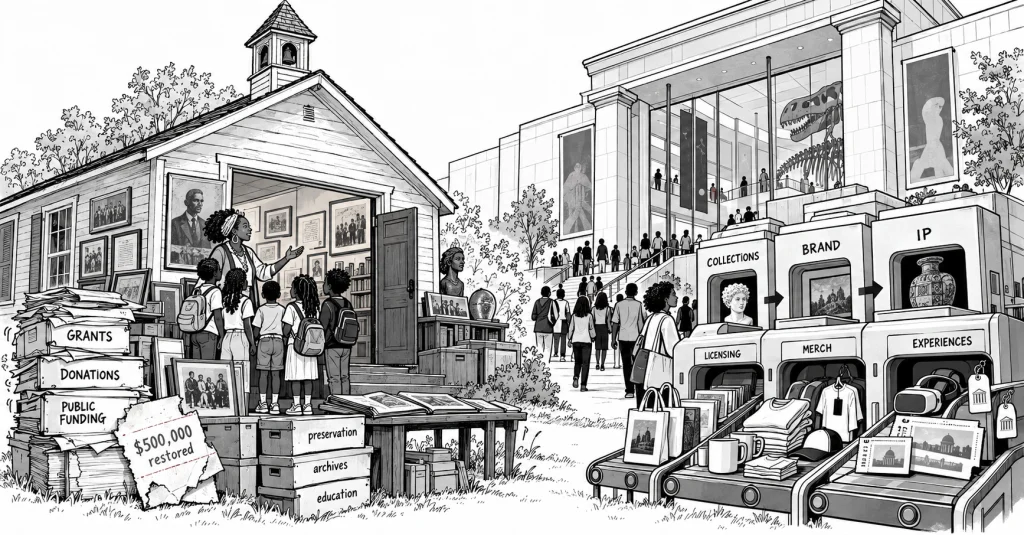
Boston’s Museum of African American History lost nearly $500,000 in federal funding before eventually getting it restored. Its disruption came as larger cultural institutions increasingly turn collections, brands and intellectual property into new revenue streams.
Boston’s Museum of African American History has spent more than six decades preserving Black history in a city where some of that history physically survives in buildings such as the African Meeting House and Abiel Smith School. Its educational reach has also expanded: the museum says it has grown from serving about 800 students to nearly 3,000through field trips, programming and an online curriculum. But the institution has simultaneously been forced to confront how fragile the financial structure supporting that work can be. A federal grant worth nearly $500,000 was pulled in 2025, according to Boston.com’s interview with museum president and CEO Noelle Trent. The funding was eventually restored after an appeal, but the uncertainty had already contributed to layoffs of three director-level employees.
Preservation Has Fixed Costs. Funding Does Not.
The episode exposes a financial problem that extends beyond Boston. Black museums are often responsible for preserving buildings, archives and collections that cannot simply be downsized when funding becomes uncertain. Buildings still require maintenance. Collections still require conservation. Security still has to be provided. Programming, research and educational access require staff even when a grant disappears temporarily or permanently. Trent described the nonprofit environment as increasingly unstable and said Black museums historically have not received support at the same level as peer institutions of similar size. The federal government itself recognizes that capacity gap: the Institute of Museum and Library Services offers a dedicated grant program for African American museums, with awards ranging from $5,000 to $500,000 for institutional capacity, collections access and workforce development.
Boston is not an isolated example. In Ohio, the National Afro-American Museum and Cultural Center lost employees as part of broader staffing reductions by the Ohio History Connection, which eliminated 30 full-time positions amid financial and operational pressures. In Albany, the Underground Railroad Education Center recently had a $250,000 federal grant restored after it had initially been canceled as part of federal cuts targeting diversity-related programs. The organization had challenged the cancellation in court. Those cases differ in structure and circumstance, but they share a vulnerability: organizations preserving Black history often depend on public funding streams that can shift faster than the underlying costs of preservation.
Other Museums Are Learning to Sell the Brand
At the same time, another model is expanding across the museum sector. Major cultural institutions are increasingly treating their collections and institutional identities as commercial intellectual property. The Guardian reported this week that museums including London’s Natural History Museum, British Museum and Victoria and Albert Museum are extending their brands into fashion, hotel rooms, technology products, virtual experiences and other licensing agreements. UK sales of licensed merchandise and services rose 7% to $19.2 billion last year, while licensing tied to attractions and promotions grew particularly quickly.
That approach offers museums something traditional philanthropy does not: revenue generated from assets they already control. A dinosaur collection can become clothing, hotel décor or an immersive experience. A recognizable artwork can become a consumer product. A globally known institutional name can carry value far beyond the admission desk. Licensing can also reach audiences who may never enter the museum itself. For institutions with recognizable brands, extensive digitized collections and corporate partnerships, cultural preservation can increasingly support a parallel commercial enterprise.
Black museums do not necessarily enter that market from the same starting position. Many were established not around globally marketed collections but around preservation work that larger institutions had neglected: historic homes, churches, documents, community archives and stories that might otherwise have disappeared. Their value can be enormous without being easily converted into consumer products. A building where Frederick Douglass spoke has historical significance that cannot be measured by how effectively its image can be licensed onto merchandise.
The Funding Question Is Becoming an Ownership Question
That leaves Black museums confronting two pressures at once. Public and philanthropic funding is becoming less predictable, while the museum sector increasingly rewards institutions capable of generating their own commercial income. The risk is not simply that some museums will have smaller budgets. It is that the cultural institutions best positioned to survive become those whose histories are easiest to monetize.
Boston’s museum is trying to move in the other direction by expanding educational access, digital programming and awareness while preserving the physical places where Black history occurred. Trent has said the institution’s goal is to become more widely known while remaining available to future generations. That requires more than surviving each individual grant fight. It requires a funding structure that recognizes preservation as continuing infrastructure rather than an expense communities must repeatedly justify once an institution reaches crisis.